









Ananda Spa in the Himalayas
-
- July 7, 2025

Back in 2011, I was on holiday in Rishikesh (India) which is in the foothills of the Himalayas. Not only is it a pilgrimage town for Hindus, it is considered the birth place of Yoga. In the 1960’s it gained global recognition when the Beatles decamped there at the controversial Mahesh Yogi’s ashram.
I thought I had immersed myself fully in all the sights that were on offer but one morning I was being whizzed by a local on a motor-bike through the snake-like roads meandering up the mountains. We made a pit-stop and low and behold there was a marvel to bestow – the sight of the Royal Palace of the former King of the region of Tehri Garhwal. I was awe-struck at its architecture and how it was hidden away in the hills from the town below like Rapunzel’s castle.
On returning home, I was still intrigued at the palace and it was by chance I saw a photo of it in a magazine and discovered it was now a world-famous spa. I vowed that I would return to India and visit this marvel. Fast forward three years later and I returned to Rishikesh and managed to secure a 2-night stay at Ananda Spa. It was a magical and unforgettable experience and I engaged in all that was available to me.
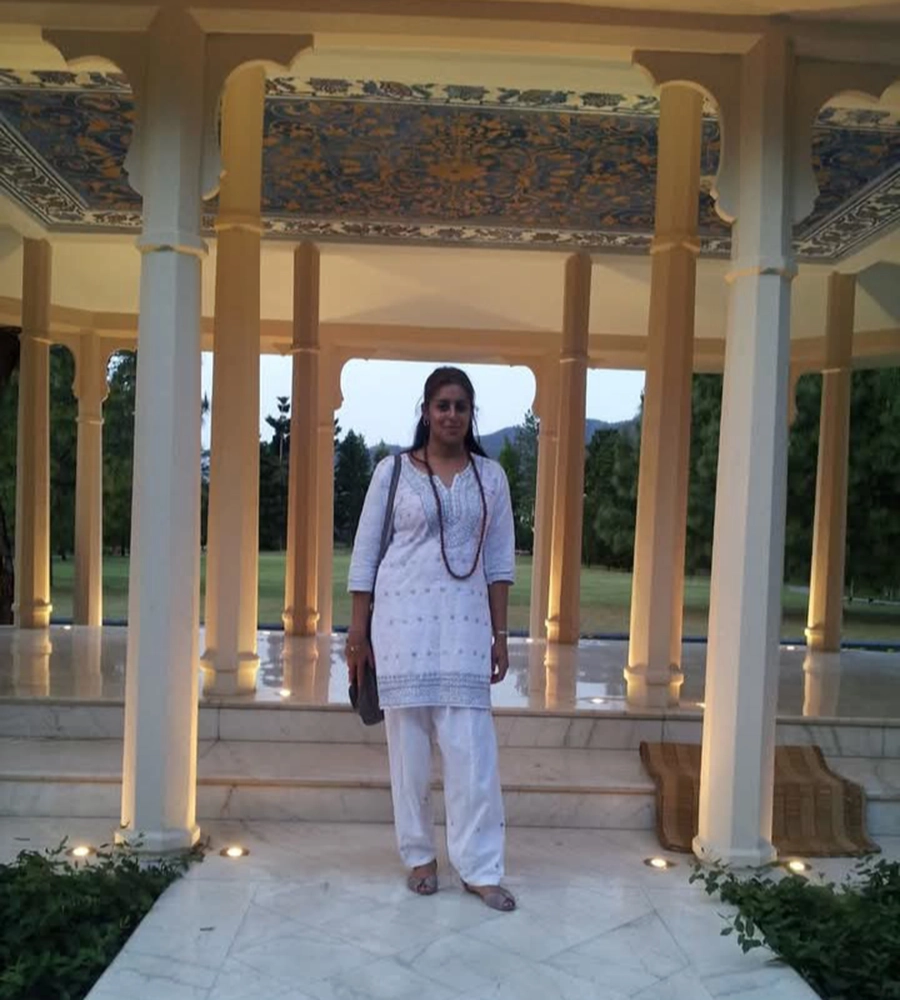
The small hamlet of Narendra Nagar was created in 1895 by the Maharajah of the region who had decided to move his capital to the picturesque location. He built a palace above the spiritual town of Rishikesh which is surrounded by the holy river Ganges in North India. The palace is now home to ‘Ananda in the Himalayas’ and looks down into the Doon valley of 3500 feet. Remnants of its past remain with two World War one canons flanking the royal gateway. An annexe was added to the complex in 1910 to house the British Viceroy who was a regular visitor.
On arrival, you enter the Palace which is now used as an office. The staff greet you in their elegant saris with a garland placed over your neck, mark a vermillion red bindi on your forehead. Little touches of personal service include your bed covers being turned over late afternoon and a tray with a choice of teas and biscuits being left daily in your room. Rose – petals in bowls adorn not only your bedroom but the whole complex, incense wafting only adds to the spirituality. I liked the fact that you are gifted a white cotton Kurta top and bottom to wear for the period of your stay. This puts one at ease and on an equal footing with everyone. The concept of hierarchy and class is gone.
As a yoga enthusiast, I joined in the morning class which took place in the outdoor Greek – style amphitheatre. Everything is covered from asanas, pranayama, mudras, bandhas and meditation. Late afternoon I joined in the Pranayama class which took place in the indoor gym. We learned about Brahmari (bee breathe), alternate nose breathing and Kapalbhati (skull shining breathe). The teacher took care to inform of the contraindications and benefits of each practise.
There are daily Vedanta talks. Surprisingly at that time it was being delivered by a charismatic young American man who explained the discourse in an engaging, simplistic and funny manner. The Room was full and he explained everything in an accessible way with the use of a flip-chart inviting lots of questions from all.
Overall, there is a sense of peace and tranquillity. The Sal trees everywhere are considered sacred with medicinal properties. Peacocks and the occasional monkey potter around on the lawns. A bagpiper dressed in Scottish traditional attire plays on the hill as the sunsets.
Its founder Ashok Khanna, the grandson of the founder of India’s illustrious Oberoi Hotel chain had a clear vision. “There was a transformation within India in the early 1980’s with the advent of I.T., a work culture causing soaring stress levels. I wanted to create a haven to escape.”
It wasn’t until 1998, that along with his father he decided on the location. He wanted to create India’s first luxury wellness retreat which was based around the principles of Ayurveda, Yoga and Vedanta.
“I wanted a sanctuary where ancient wisdom meets modern wellness. Ananda’s Integrated approach addresses every aspect of a person – spiritual, mental, emotional and physical,”.
Within five years of opening, the spa was ranked, ‘Number one Destination Spa in the world’ by Conde Nast Traveller.
Its Yoga teachers come from the Bihar school teaching the Hatha method with its traditional approach aiming to appeal to a broad audience.
Spiritual awareness come in the form of Vedanta talks inspired by Swami Parthasarathy who translated the ancient scriptures of the Bhagavad Gita and Vedas. ‘Veda’ meaning knowledge and ‘Anta’ is the End. The aim is to allow individuals to be guided into the wisdom of introspection, by examining and answering the questions of life. Or you can opt for mantra chanting, meditation to enhance self – realisation.
Latest additions in the past few years include a focus on a holistic approach to Women’s’ health at every stage; menstrual, fertility and menopause. Chronic ailments are also addressed with personalised wellness programmes for; diabetes, cardiovascular diseases, chronic respiratory issues, sleep disorders, skin conditions, obesity and arthritic pain. One can stay for 2 weeks or 2 months according to ones’ wellness programme or budget!
Immersion and spiritual awareness workshops involve mantra chanting and sound healing. Other Emotional healing therapies include; hypnosis, regression, inner child healing and energy therapies treating stress and blockages. Chronic conditions such as insomnia, autoimmune conditions, pain management, weight loss, anxiety, emotional patterns of guilt, anger, jealousy, rejection or childhood traumas are all tackled.
Ayurveda dates back 5000 years and its approach are to cleanse, rejuvenate and revitalise the body and mind. The onsite spa offer ayurvedic Panchakarma treatments, massages, detoxifying therapies, herbal supplements and specialised diet programmes.
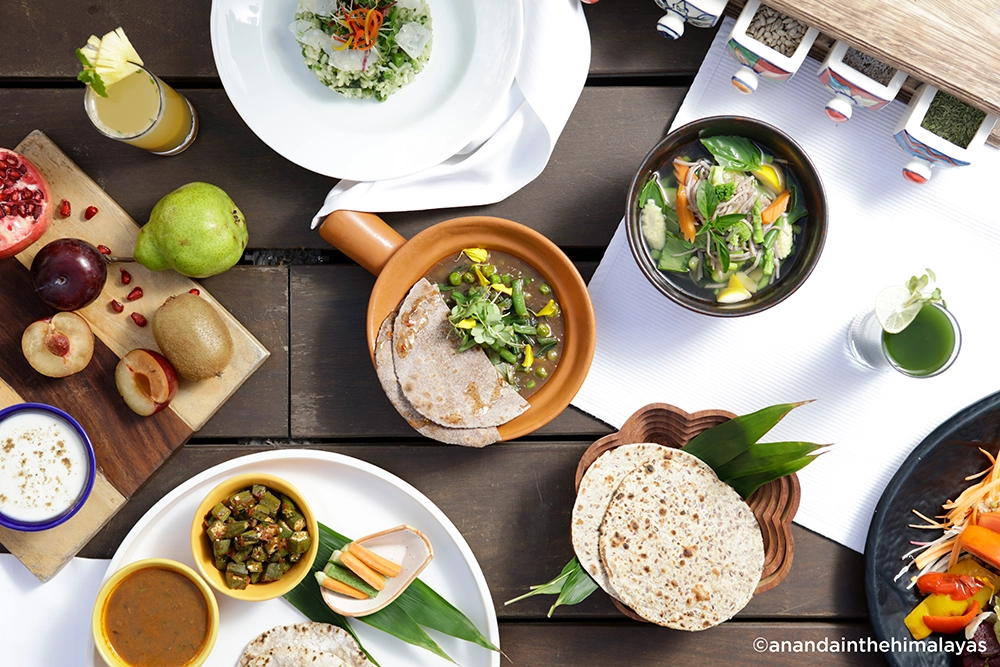
The kitchen staff can cook up 300 customised dishes daily with locally sourced fruit and vegetables. Detox and weight managements menus can be personalised according to your dosha (body type). I found the dishes on offer catered for every palate be it Western, Indian or Chinese. They were aesthetically pleasing to the eye as well as being healthy and nourishing.
Up to 100 guests can be accommodated in 64 rooms, 8 suites and 3 villas. The rooms have bathtubs overlooking the gardens or the valley, some have balconies. My bathtub gave me the view of the Valley below and the window was surrounded by Sal trees. The suites have their own secluded private gardens but the villas have their own private swimming pools.
General amenities for the physical body include a spa, gym, physiotherapy centre, outdoor pool, Finnish sauna, Turkish steam bath, plunge pool and a footbath with pebbles.
If you have other interests, you can explore the billiards room, library or spa boutique. Or if your wish to go further outdoors, they can organise excursions to the Ganges, trekking, walks in the Rajaji and Chila national park, golf and white-water rafting.
Whilst the Spa can be perceived accessible for the elite only it counters this by giving back to the local community. Vocational training is given to women from socially, educationally and economically backward areas. It collaborates with local farmers to source organic produce. Schools have been adopted to provide for maintenance and upkeep of underprivileged children. There is also a cleanliness drive in the locality surrounding the Ganges river.
In keeping with the times, on site sustainable practices involve recycling waste i.e. used oil is sent to bio-diesel manufacturers for re-use. Water management include using reusable glass bottles and an on-site bottling plant. Drip irrigation and sprinklers are installed on the lawns.
Energy saving is practised with LED bulbs and micro switches, battery operated golf carts to ferry guests around, heat pumps in place of hot water generators.
The Palace had seen former Prime Ministers of India and Lord Louis Mountbatten the last British Viceroy of India walk through its doors. In contrast, the spa has otherwise hosted Bollywood and Hollywood stars such as our very own King Charles and Queen Camilla, actress Uma Thurman, Nicole Kidman, Kate Winslet, author Deepak Chopra, Oprah Winfrey amongst many more.
What is the next chapter? Does the emergence and success of the Six Senses Vana Retreat also in the same region cause any cause for concern? Ananda’s founder Ashok Khanna simply remarks, “I am reminded of the journey that has brought us here. What began as a vision for holistic well-being has evolved into a sanctuary where ancient wisdom meets modern wellness. We have nurtured our offerings to adapt our timeless philosophies to the ever-changing needs of our guests.”
As Ananda Spa celebrates its silver anniversary this year, I wish it well and hope it remains to mark its Golden anniversary. In my experience it truly is a hidden paradise.
DISCOVER: anandaspa.com
Written By: Karen Bans
Born in London to Sikh parents, Karen is a second generation British Asian. She has a passion for Yoga and is a qualified Iyengar yoga instructor. This has led to a further interest in exploring all things concerning wellness and
health e.g. Ayurveda, natural herbal remedies and sound bath therapy.
- About the Author
- Latest Posts

Our Editorial Team are writers and experts in their field. Their views and opinions may not always be the views of Wellbeing Magazine. If you are under the direction of medical supervision please speak to your doctor or therapist before following the advice and recommendations in these articles.


