From Clinical to Comfortable: VIM & VIGR’s New Perspective on Pregnancy Compression
Brands like VIM & VIGR are reshaping pregnancy compression by combining graduated support, breathable fabrics and everyday comfort for tired, swollen legs.…
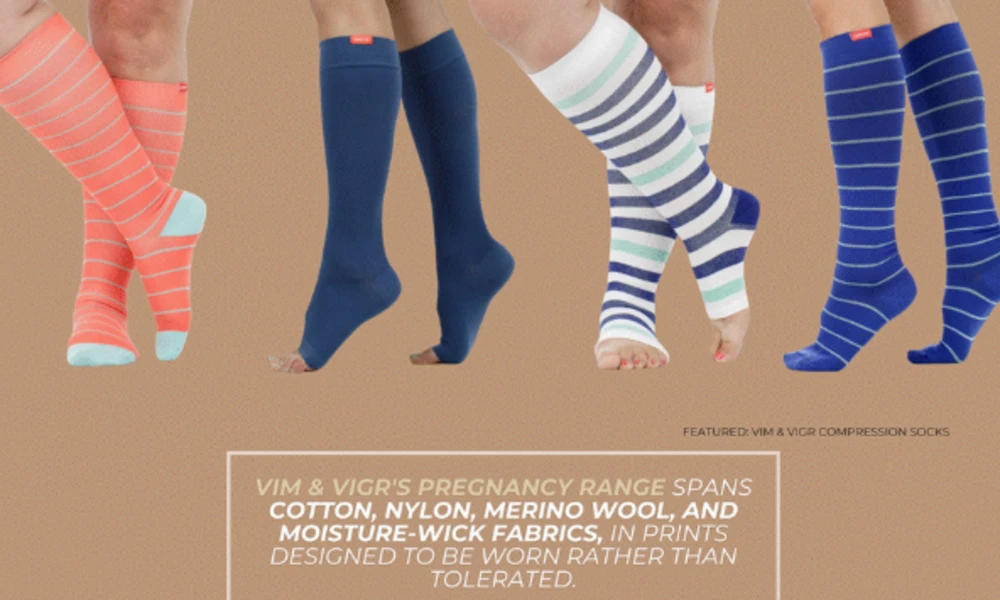
Pregnancy compression was once associated primarily with clinical-looking hosiery. VIM & VIGR is approaching the category differently, combining graduated support with breathable fabrics, considered sizing, and designs intended to fit naturally into everyday life.
Pregnancy can alter how even an ordinary day feels.
A commute that once passed unnoticed may leave the ankles puffy. A desk-based afternoon can end with heavy calves, while a shift spent standing may make the feet and lower legs feel tired long before the working day is over.
These changes are not simply the result of carrying additional weight. During pregnancy, blood volume increases, hormonal changes affect the walls of the blood vessels, and the growing baby places additional pressure on veins in the pelvis and legs.
Together, these factors can make it more difficult for blood to travel from the lower body back towards the heart.
But ask most pregnant women about compression socks, and you will get a predictable reaction. Something between a resigned shrug and a mild grimace. Because for a long time, the category existed in a strange clinical middle ground: useful in theory, uninspiring in practice, and distinctly at odds with the kind of thoughtful, style-conscious choices that busy working women make about everything else they wear. That disconnect is exactly what VIM & VIGR set out to resolve. And in doing so, the brand has quietly shifted what the conversation around pregnancy leg wellness looks and sounds like.
Why pregnancy compression has a perception problem
The case for wearing compression socks during pregnancy is well established. As blood volume rises significantly across the nine months of pregnancy, and as the growing uterus exerts increasing pressure on the major veins running through the pelvis, venous return, which is the process of blood travelling back up the legs toward the heart, becomes meaningfully more difficult.
The result is familiar to most pregnant women: legs that feel heavier than they should by mid-morning, ankles that swell over a long day at a desk or on your feet, and a general weariness in the lower limbs that no amount of stretching or hydration fully addresses.
Current wellness research suggests that graduated compression, the kind that applies the most pressure at the ankle and eases progressively up the leg, can actively support venous return and help manage this kind of fluid build-up.
Healthcare providers routinely include compression socks among their recommendations for pregnant women, particularly those navigating long working days or extended travel.
Yet despite this, uptake remains patchy.
The reason is not ignorance. It is aesthetics. The traditional compression sock, developed primarily for clinical and post-surgical use, was never designed with the pregnant professional in mind. Beige, tan, or white. Thick and functional in texture.
Marketed around medical needs rather than daily life. For a woman who has spent considerable effort navigating a changing wardrobe during pregnancy while still wanting to feel like herself at work, these options are easy to put back on the shelf.
A different starting point
VIM & VIGR was founded on the premise that this trade-off between function and wearability was a design failure, not an inherent limitation of the category.
The brand built its product range from the science up, partnering with vascular surgeons and vein clinics to develop what founder and CEO Michelle Huie describes as an approach grounded in circulatory research from the outset. In her words:
"We built our product starting with scientific insights, partnering with vascular surgeons and vein clinics. We found the right formula to create integrally knit, true graduated compression technology, then wove it together with functional fabrics that can stand up to the daily grind and stand out in a crowd."
That phrase, stand out in a crowd, is doing real work here. Because where most compression brands treat design as a secondary consideration, something to be added once the functional brief is satisfied, VIM & VIGR treat it as core to the product's actual effectiveness.
A compression sock you enjoy wearing is one you put on every morning. A clinical-looking garment that makes you feel like a patient rather than a person is one that stays in the drawer.
The result is a pregnancy compression range that spans cotton, nylon, moisture-wick nylon, and merino wool fabrics, available in prints that range from bold patterns to elevated solids, with compression levels from 15-20 mmHg through to 20-30 mmHg.
Designed to work inside the kind of wardrobe a busy working woman, whether she is commuting to an office, working from home, or travelling, actually has.
What makes graduated compression different?
An ordinary tight sock and a graduated compression sock are not the same thing.
Graduated compression applies the greatest pressure around the ankle before becoming progressively gentler farther up the leg. And, VIM & VIGR’s pregnancy compression stockings for swelling combine graduated compression with a choice of fabrics, colours and designs.
Compression strength is measured in millimetres of mercury, written as mmHg.
VIM & VIGR’s pregnancy collection centres on 15–20 mmHg graduated compression, with the greatest pressure at the ankle and gradually decreasing support up the calf.
The company positions this as an everyday level for women experiencing common concerns such as tiredness, mild swelling and heaviness.
A higher number is not automatically better. The most appropriate pressure depends on the individual, the severity of the symptoms and any underlying medical concerns. Women with pronounced swelling, varicose veins, circulation conditions or a history of blood clots should speak with their doctor or midwife before choosing a compression level.
As UCI Health obstetrician-gynaecologist Dr Donna Baick advises: “Whatever you choose, you should consult with your physician to determine if compression socks are appropriate for you.”
Moving beyond the one-fabric approach
Compression is only helpful when the garment is wearable for the length of time it is needed. During pregnancy, that may mean a full day incorporating a commute, work, appointments, and responsibilities at home.
This is where VIM & VIGR’s approach moves beyond pressure alone. Rather than using a single fabric across the entire range, the brand produces compression legwear in cotton, nylon, moisture-wicking nylon and merino wool.
Each option answers a different practical concern.
Cotton offers a softer, more familiar sock-like feel. Smooth nylon can work discreetly beneath office clothing, while moisture-wicking nylon may be more comfortable during active shifts, warmer weather or long travel days.
Merino wool provides another option for cooler environments and women who prefer a temperature-regulating natural fibre.
Michelle Huie has described this variety as an intentional part of the original concept. The different fabrics, colours and patterns were created so wearers could choose compression according to their plans, preferences and the season rather than relying on one standard medical style.
For pregnancy wear, that flexibility is particularly relevant.
A breathable sock that works for a summer commute may not be the same pair someone chooses for a cold office, a hospital shift or a winter pregnancy. Comfort is not a decorative extra; it helps determine whether compression can realistically become part of the daily routine.
Why style has a functional role
It would be easy to dismiss colour and pattern as superficial considerations in a health-support product. In practice, however, appearance can influence whether a garment feels compatible with everyday life.
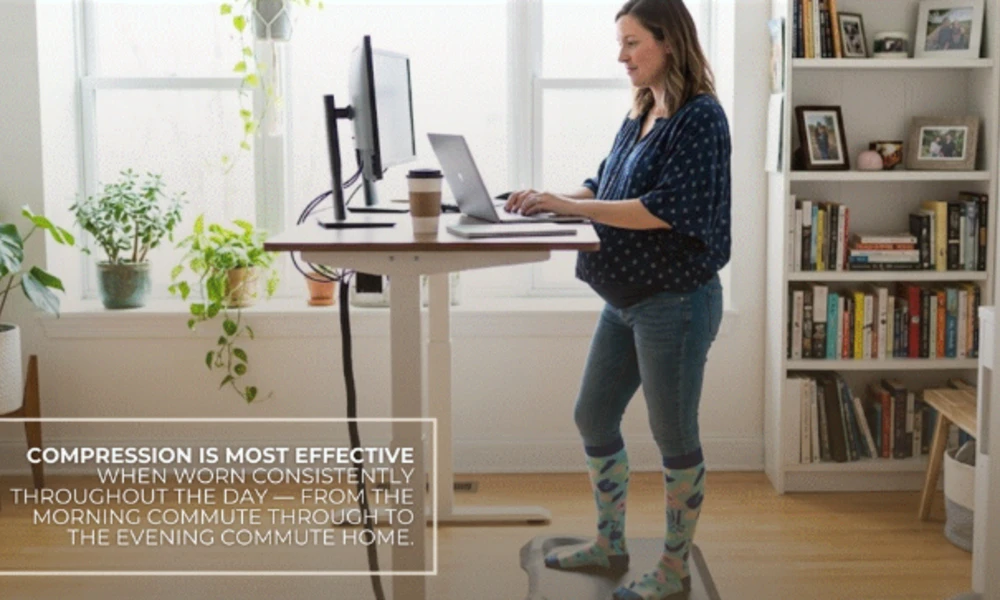
VIM & VIGR’s maternity range includes bold prints, brighter colours and elevated solid shades intended to work with maternity dresses, trousers, uniforms and casual clothing.
The underlying proposition is not simply that compression socks should be attractive. It is that a product intended for repeated wear should not make the wearer feel unnecessarily defined by a medical need.
Pregnancy already introduces numerous changes to the body and wardrobe. A woman may be adjusting waistbands, footwear, and working routines at the same time. Compression that resembles an intentional part of an outfit can feel easier to incorporate than a garment that must constantly be concealed.
Style therefore becomes part of wearability. When the design feels personal rather than prescribed, compression can sit more naturally within a morning routine.
The importance of reliable pressure
The move towards colour and comfort does not mean leaving the technical side of compression behind.
VIM & VIGR says its products were developed using scientific insights and through relationships with vascular surgeons and vein clinics. The socks use integrally knit graduated compression, meaning the changing pressure is created within the construction of the garment.
The company also reports testing the sizing and compression of incoming product batches at its headquarters.
A PicoPress device is used to check whether socks produce the specified pressure in the correct areas. VIM & VIGR tests its everyday products for 15–20 mmHg compression and its firmer products for their corresponding ranges. Its compression products are listed with the US Food and Drug Administration; FDA listing should not be confused with a claim that every product is individually FDA approved.
This quality-control process matters because compression depends on more than the fabric feeling tight. The pressure must be distributed appropriately, and the garment must correspond with the wearer’s measurements.
Fit is part of the therapy
Choosing compression socks by shoe size alone can lead to a poor fit. Ankle and calf measurements also matter, and these may change as pregnancy progresses.
A well-fitted sock should feel firm, sit smoothly and never cause pain or roll tightly below the knee. Remove it and seek medical advice if you notice numbness, tingling, discolouration, skin irritation or worsening swelling.
Making compression part of the morning
"The best time of day for a pregnant woman to put on her compression stockings is first thing in the morning." — Dr. Salma Aziz, board-certified podiatrist
Compression socks are generally easiest to put on early in the day, before fluid has accumulated around the feet and ankles.
To put them on, turn the sock partially inside out as far as the heel, position the foot correctly, and gradually unroll the fabric up the leg. Pulling from the top band can overstretch the garment and make it more likely to sit unevenly. Once in place, smooth out wrinkles and check that the heel and toe are aligned.
Compression should also complement movement rather than replace it. Changing position, taking short walks, performing ankle movements and elevating the feet when resting can all help women avoid remaining still for extended periods.
Cleveland Clinic similarly recommends avoiding long stretches of sitting or standing, staying physically active and elevating the feet when managing pregnancy-related vein discomfort.
Knowing when swelling is more than tiredness
Gradual swelling in both feet and ankles can occur during pregnancy, particularly later in the day. Sudden or one-sided symptoms require more caution.
Pain, warmth, redness or marked swelling in one leg can be associated with a blood clot and should receive prompt medical assessment.
Sudden widespread swelling or swelling accompanied by symptoms such as a severe headache, visual changes, chest pain or shortness of breath should also be treated as a medical concern rather than managed solely with compression socks, as these can be associated with pre-eclampsia.
Compression is a supportive tool, not a way to conceal symptoms that need investigation.
A more human approach to compression
Compression socks have always worked. The barrier has never been science. It has been the assumption, baked into almost every product in the category for decades, that function and comfort are in tension, and that the clinical version is the only version worth taking seriously.
That shift, from something you are told you should wear to something you are happy to wear, is a small one in theory and a significant one in practice.
This article is intended for general information and does not replace medical advice. Pregnant women should consult their doctor or midwife regarding significant swelling, existing circulation conditions, and the compression level most appropriate for their individual needs.
Filed underFertility & pregnancy