
How Do You Achieve a Seamless Gray Blend with a Natural Look
A practical guide for men over 40 on blending gray sides with a hair system naturally through color matching, density control, and gray percentage…
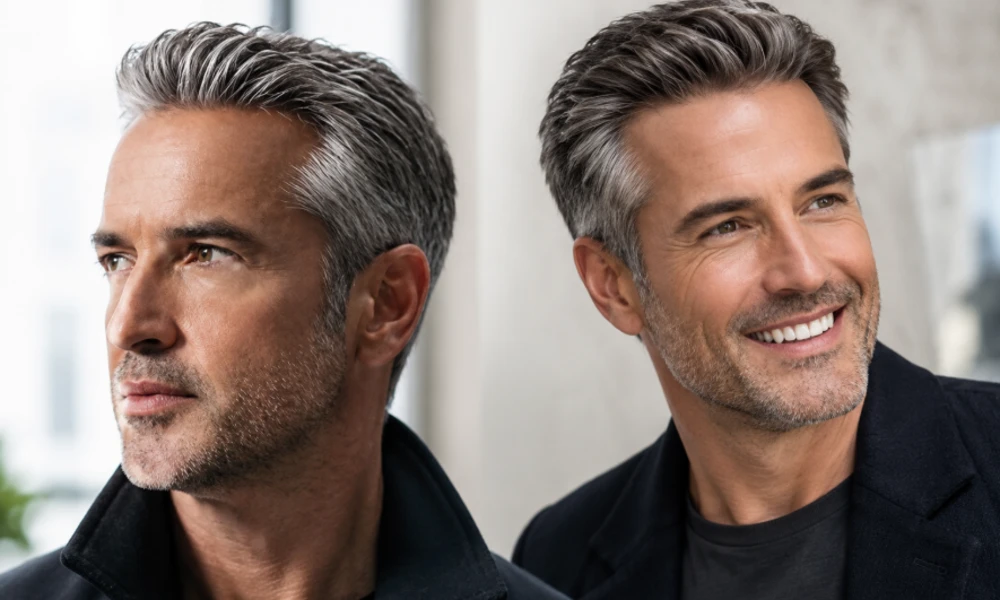
Why Gray Sides Make Hair Replacement More Complicated
For men over 40, hair loss rarely happens in a clean, simple pattern.
Most men are not dealing with only a bald crown or a receding front. They are also dealing with another very visible change: the sides are starting to turn gray, silver, or white.
This is especially common around the temples and sideburns. The top may still have darker hair, while the sides begin shifting into salt-and-pepper tones. For white men with male pattern baldness, this creates a very specific challenge when choosing a hair system.
If the system on top is too dark, too dense, or too “young-looking,” it can instantly look fake.
The mistake is easy to imagine: a man has gray temples and lighter side hair, then places a full black or dark brown hair system on top. Instead of looking younger, the result comes off as disconnected. The top looks like a separate piece. The sides reveal the real age. The whole style stops feeling believable.
A natural result does not come from hiding gray hair. It comes from blending it properly.
The Biggest Mistake Is Trying to Erase Age Completely
Many men approach hair replacement with the emotional memory of how they looked 10 or 20 years ago. That is understandable. Hair loss can make people want to restore the version of themselves they remember most confidently.
But the most natural hair system is rarely the one that makes a man look 25 again.
For men over 40, the goal should not be to erase every gray strand. The goal should be to create a version of the hair that looks healthy, full, and age-appropriate.
That difference matters.
A hair system that is too dark can make the face look harsher. It can also create strong contrast with the side hair, especially in daylight. Instead of softening the appearance, it draws attention to the system.
Gray hair, when blended correctly, can actually make a hair system look more expensive, more realistic, and more mature in the best way.
The secret is not removing gray. It is controlling the gray percentage.
What Gray Percentage Actually Means
Gray percentage refers to how much gray or white hair is mixed into the hair system compared with darker hair.
For example, a system may be:
10% gray for a subtle mature effect
20% gray for early salt-and-pepper blending
30% gray for visible temple matching
40% or more for stronger silver blending
This percentage should not be chosen randomly. It should be based on the natural gray level of the wearer’s side hair, especially around the temples and sideburns.
If the sides are about 30% gray, but the top system is 0% gray, the mismatch will be obvious. If the sides are only slightly gray, but the system has too much silver mixed in, the top may look older than the rest of the hair.
The right gray percentage creates continuity.
That is what makes the system disappear visually.
Why the Temples Matter More Than the Crown
When blending gray hair, most people focus too much on the top and not enough on the temples.
The temple area is where the hair system meets the natural side hair. This is also where gray usually appears first. If the color transition is wrong here, the system becomes much easier to detect.
A natural temple blend should not look like a sharp boundary between dark hair and gray hair. It should look gradual.
This means the front and side areas of the system may need slightly lighter density or a more careful gray mix than the center of the top.
For men with strong gray around the sideburns, adding gray only to the lower side area may not be enough. The system itself may need a controlled amount of gray throughout the top to avoid looking like a dark patch.
The transition should feel intentional, not accidental.
Match the Side Hair Before Choosing the Top Color
A common beginner mistake is choosing the color of the system based on what the top hair used to look like years ago.
That is usually the wrong reference.
The better reference is the hair that still exists today.
Look at the side hair in natural light. Not bathroom light. Not a filtered photo. Not indoor yellow lighting.
Daylight gives the most honest color reading.
Check three things:
The base shade of the side hair
The amount of gray or white hair
Whether the gray tone is cool, silver, warm, or white
Some men have cool ash-gray sides. Others have warmer salt-and-pepper tones. Some have white temple hair but darker side hair behind it. These differences change how the system should be customized.
A realistic blend starts with what is already on your head, not what you wish was there.
Density Has to Match the Age of the Hair
Color is only one part of the gray blending problem.
Density matters just as much.
A man with naturally thinning gray sides should not usually choose a very thick, heavy top system. Even if the color is correct, the density contrast can still make the system look unnatural.
Real mature hair usually has some softness to it. The hairline may not be extremely thick. The temples may not be packed. The top can still look full, but it should not look like teenage hair sitting on a middle-aged face.
This is where many systems fail.
They solve the baldness problem but create a believability problem.
For natural-looking hair systems for men, the best result usually comes from controlled density: enough coverage to restore confidence, but not so much that the style becomes visually suspicious.
Texture and Shine Can Expose a Bad Blend
Gray side hair often has a different texture from darker hair. It may feel slightly coarser, drier, or more wiry. If the hair system on top is too silky or too shiny, the mismatch becomes noticeable.
This is especially true under office lighting, car windows, outdoor daylight, and phone cameras.
A natural gray blend should consider:
Hair texture
Wave pattern
Shine level
Direction of growth
How the hair moves after styling
If the side hair is matte and slightly coarse, but the system hair is glossy and smooth, the result can feel artificial even if the color is close.
The best blend looks consistent in movement, not just in shade.
Why All Black Is Usually the Wrong Choice After 40
A full black or dark brown hair system can work for some men, but it becomes riskier with age.
For a man with visible gray sides, a solid dark system often creates a “cap” effect. The top looks newly added, while the sides look naturally aged. This contrast draws attention to exactly what the wearer wants to hide.
It can also make the face look less natural. Hair that is too dark may sharpen facial lines, emphasize skin tone changes, and create a stronger contrast around the forehead.
Adding a small gray percentage softens the entire appearance.
Even 10% or 15% gray can make the system look more believable for men whose sides are beginning to turn.
Gray blending is not about making the hair look old. It is about making the hair look real.
The Aesthetic Logic of Gray Percentage Customization
The most natural gray blend usually follows a visual logic.
If the side hair is lightly graying, the system should have a low gray percentage, often just enough to break up the flat dark color.
If the temples are clearly silver, the system may need more gray around the front and sides to create a smooth transition.
If the wearer has a full salt-and-pepper look, the system should not only include gray hair, but also distribute it in a way that looks organic.
Real gray hair is not perfectly even. It appears in clusters, around the temples, through the sides, and sometimes lightly across the top.
That is why a custom gray blend often looks better than a standard color.
The goal is not mathematical perfection. It is visual believability.
Why Customization Matters More Than Buying From a Photo
Product photos are useful, but they rarely show what your personal gray blend should look like.
A model with dark side hair can wear a dark system and look great. That does not mean the same system will work for a 48-year-old man with silver temples.
This is why choosing a system only from product photos can be risky.
A better approach is to compare the system against your own side hair. If possible, use clear photos taken in daylight from the front, side, and temple area.
This gives a supplier or stylist a much better chance of matching the gray percentage correctly.
For men over 40, the right color blend is often more important than choosing the trendiest base or hairstyle.
Where TopUniqueHair Fits Into the Gray Blend Conversation
In the second half of the buying process, once a man understands that gray blending is not optional, the supplier choice becomes more important.
This is where customization makes a real difference.
TopUniqueHair approaches gray blending as part of the overall system design, not just a color add-on. For men with graying temples or white sideburns, the ability to customize gray percentage helps avoid the most obvious mistake: a dark top system that clashes with mature side hair.
Instead of forcing one standard color, a better system should allow the top, front, and side transition to work together visually.
That is especially important for men who want a natural, age-appropriate result rather than an obvious “replacement” look.
A Simple Gray Blending Guide for Beginners
If you are choosing your first system and your sides are starting to gray, use this as a practical starting point.
If your sides are only slightly gray, consider a low gray mix, around 5% to 10%.
If your temples are visibly salt-and-pepper, 15% to 30% gray may look more natural.
If your sideburns are strongly silver or white, you may need a higher gray percentage or a more customized distribution.
If your top used to be dark but your sides are now mostly gray, do not automatically choose your old top color. Match the current sides first.
The best result should make people think you simply have good hair for your age, not that you are wearing a system.
The Most Natural Result Is Usually Subtle
A seamless gray blend should not look dramatic.
It should not make the wearer look like a completely different person. It should simply make the hairstyle feel complete again.
The most convincing systems often have a quiet effect. The face looks better framed. The top looks fuller. The side transition makes sense. Nothing appears too dark, too thick, or too perfect.
That subtlety is the whole point.
For men over 40, especially those with visible gray sides, realism usually comes from restraint.
A little gray can make the entire system look more natural.
Final Thoughts
Blending gray sides with a hair system is one of the most important details for mature men.
The biggest mistake is choosing a system that ignores the natural aging pattern of the side hair. A full dark top against gray temples can look obvious very quickly.
The better approach is to match the current hair, not the memory of younger hair.
Gray percentage, density, texture, shine, and temple transition all work together. When they are balanced correctly, the system does not look like a separate piece. It looks like part of the same head of hair.
That is the real goal of gray blending.
Not to hide age completely, but to make confidence look natural.