Into the Past: 5 New Historical Novels That Bring History Roaring Back to Life
The best historical fiction does more than dust off the past—it drops you into the middle of it, close enough to feel the heat of a factory floor or the chill of a frozen river.
The best historical fiction does more than dust off the past—it drops you into the middle of it, close enough to feel the heat of a factory floor or the chill of a frozen river. The novels on this list travel from a Tudor throne room to a Gilded Age ballroom, from a colonial midwife's cabin to a Cold War boardinghouse, but they share a gift for making history feel urgent and alive. Again and again they hand the story to the people the history books left out—the impostor, the seamstress, the midwife, the women keeping secrets behind respectable doors—and let them speak. If you love a novel that teaches you something true while keeping you up past midnight, these five are for you.
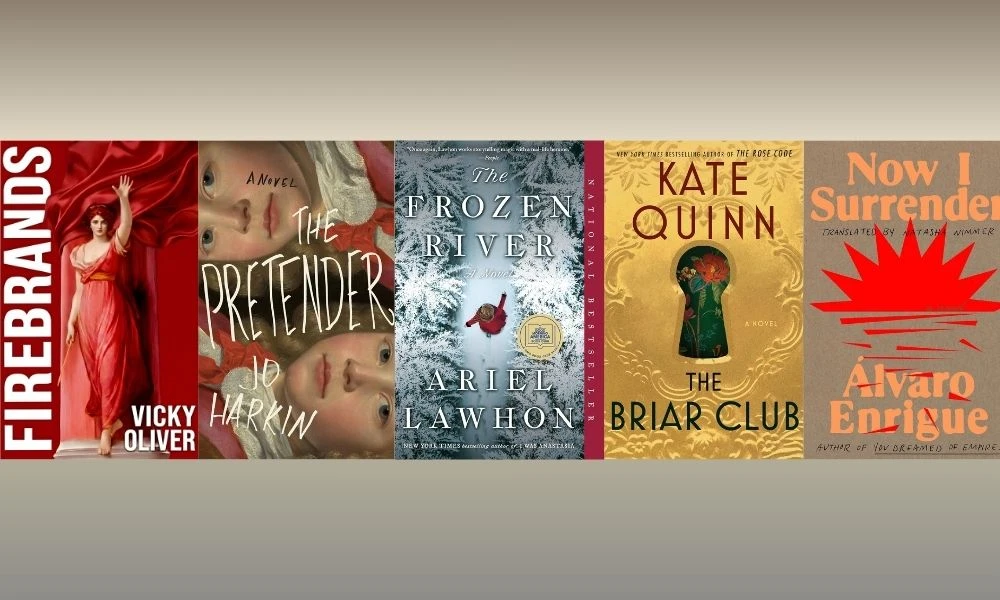
The Pretender
by Jo Harkin
One of the most acclaimed historical novels of the year—shortlisted for the Walter Scott Prize and hailed as a worthy heir to Hilary Mantel—The Pretender resurrects a genuine footnote of history and turns it into a rollicking epic. In 1480, a farm boy named John Collan believes his biggest problem is the village's devil goat, until a well-dressed stranger arrives to tell him he is actually the hidden son of a Plantagenet duke and a claimant to the English throne. Renamed and swept into a dangerous game of royal intrigue, the boy the world will call Lambert Simnel must navigate a court where the wrong word can cost a head. Jo Harkin writes with wit, warmth, and a wicked sense of humor, conjuring fifteenth-century England in all its danger and absurdity while asking timeless questions about identity, ambition, and who really gets to decide who we are. Gripping and irreverent, it's historical fiction at its very finest.
Firebrands
A Sizzling Gilded Age–Style Tale of Morals Versus Money
by Vicky Oliver
In the Manhattan of 1908, the city is a tale of two worlds: downtown, workers sleep ten to a room and the labor movement is beginning to roar, while uptown along Millionaire's Row, the wealthy glide through Gilded Age palaces. At the center stands Helena James—seamstress, suffragist, gifted speaker, and, by her own admission, a trouble magnet. When her beloved sister Summer falls for Derrick Dupré, a charming tycoon with a velvet smile and a labor-busting empire, Helena's fight for justice suddenly turns personal. Vicky Oliver's novel brims with twisty suspense, romance, humor, and heat, moving from the union halls to the ballrooms with equal confidence. A Killer Nashville Claymore finalist and a Writers' League of Texas finalist for historical fiction, Firebrands explores the lighter side of the feminist movement, the darker side of industrialization, and the loving, confounding bond between sisters. Sure to delight fans of HBO's The Gilded Age, it tells a story that feels as relevant now as it was more than a century ago.
The Frozen River
by Ariel Lawhon
A New York Times bestseller and Good Morning America book club pick, The Frozen River is inspired by the real diary of Martha Ballard, an eighteenth-century midwife who quietly wrote herself into American history. In Maine in 1789, the Kennebec River freezes over and gives up a body—a man entombed in the ice—and Martha is called to examine it and determine how he died. What follows is a gripping mystery that pits her hard-won knowledge and fierce independence against a legal system that has little use for a woman's word. Ariel Lawhon brings the harsh beauty of colonial New England vividly to life, and in Martha she gives us a heroine who is brave, outspoken, and unforgettable. Part murder mystery, part portrait of a remarkable real woman, it's a tense and tender novel about truth, justice, and the courage it takes to speak up when no one wants to listen.
The Briar Club
by Kate Quinn
From the bestselling author of The Rose Code and The Alice Network comes a haunting story of female friendship and buried secrets set in Washington, D.C., during the paranoia of the McCarthy era. At Briarwood House, a down-at-the-heels all-female boardinghouse, everyone keeps to themselves—until a mysterious widow named Grace March moves into the attic and begins hosting a weekly supper club. Her dinners slowly draw an unlikely group of women together: an English beauty, a policeman's daughter, a frustrated baseball star, and a fiercely pro-McCarthy typist among them. But Grace hides a secret of her own, and when a shocking act of violence tears the house apart, the women must decide who among them is the real threat. Kate Quinn balances the cheerful surface of the 1950s against its undercurrents of fear, prejudice, and persecution, delivering an intimate, twisty, and deeply satisfying novel about the bonds women forge to survive.
Now I Surrender
by Álvaro Enrigue
For readers ready to venture beyond the drawing room, this sweeping, acclaimed novel carries the historical-fiction spirit onto the contested ground of the American Southwest. From Mexican master Álvaro Enrigue—whose You Dreamed of Empires was a New York Times Top 10 book—comes a part-epic, part-alt-Western reimagining of the Apache Wars and the 1886 surrender of Geronimo and the Chiricahua Apache. Enrigue braids several threads together: a rollicking 1830s frontier story following Camila, the lone survivor of a raid on her ranch; the historical drama of the Apache resistance itself; and the author's own present-day road trip through the borderlands his family calls Apachería, “a country that still exists but was erased from the maps.” Translated by Natasha Wimmer, it's a searing, genre-defying elegy for a lost way of life and a pointed reconsideration of the myths that built two nations. A bracing counterpoint to the ballrooms and boardinghouses elsewhere on this list, it's a reminder that whose story gets told is itself a kind of power.