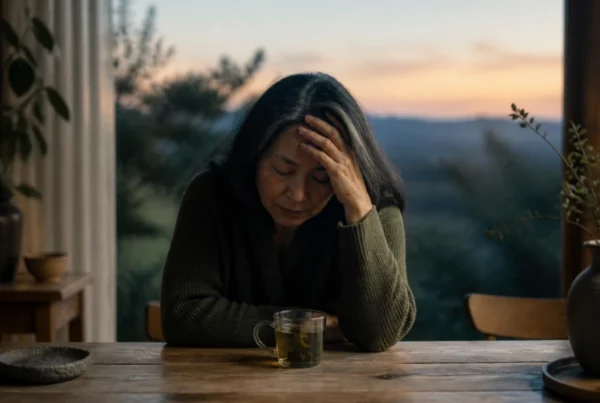
The house feels different when the last child leaves. The silence has texture to it, and it catches you off guard in the doorway of a bedroom that stays tidy now. Decades of morning and evenings were shaped by sounds that have simply stopped.
Most conversations about empty nest focus on the loss. This is real but beneath the grief sits something more complex. Now there is the invitation to remember who you are beyond the role that defined the last twenty years.

The Identity Question
For many women, becoming a mother rewrote the story they told themselves about who they were. Entire seasons of life organised around school runs, homework, illness, achievement and worry. Somewhere in that devotion, other parts of the self went quiet.
Then the logistics disappear and a harder question surfaces. Who am I when I’m not doing this?
Recent research frames this as identity reorganisation rather than depression. Two forces pull in opposite directions:
- Role loss: Where the identity built around parenting suddenly has nowhere to go
- Role strain relief: Two decades of daily demands now lift, freeing up time, energy and attention for your own interests and relationships.
Psychologists writing in Communications Psychology found, after reviewing the evidence across cultures, the dominating force has less to do with character than with circumstance. Yes, there can be disorientation, but there is also the strange freedom of a life that suddenly has space in it again.
The Midlife Threshold
This moment tends to surface alongside a wider reckoning of midlife. Wellbeing Magazine has written before about the way our relationship with time shifts at midlife, and how the future stops feeling endless and starts feeling finite. That awareness brings both vulnerability and clarity.
The version of yourself assembled in early adulthood was built out of necessity. You needed to belong, cope, succeed, and keep everyone fed. Now, as you reach this threshold, something begins to soften, and the roles that once kept you safe no longer let you grow.
A Season of Reclamation
Starting again is different from starting over. It means reclaiming the parts of yourself that were put on pause. For some women, that’s reconnecting with a partner who became a co-parent and little else. For others, it’s picking up a creative practice abandoned years ago: painting, writing, music, a language half learned and forgotten.
Some parents describe the strange freedom of booking travel without school holidays dictating the calendar. Others talk about volunteering, going back to study, training for something physical they used to love. A few find friendships deepening again, once conversations stop revolving around logistics and school updates.
Which path you follow matters far less than the fact that a path exists at all. Time once distributed across daily demands is now more freely available, and what you do with it is entirely your choosing.
The Space Between
Before you fully step into what comes next, though, there’s a stretch of in-between to cross. You’re no longer in the role that shaped the last twenty years, but have yet to be fully present in whatever follows. This gap can feel uncomfortable, but it’s also where the shift happens. .
Read the quietness as availability, not emptiness. A more useful question than “What do I do now?” is “What wants to happen through me now?”.
Where Money Fits
One conversation that often gets overlooked is money, which generates a hum of worry for many women. Education costs wind down, the shape of household spending changes, and your own future suddenly becomes urgent in a new way.
Knowing where you stand with pensions and long-term planning has less to do with getting it perfect than with quietening the noise enough to think clearly about what you want from this next chapter. The link between financial wellbeing and overall quality of life runs more directly than we tend to acknowledge. Longevity research has found that stable finances in midlife track with better health decades later, and that sudden financial shocks carry a measurable cognitive cost of their own. For many women moving through the empty nest stage, that kind of clarity becomes a form of self-care.
There are of course practical elements to consider as well as emotional ones. If you have children heading into higher education, the system is changing. Applications for the new Lifelong Learning Entitlement open in September 2026, covering courses and modules that start from January 2027, so it’s worth knowing which rules your family falls under.
Beginning Again
The echo of an empty nest eventually fades, leaving the space for you to fill as you choose. Some of it will surprise you with how right it feels, while other elements will simply be quieter and more aligned with who you’ve become.
This isn’t an ending dressed up as a new beginning. You’re on the brink of a genuine moment where the self you’ve been encounters the self you’re becoming. That is where the story restarts.
- About the Author
- Latest Posts

Annie Button is a freelance writer specialising in well-being and sustainable lifestyles, empowering readers to make impactful changes, one step at a time. She provides practical insights and solutions for achieving a balanced, sustainable lifestyle amid fast-paced contemporary living.