Ten years ago, one of the biggest questions surrounding Shilajit was whether the black resin contained too much lead. That concern has never entirely gone away, and quite rightly so, because Shilajit is a naturally occurring material associated with rock and soil, and geological materials can contain elements we would rather not consume in large amounts. In 2026, however, scientists at the official food-control laboratory CVUA Stuttgart asked what may be an even more basic and extremely obvious question: Does the jar actually contain Shilajit at all?
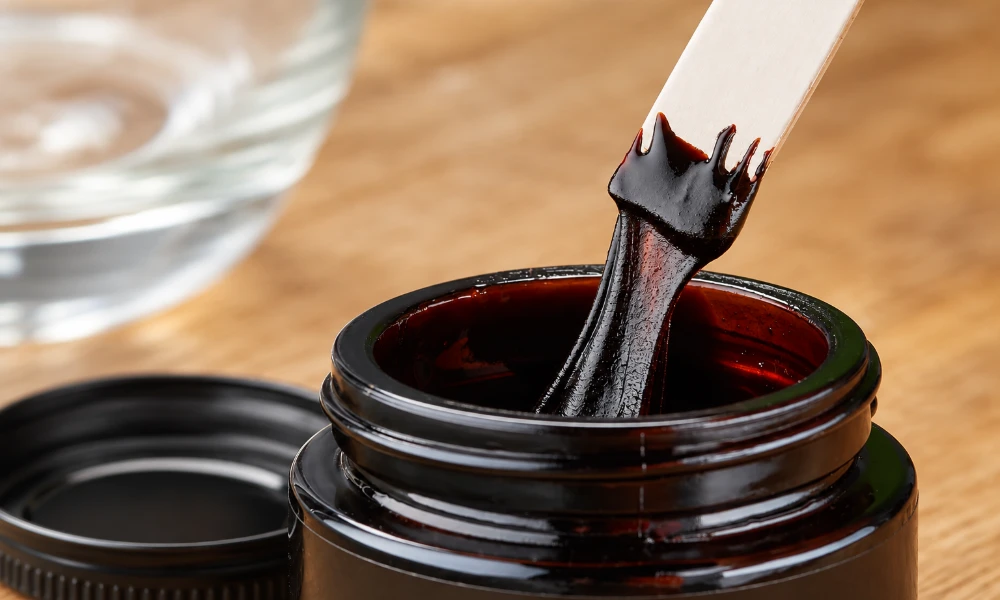
The lab examined 12 commercial Shilajit products using several analytical approaches, looking not only at heavy metals but also at their broader composition, foreign substances, minerals, mineral-oil hydrocarbons and, where the initial results justified it, sugars and compounds associated with heating. Three of the products gave the researchers reasonable grounds to suspect that Shilajit was present only in traces or not present at all. In one sample, none of the substances they regarded as typical of Shilajit could be detected.
That’s a rather different problem from finding too much lead in genuine Shilajit. If the Stuttgart results are representative of a wider issue, then some consumers may not simply be buying contaminated Shilajit; they may be buying something whose identity is considerably less certain.
Why would anybody fake Shilajit?
There’s nothing particularly unusual about economically motivated food adulteration. Valuable ingredients have been diluted, substituted, and imitated for a very long time, usually for the uncomplicated reason that the substitute costs less than the thing named on the label. The UK Food Standards Agency describes economically motivated adulteration as intentionally substituting or adding substances to increase a product’s apparent value or reduce the cost of producing it. Honey, olive oil, spices, and seafood have all produced their own versions of the same problem.
Shilajit seems to have several characteristics that could make it particularly vulnerable. It has moved from a relatively obscure traditional substance into a fashionable international supplement, yet authentic Shilajit is still supposed to originate from naturally occurring mountain material that has to be located, collected, purified, processed and moved through what can be a fairly opaque supply chain. Unlike creatine or vitamin C, genuine natural Shilajit cannot simply be manufactured in unlimited quantities whenever demand increases.
I’m conscious about turning that into a story about the world “running out” of Shilajit, because I haven’t yet found reliable, published figures showing global reserves, annual production or how quickly deposits replenish across the various regions in which it occurs. We simply don’t know enough to make that claim. But you don’t need a proven global shortage before an economic incentive for adulteration appears. If genuine material is relatively difficult to source, expensive to process and increasingly valuable at retail, while customers have limited ability to judge authenticity for themselves, the conditions are already fairly attractive.
I’ve started thinking of it as the Shilajit Fraud Equation: rising demand + premium pricing + opaque natural supply + no simple identity test + an easy-to-copy appearance = unusually attractive conditions for adulteration. It doesn’t tell us that any individual product is fraudulent, but it does explain why I wouldn’t regard “100% pure Himalayan Shilajit” on a label as particularly strong evidence that it is. The economics make verification more important, not less.
Shilajit is surprisingly easy to imitate badly
A product like Shilajit creates another problem because most of the qualities customers associate with authenticity are physical rather than chemical. People expect a dark brown or black material with a distinctive smell and taste, and in resin form they expect it to soften when warm, become firmer when cold and disperse or dissolve in warm water to produce a brown liquid. Those characteristics can be important observations, but none of them establishes the underlying chemical identity of the substance.
This is why I’ve always been wary of the famous Shilajit home tests. Stretching it, freezing it, burning it or dropping it into warm water may tell you something about how that particular material behaves, but a customer who has used Shilajit for years still cannot look at a spoonful of black resin and determine its chemical composition. Lots of dark organic substances can soften, harden, dissolve, burn or colour water. A convincing physical imitation is not necessarily a convincing chemical one.
The Stuttgart results make this considerably more interesting because several products contained evidence suggesting that appearance may sometimes be created or altered through relatively simple processing. In four of the 12 samples, the laboratory detected 5-hydroxymethylfurfural, usually shortened to 5-HMF, together with 4-methylimidazole. Some contained relevant amounts of sugar, and individual samples contained more than 4,500 mg/kg of 5-HMF. The lab explained that these substances can form when sugar-rich foods undergo strong heat treatment and specifically raised the suspicion that simple caramelisation of sugar may have been used to create the impression of more of the tar-like natural material.
We should be careful about what that does and doesn’t prove. It doesn’t tell us who added anything, exactly how those products were manufactured, or whether somebody deliberately stood over a vat trying to recreate the appearance of Shilajit with caramelised sugar. What it does show is that several products contained chemical evidence of substantial heating, and that the investigators themselves considered caramelisation a possible explanation for the resulting appearance.
That raises a rather obvious question about the way authenticity is judged online. If customers are repeatedly taught that genuine Shilajit should be black, sticky, soft when warm and capable of producing a dark solution in water, then those same expectations become a blueprint for anybody trying to imitate it. I think there is a reasonable hypothesis here that could apply far beyond Shilajit: the more consumers depend on a small number of simple home authenticity tests, the greater the incentive becomes to manufacture products that pass those tests without necessarily reproducing the thing they are supposed to identify.
If it isn’t Shilajit, what is actually in the jar?
This is probably the most intriguing question raised by the Stuttgart investigation, and frustratingly it isn’t one the results answer completely. The lab could identify unusual chemistry and compare the samples with substances it considered characteristic of Shilajit, but that’s not the same as being able to reconstruct exactly how every product had been made.
The researchers regarded hippuric acid as a typical Shilajit substance and also found various sulfated phenolic compounds, including phenol sulfate and cresol sulfate, to be characteristic. Some products contained unusually little of these substances, while one contained none of the typical Shilajit substances the laboratory was looking for. All of the samples also contained substances described as foreign, with chlormequat attracting attention in several and lupin-associated quinolizidine alkaloids such as lupanine appearing in two. The lab said it could not conclusively determine where all of these unexpected substances had come from.
I think where the evidence is unclear, it’s better to say so than speculate. There are plenty of claims online about fake Shilajit being made from molasses, asphalt, bitumen, wax or various other substances, but repeating those claims as though laboratories have established a standard counterfeit recipe would be misleading. What Stuttgart gives us is more useful because we can separate what was found from what is merely suspected. We know some samples contained sugar and markers of strong heating, some contained unexpected agricultural or botanical compounds, several contained mineral-oil hydrocarbons, and some had surprisingly little evidence of the chemistry the researchers associated with Shilajit.
There is another possibility that disappears when we reduce everything to “real” or “fake”. An adulterated product does not have to contain no Shilajit whatsoever. It could contain genuine Shilajit diluted with something cheaper, and the more genuine material it retained, the more difficult the problem could become. Enough authentic Shilajit might preserve the smell, taste, colour and some characteristic analytical compounds while a cheaper material provides much of the bulk.
That leads to what I think is an interesting purity paradox. Imagine authentic material containing a certain natural concentration of an unwanted element, then imagine diluting it heavily with a relatively clean substitute. In theory, the contaminant number on a narrow lab report could improve while the authenticity of the product gets worse. I’m not suggesting that this happened in Stuttgart, because the investigation doesn’t establish that, but it illustrates an important point. A clean contaminant report and an authentic product are not the same thing.
The problem with “lab tested”
This is where the Stuttgart report becomes particularly relevant to the modern supplement market. Nine of the 12 products were advertised with claims such as “laboratory tested”, but when the investigators looked at the available certificates they found that testing often covered things such as microbiological purity or heavy metals rather than the broader identity, composition and quality that a consumer might reasonably assume had been checked. Eight of those nine “lab tested” products were considered misleading by the laboratory.
I think this is an important distinction because proper lab testing absolutely should be reassuring. I want Shilajit screened appropriately for heavy metals, microbiological contamination and other relevant contaminants. The difficulty is that “lab tested” has gradually become a marketing conclusion rather than a description of a process, and the phrase itself tells you surprisingly little unless you can see what the lab actually measured.
A company can truthfully send a finished product to a lab for lead, arsenic, cadmium and mercury, receive perfectly genuine results, and then describe the product as third-party tested. Nothing about that statement necessarily establishes whether the material is authentic Shilajit, whether it has been heavily heated, whether cheaper materials have been added, or whether substances nobody thought to request are present. The lab has answered the questions it was asked.
That is why I increasingly think the more important question isn’t “Is it lab tested?” but “What was it tested for?” The next questions follow quite naturally. Which batch was tested, who supplied the laboratory sample, which methods were used, were those methods suitable for what was being measured, and can the tested batch be linked convincingly to the product sitting in front of the customer? None of those questions is quite as attractive as putting a big lab name on a website, but they tell us considerably more.
What does an authenticity test actually look like?
The science here is still developing, which makes Shilajit a more difficult product to authenticate than its marketing sometimes suggests. A 2026 paper in the Journal of Chromatography A developed an HPLC method for quantifying hippuric acid and benzoic acid, while also using HPTLC and LC-MS for biomarker identification, gravimetric analysis for fulvic acid and ICP-MS for minerals and heavy metals. Fulvic acid testing has its own complications, particularly because different analytical methods can produce very different looking results. In other words, the researchers did not rely on one magic number that could easily divide all samples into genuine and fake.
There’s a good reason for that. A recent review of Shilajit chemistry concluded that its full composition is still not known with certainty, while research on material from different geographical locations has repeatedly shown substantial variation. Origin, local geology, biological inputs, purification and processing can all influence the final material. The Stuttgart laboratory itself acknowledged that defining a typical composition is difficult because formation theories vary and there are limited authentic reference samples available for comparison.
That creates a problem for anybody hoping Shilajit authentication will eventually become as simple as checking one compound. If you choose one marker and declare that genuine Shilajit must contain it, a sufficiently sophisticated adulterator eventually knows exactly what the lab is looking for. Add a second marker and the problem becomes harder, but the principle remains the same.
My suspicion is that Shilajit authentication will ultimately need to rely much more heavily on patterns than on individual headline numbers. Instead of asking whether one marker exists, laboratories may need to ask whether a much broader chemical fingerprint resembles authentic material from known sources. It makes things less straightforward but probably gives us a better chance of getting an honest answer.
The mineral-oil finding deserves attention too
Four of the Stuttgart samples contained MOSH concentrations of up to 290 mg/kg, exceeding orientation values that have been established for various other food categories. One sample also contained enough MOAH for the laboratory to judge it unsafe and therefore not marketable. CVUA Stuttgart could not establish exactly how those hydrocarbons entered the products.
That last point matters because mineral-oil hydrocarbons can enter foods through several routes, including machinery, packaging and environmental contamination. Their presence doesn’t automatically mean somebody deliberately poured mineral oil into a Shilajit product. It does, however, tell us that something happened somewhere between collection, processing, packaging and sale that deserves understanding.
It also reminds us why identifying adulteration is about more than simply receiving less of the expensive ingredient than we paid for. Once an unknown or unexpected material enters a food or supplement, it can introduce contaminants or biological substances that nobody would have thought to test for because nobody expected them to be there. Food fraud becomes a safety problem when the substitute brings its own chemistry with it.
Heavy metals weren’t the biggest problem this time
There’s an interesting twist to the Stuttgart investigation because none of the 12 products showed excessive heavy-metal contamination. After years in which lead, arsenic, cadmium and mercury have dominated much of the Shilajit safety conversation, that is genuinely good news.
It also shows why supplement testing has to move with the evidence rather than becoming fixed on whichever concern received the most attention ten years ago. A product could pass every heavy-metal limit asked of it and still have questions around identity, processing, adulteration or other contaminants. The fact that one problem is controlled doesn’t mean the product has therefore answered every other question.
This is probably the main thing I take from the investigation. For a long time, people interested in Shilajit quality have tended to ask whether a product contains too much lead, whether its fulvic-acid number is high enough or whether it passes a familiar kitchen authenticity test. All of those questions can tell us something, but none starts with the most basic question of all.
How do we know it is actually Shilajit?
The Stuttgart laboratory has shown that the answer can be considerably more complicated than looking at the colour, reading a certificate or checking four heavy metals. That doesn’t mean every Shilajit product is fake, and 12 samples certainly don’t tell us the prevalence of adulteration across the whole international market. What they do tell us is that authenticity can no longer be assumed simply because a product looks right and has the words “lab tested” on the website.
For years, the Shilajit industry has encouraged consumers to look for lab reports. I still think that’s good advice. I would just add one more question before being impressed by the certificate: what did the lab actually establish?
Chris is the founder of One Life Foods. He’s worked with supplements for many years and has a particular interest in Shilajit research, testing, sourcing and the gap between supplement marketing and what the evidence actually supports.
- About the Author
- Latest Posts

Our Editorial Team are writers and experts in their field. Their views and opinions may not always be the views of Wellbeing Magazine. If you are under the direction of medical supervision please speak to your doctor or therapist before following the advice and recommendations in these articles.