
What Stress Actually Does to Your Skin
Most people notice it before they can explain it. A stretch of bad weeks at work, a few nights of broken sleep, and the face in the mirror looks different.
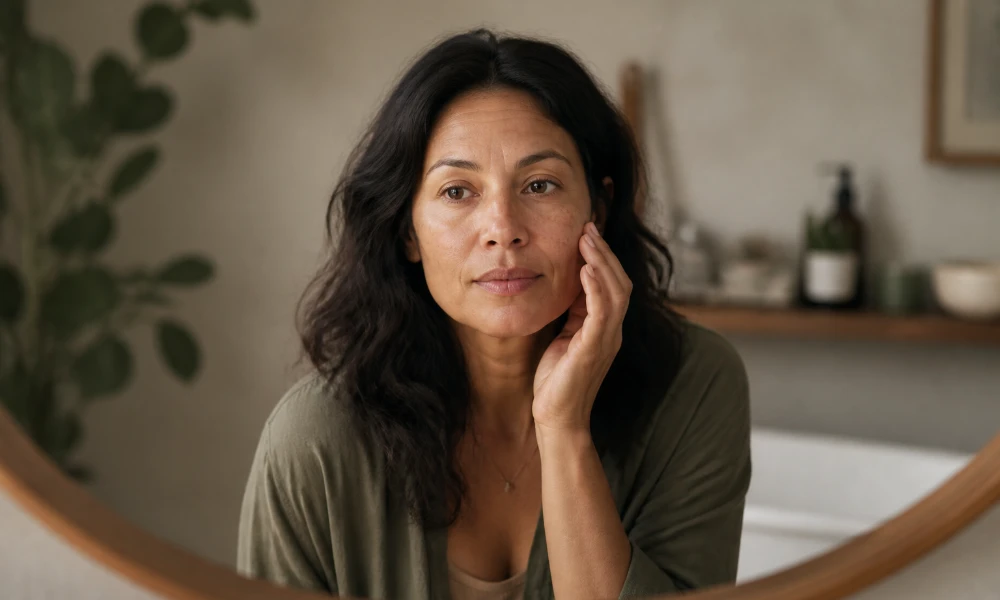
Most people notice it before they can explain it. A stretch of bad weeks at work, a few nights of broken sleep, and the face in the mirror looks different. Duller. Puffier around the eyes. Breakouts in places that had been quiet for years.
It is easy to write this off as tiredness, or as a trick of the light. The physiology behind it is more interesting than that, and it is reasonably well described in the research literature.
The cortisol part
Cortisol is the hormone most people associate with stress, and for good reason. It rises in response to a perceived demand, peaks in the morning under normal conditions, and tapers through the day. That daily rhythm is part of how the body coordinates repair.
When stress becomes ongoing rather than occasional, the rhythm flattens. Levels stay elevated at times of day when they would usually be low. Skin is one of the tissues that responds, partly because skin cells have receptors for cortisol and partly because skin is metabolically expensive to maintain. Under sustained stress, the body deprioritises it.
Several things follow from that. Sebum production tends to increase, which is one of the reasons stress-related breakouts often appear along the jaw and chin. Collagen synthesis slows. Wound healing takes longer, which is measurable in controlled studies and is one of the clearer findings in the field.
The barrier
The outermost layer of skin does an unglamorous job. It holds water in and keeps irritants out. Researchers call this barrier function, and it can be measured by how quickly water evaporates from the skin surface.
Barrier function degrades under psychological stress. Studies looking at students during exam periods, and at adults exposed to sleep restriction, have found slower barrier recovery after minor disruption. The practical version is that skin becomes reactive. Products that were fine last month start to sting. Redness lingers. Dry patches appear in people who have never had dry skin.
This is the mechanism behind a frustrating pattern. Someone notices their skin looking worse, buys stronger actives to correct it, and makes the reactivity worse because the barrier was already compromised.
Sleep, which is doing more work than it gets credit for
Sleep and stress are difficult to separate. Stress fragments sleep, and poor sleep raises stress hormone output the following day. Either way in, the loop runs.
Skin repair is concentrated in the overnight period. Blood flow to the skin increases, cell turnover picks up, and the barrier does most of its rebuilding. Cut that window short across weeks and the backlog shows.
Sleep researchers have documented visible differences after even a few nights of restriction. Independent observers, shown photographs, rate sleep-restricted faces as less healthy looking without being told what the study is about. The effect is real and it is visible to other people, not just to the person examining their own face at close range.
The inflammation loop
The thread connecting all of this is low-grade inflammation.
Chronic stress shifts immune signalling toward a more inflammatory profile. For skin, that matters because most of the common concerns people bring to a clinic sit somewhere on an inflammatory spectrum. Redness. Flushing. Congestion. Sensitivity that has no obvious trigger.
Inflammation also interacts with the skin’s microbial population and with how quickly pigment-producing cells respond to injury, which is part of why marks left by a breakout can take months to fade in some people and weeks in others.
None of this means stress causes any particular skin condition on its own. It is closer to a modifier. It changes the threshold at which other things become visible.
Why topical-only approaches sometimes stall
There is a version of skincare that treats the face as a surface problem with a surface solution. For plenty of concerns, that works fine.
Where it tends to stall is with recurrent, diffuse, or oddly timed presentations. Skin that flares in a predictable monthly pattern. Adult acne that appeared for the first time at 34. Redness that started during a difficult year and never fully settled.
In those cases the surface is reporting something rather than causing it, and a routine built entirely around the surface can only do so much. Practices working at both ends at once are still relatively uncommon, though the model has been gaining ground, and naturopathic aesthetics in Vancouver has become one of the more visible examples of it in Canada.
Where this points
The interventions with the most support behind them are unremarkable, which is probably why they get skipped.
Protecting sleep timing appears to matter as much as total hours. Regular sleep and wake times support the cortisol rhythm that skin repair depends on.
Anything that genuinely lowers physiological arousal helps, and the specific method seems to matter less than consistency. Walking, breathing practices, and strength training all have evidence behind them for stress markers.
Simplifying a skincare routine during a reactive period is often more useful than adding to it. Barrier support first, actives reintroduced slowly once things settle.
Alcohol is worth examining honestly. It disrupts sleep architecture, affects hydration, and dilates surface blood vessels, and it tends to increase during exactly the periods when stress is high.
And if a skin concern has persisted for months, or is changing in ways that are hard to explain, it is worth having someone look at it properly rather than working through it alone. Some clinics now assess skin concerns alongside sleep, stress, and hormonal factors rather than treating them as separate questions. FaceCrime Skin Labs in Vancouver is one example of that model.
The honest limits
Research in this area has real constraints. Stress is hard to measure objectively, most studies are small, and many rely on self-reported skin outcomes. The mechanisms are well established. The size of the effect in any individual person is not.
What can be said is that the relationship runs in both directions. Stress affects skin, and skin that is not behaving affects how people feel. That loop closes quickly, and it is worth interrupting at whichever point is easiest to reach.
Filed underStress & burnout, Women's health & hormones, Sleep