Dr Barbara Kubicka on Longevity, Care and Recovery
Meet Dr Barbara Kubicka, founder of London’s Clinicbe, as she shares her approach to whole-person care, healthy ageing and her own recovery journey.

Tucked away in a mews house in central London, away from the bustle of the main streets, sits a medical and wellness sanctuary that feels less like a clinic and more like coming home. Yet the most extraordinary thing about Clinicbe isn’t the cutting-edge diagnostic technology or the serene, softly lit treatment rooms. It is the woman behind it—a doctor who quite literally used her own clinical philosophy to put herself back together after a devastating car accident left her with a broken spine, a ruptured intestine, and a prognosis that should have kept her away from work for up to six months. Instead, Dr. Barbara Kubicka was back at her clinic in six weeks, and back in the dance studio in four months.
When I connected with Barbara for Wellbeing Magazine —I loved diving into open questions and letting her story unfold naturally.What struck me immediately was her warmth, her candid honesty about modern medicine, and her infectious curiosity about how the human body heals. She is one of those rare practitioners who blends deep scientific rigor with genuine soul, and her journey is nothing short of inspiring.
From Warsaw and NHS Night Shifts to a Vision of Care
Born and raised in Warsaw, Poland, Barbara studied medicine before moving to the UK to spend two years working in the NHS. Even in those early hospital days, she knew she looked at people differently from the system around her. Alongside her love of science, she had always been drawn to art, and as aesthetic medicine began to emerge, something clicked.
More than aesthetics, though, it was a growing disillusionment with conventional institutional care that pushed her to carve her own path. "I never liked conventional medicine, and that's why I couldn't see myself in an organization like the NHS or any other medical establishment," Barbara shared honestly. Inside huge hospital systems, she saw treatment plans dictated by rigid protocols, institutional economics, and pharmaceutical agendas rather than the unique human being sitting in front of her. "It's not a patient in focus," she explained."For me, that was really disheartening when I was working in the hospital to actually see it."
Determined to find a better way, Barbara began studying part-time in Paris while still working her NHS shifts, earning a postgraduate master's degree in aesthetic and anti-aging medicine at the Sorbonne. Long before "longevity" became a wellness buzzword, her professors were researching cellular aging and "inflammaging"—looking at how chronic internal inflammation accelerates aging, and how supporting the body at a cellular level can restore vitality rather than simply masking symptoms.
Those years were demanding, yet they planted a crystal-clear vision. "I remember when I was still working in the NHS, walking through the corridors of the hospital, especially on the night shifts, I would imagine myself walking in my clinic and what would be there," she recalled. In her mind, that future space rested on two non-negotiable pillars: uncompromising medical expertise and genuine human care. "That was the vision—just like this warm bubble that you create."
Before taking the leap, Barbara spent several years gaining hands-on experience across Harley Street, Harrods, and a clinic outside London, mastering everything from lasers to injectables. Yet even in prestigious clinics, she noticed the focus remained transactional, selling isolated procedures rather than caring for the whole person. So, she stepped out on her own and created Clinicbe.
Designing a "Warm Bubble" Where Safety Comes First
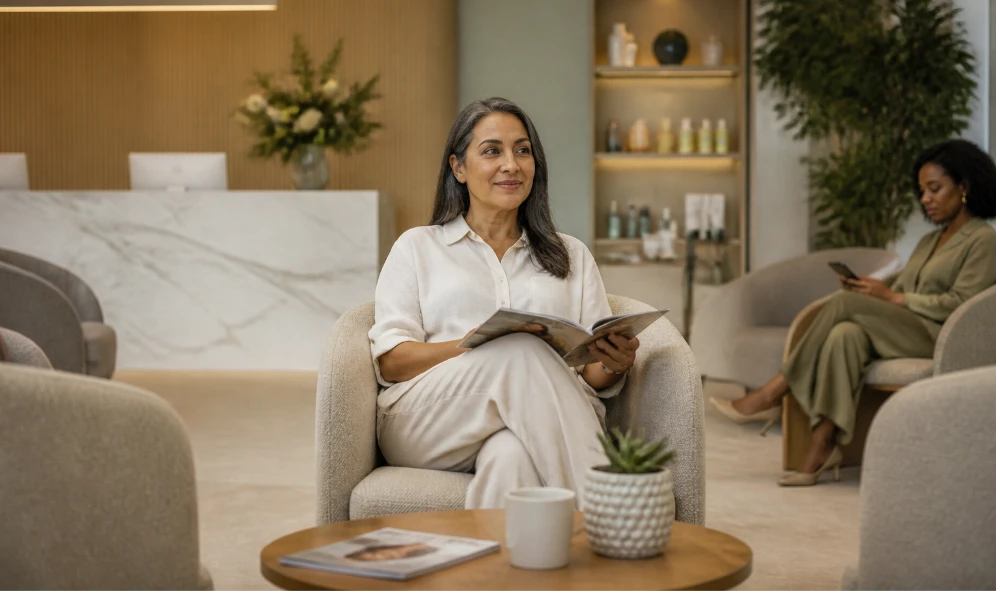
When it came time to design Clinicbe, Barbara knew exactly what she didn't want. She had seen monumental, overly sterile Harley Street buildings that felt intimidating, and tiny, cramped department-store treatment rooms where you could barely walk around the bed. Choosing Mews House was intentional: discreet from the outside, calm, and welcoming on the inside.
During a three-month pause while waiting for building permissions and agreements to finalize, Barbara poured her heart into every sensory detail. "I remember I was buying lights, different lamps, so you have nice lighting," she said. "For me, the light was the most important, so that it feels warm and has that welcoming feeling." She chose soft, natural colors, comfortable furnishings, and spacious rooms that give patients space to breathe.
That philosophy lives right inside the clinic's name and motto: Clinicbe — be happy, be healthy, be beautiful. For Barbara, true wellbeing starts with safety—feeling safe in your environment, and safe inside your own body. From the very first phone call or message with her team, patients are met with unhurried reassurance. Before discussing any procedure, everyone completes an in-depth questionnaire exploring not only their skin or hair, but their sleep quality, stress levels, and daily lifestyle.
"It's stressful enough to make that step to book an appointment to a new place and be vulnerable, because you don't know what's going to come or who you're going to meet," Barbara noted. Some people arrive motivated to overhaul everything at once, while others need to move step by step. By listening first, she ensures the process never adds more stress to someone's life.

Diagnostics, Longevity, and "Exercising" the Skin
Over the past two to three years, Barbara has witnessed a powerful shift in the people seeking her help, including international clients who travel from as far afield as Australia whenever they visit London. Rather than chasing quick cosmetic fixes, people are increasingly investing in long-term health, prevention, and aging well.
At Clinicbe, that process starts beneath the surface. For hair loss, Barbara uses DNA testing alongside AI-assisted trichoscopy to assess follicle genetics and scalp health, taking the guesswork out of treatment plans. For cellular health, she uses OligoScan, a spectrometry device that reflects light off the tissue to measure intracellular minerals and heavy metals. As Barbara explained, standard blood tests often look normal because the body works hard to keep blood balanced, even when cells are depleted or storing heavy metals like aluminum or cadmium. When imbalances show up, she rebuilds from within using bespoke IV vitamin infusions, intramuscular injections like vitamin D3 and B12, NAD+ courses for cellular energy, and glutathione chelation therapy.
When it comes to skin and hair regeneration, Barbara uses a brilliant analogy. "It's the same principle of going to the gym," she told me. "You need to exercise the skin—for example, microneedling or lasers—and then you need to give it food to actually produce new collagen."
She practices every bit of what she preaches. At home and in the clinic, she is devoted to red light therapy—owning everything from full-body panels and LED face masks to red light caps for hair—alongside microneedling, polynucleotides, Sunekos skin boosters, Korean biostimulator EstheFill, and autologous exosomes harvested and activated from her own blood every three months.
Her obsession with "feeding" the body's repair process also led her to launch her own pure supplement brand, Collagevita. After seeing how dramatically oral collagen improved her patients' clinical results, Barbara went searching for a clean product—and was horrified by commercial powders loaded with tiny doses, sweeteners, coloring, and synthetic additives. Determined to create something pure, she partnered with a specialist manufacturer to formulate organic, ethically sourced bovine, fish, and eggshell peptides broken down to two to five kilodaltons for optimal absorption, delivered in a potent 20-gram daily dose.
Her newest addition takes cellular recovery even further: a hyperbaric oxygen chamber. By delivering oxygen under pressure, it saturates not only the blood but also the lymphatic system, reaching joints, muscles, and the brain to calm inflammation, clear brain fog, boost low energy, and support healing after surgery or demanding medical treatments. In fact, Barbara was heading off to a certified course in hyperbaric medicine that very weekend, constantly expanding her knowledge to better serve her patients.

Healing Herself From the Inside Out
It wasn't until the end of our conversation that Barbara shared the deeply personal story that tested everything she knew. Three years ago, she survived a severe car accident that left her with a broken spine requiring fusion surgery, a ruptured intestine that demanded three separate operations, and fractures across her ribs, clavicle, and ankle.
Surgeons told her to stay away from work for three to six months. Because of her intestinal rupture, she couldn't eat normally for an entire month, leaving her body severely depleted in protein and essential nutrients.
Drawing on every tool in her medical arsenal, Barbara became her own most dedicated patient. She placed infrared magnetic mats in every room of her home to ease her recovering spine, wrapped herself in a red light therapy belt, used low-frequency ultrasound to heal deep soft-tissue injuries and scarring, and relied on amino acid IV infusions to rebuild her strength from the inside out. Six weeks after the crash, she walked back into her clinic. Four months later, she was dancing again.
"Unless you face something like that, you can't fully appreciate what truly makes a difference," she reflected quietly. Those intense months didn't just restore her body; they inspired a deeper commitment to the restorative treatments she now offers her patients.
Filed underSkin conditions, Women's health & hormones, Cosmetic & aesthetics

About the author
Sara AndrewJournalist
Sara is also a Certified Yoga Teacher, Meditation Instructor, and Recovery Coach, guiding individuals toward balance, healing, and self-discovery. Whether uncovering truths through investigative reporting, curating transformative travel experiences, or empowering others through wellness practices.