How to choose an online yoga teacher training that fits around real life
People choose online yoga teacher training for three reasons: to teach, to understand their own body better, or to belong to a community of practice.

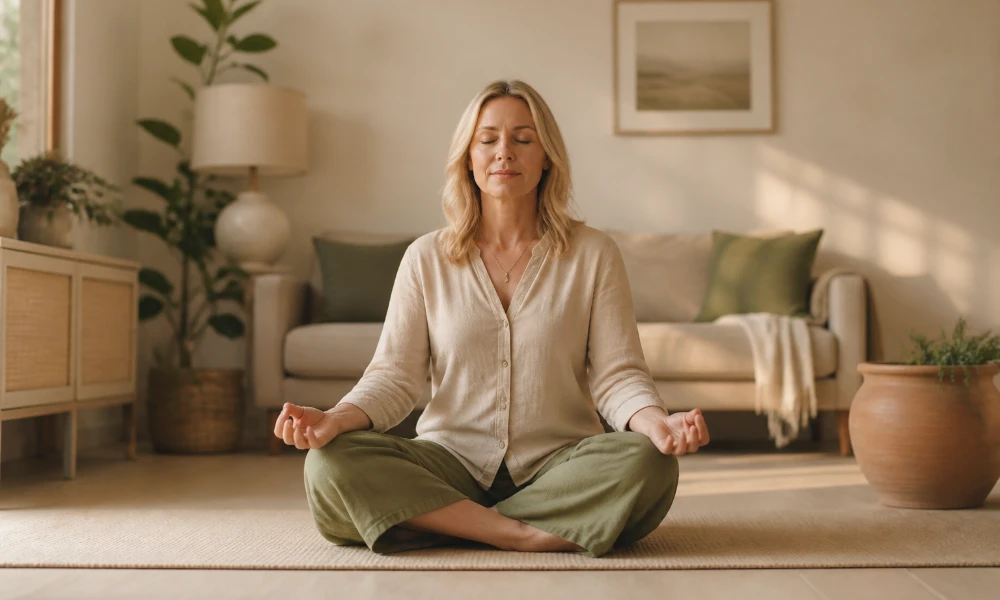
Picture a 38-year-old accountant who has practised yoga twice a week for six years. She has no plan to quit her job or spend a month at an ashram, but she keeps thinking, "one day I would like to train." Most people who consider a yoga teacher training look like her: parents, desk workers, nurses and retirees who want to go deeper into a practice that already helps them. For them, an online training can be the difference between "one day" and actually doing it.
But the choice is wide, and the marketing is loud. Here is how to sort the options calmly.
Start with why you want to train
People train for three reasons: to teach, to understand their own body better, or to belong to a community of practice. All three are good reasons, and each leads to a different choice.
If you plan to teach, you will want a programme that gives you supervised practice teaching and feedback. If you mainly want depth, a self-paced course with strong anatomy and philosophy content may suit you better. Write your reason down before you compare anything.
Over the years, I have spoken with many people considering yoga teacher training, and one thing I have noticed is how often they focus on the certification before asking themselves what they really want from the experience. I always encourage them to think about the kind of teacher they hope to become, or how they want their own practice to grow. That clarity can make all the difference when choosing a training.
Know what "200-hour" and "Yoga Alliance" mean
The 200-hour training is the standard first level. It is a mix of technique, anatomy, teaching methodology, philosophy and practicum, and many schools spread it over several months online.
Yoga Alliance is a US-based registry that sets a minimum standard. A school can register as a Registered Yoga School, and graduates can then register as teachers. It is not a legal requirement in the UK, Canada or Australia, but studios and insurers often ask for it, so it is worth checking before you pay.
Check how the hours are really delivered
"Online" can mean very different things. Some programmes are fully self-paced videos. Others run live sessions on set days, which can be hard if you live in a different time zone.
Ask three questions. How many hours are live, and at what times where you live? Is there a person who reviews your teaching, or only automated quizzes? How long do you keep access after you finish? Here is the line we come back to most: a training is only as good as the feedback you get on your teaching. A cheaper programme with no feedback can cost you more in the end if you do not feel ready to teach.
Look at the full price, not the headline price
Online trainings range from a few hundred to well over a thousand pounds, dollars or euros. Many run permanent "sales", so the discounted price is often the normal price. What matters is what is included.
We learned this the hard way. When we re-checked every price in our own comparison in September 2026, we found one listed discount that was simply wrong, two entries with no real price at all, and one programme that was being retired. We had published them, and we should have caught them sooner. We corrected the numbers, removed the retired programme and now re-check prices regularly.
Check whether the manual, the certificate and the Yoga Alliance registration fee are covered. Check whether payment plans add interest. And check the refund policy in writing. A fair school will tell you plainly what happens if life gets in the way in week three.
Read the reviews with care
Star ratings on a school's own page tell you little. Look for detailed accounts from graduates that mention a specific teacher, module or problem. Look at the school's Yoga Alliance profile too, and read how many reviews sit behind the average. A 4.9 from two reviews is not the same as a 4.7 from several hundred.
It also helps to see how reviews are weighed. At YOGI TIMES we compare 13 online schools on price, hours, live teaching, support after graduation and Yoga Alliance ratings, and we show how many reviews sit behind each score. In our September 2026 check, one school's 4.75 rested on just two reviews, another's on 6,910, and three of the 13 had no Yoga Alliance rating at all. Those three are marked "N/A" instead of being given a guess. We re-check prices against each school's own page.
Our full YOGI TIMES online yoga teacher training certification guide sets out those comparisons side by side, with prices in dollars, pounds and Canadian dollars. YOGI TIMES earns a commission if you enrol through some of the links in that guide, and that never changes the order or the verdicts. It simply saves you from opening twenty tabs.
Make a realistic plan for your week
The best programme is the one you finish. Look at your calendar honestly. If you can give four hours a week, a six-month plan is realistic. If you can only manage an hour a day, choose something self-paced with firm milestones.
The hardest part of a training is rarely the material. It is the habit. Put your study blocks in your diary like any other appointment, and tell the people around you what you are doing.
Picture a Tuesday evening: the laptop open on the kitchen table, a mug of tea going cool, the faint hum of the fan. You unroll your mat with a soft slap and feel the cold floor through your socks. Then the teacher's voice comes through, low and unhurried, and your shoulders drop an inch. Those small moments, more than any syllabus, are what carry people through the months.
Try before you commit
Good schools let you sample. Watch a free class, read a sample module or join an open session. Listen to the voice. Is it steady, does it leave room for silence, does it make your jaw unclench or tighten? Notice whether the pace feels kind, and whether you would be happy to hear this person at six in the morning for months.
Ask a question by email and see how long the reply takes. The way a school treats you before you pay is usually the way it will treat you afterwards.
Plan what comes after
Finishing the course is the start. If you want to teach, think about how you will gain real classes: a friend's living room, a community group, a local studio or an online class. If you want to deepen your own practice, think about a mentor or a study group.
A good school will help you think this through, and some offer ongoing community or mentoring. That support is worth more than a discount.
Who should skip an online training
An online training is not the right choice for everyone. If you learn best by hands-on adjustments, or you want to be taught in the same room as your classmates, an in-person immersion may serve you better. If you cannot protect any regular study time at all, wait until you can. Starting and stopping costs more than waiting.
A calm way to decide
Pick three schools that match your goal and budget. Compare them on the same five points: live hours, feedback, total cost, Yoga Alliance status and refund terms. Sleep on it. The right choice usually feels steady, not rushed.
An online yoga teacher training is a serious commitment of time and money, but it does not have to be a leap into the unknown. With a clear reason, a little patience and honest questions, you can find a programme that supports your practice and fits your life.
Filed underYoga & Pilates
Guest Contributor
Articles published under Guest Contributor have been provided by independent writers, experts or external contributors where an individual author is not credited. These contributions are selected for their relevance to health, wellbeing and lifestyle, with the aim of sharing useful information, fresh perspectives and ideas with Wellbeing Magazine readers. Views expressed are those of the original contributors and do not necessarily reflect those of Wellbeing Magazine.