I Spent a Month Helping My Mother Shop for a Headstone. Here's What Nobody Tells You.
My father died in February, and by April my mother had decided she was ready to choose his stone. I volunteered to help because I am the family's designated…

My father died in February, and by April my mother had decided she was ready to choose his stone. I volunteered to help because I am the family's designated researcher, the one who reads two hundred reviews before buying a toaster. I assumed the skills would transfer. They mostly did, but the monument industry turned out to have its own logic, its own vocabulary, and its own quiet kindnesses that no amount of toaster-shopping prepares you for. This is the guide I wish someone had handed me in April.
The first thing I did was what everyone does: I typed headstones near me into a search bar at eleven at night. The results were a mix I have since learned is typical - two local monument shops with websites last updated during the Obama administration, a cemetery's own sales office, several national companies, and one firm, Remembrance Headstones, whose site let me spin granite monuments around in 3D at midnight, which is exactly the hour when a grieving family does this kind of thing. I mention the hour because it matters. Grief does not keep business hours, and the companies that understand this design for it.
Lesson One: The Cemetery Holds A Veto
Here is the thing no search result tells you up front: your cemetery has rules, and the rules come first. Ours allowed upright monuments in Dad's section but capped them at forty-two inches, required an approved foundation, and had opinions about bases I still don't fully understand. I learned this only because a woman on a widows' forum - a community whose collective practical wisdom deserves its own book - replied to my post within an hour: "Call the cemetery office before you fall in love with anything. Ask for the monument regulations in writing. Everyone learns this the hard way or the easy way."
We learned it the easy way, thanks to her. The monument companies worth dealing with, I discovered, treat this as their job rather than yours; the good ones verified the rules with our cemetery directly and designed inside them from the first sketch. If a seller shrugs at the question, keep looking. The forum consensus on this point was unanimous in a way internet forums rarely are.
Lesson Two: "Near Me" Means Something Different Now
I expected shopping locally to mean settling for whatever the nearest shop stocked. It doesn't anymore, and this reshaped our whole search. The trade has quietly reorganized itself the way eyeglasses and mattresses did: national design and production, local presence for the parts that must be local. The delivery, the foundation work, the installation, the relationship with your specific cemetery - those stay physical. The design consultation, the granite selection, the proofs and revisions - those happen wherever you are, at whatever hour grief allows.
What this meant practically: our shortlist included a company with a showroom forty minutes away and one with a showroom in another state entirely, and the experience barely differed. Both produced scale drawings. Both handled the cemetery paperwork. The showroom visit was still worth the drive - my mother needed to put her hand on polished granite before she could choose it, and I understand that completely - but the geography anxiety I started with turned out to be obsolete. If you live in a town with no monument dealer at all, you are no longer at a disadvantage. That would have been unthinkable a generation ago.
Lesson Three: The Vocabulary is Learnable in an Afternoon
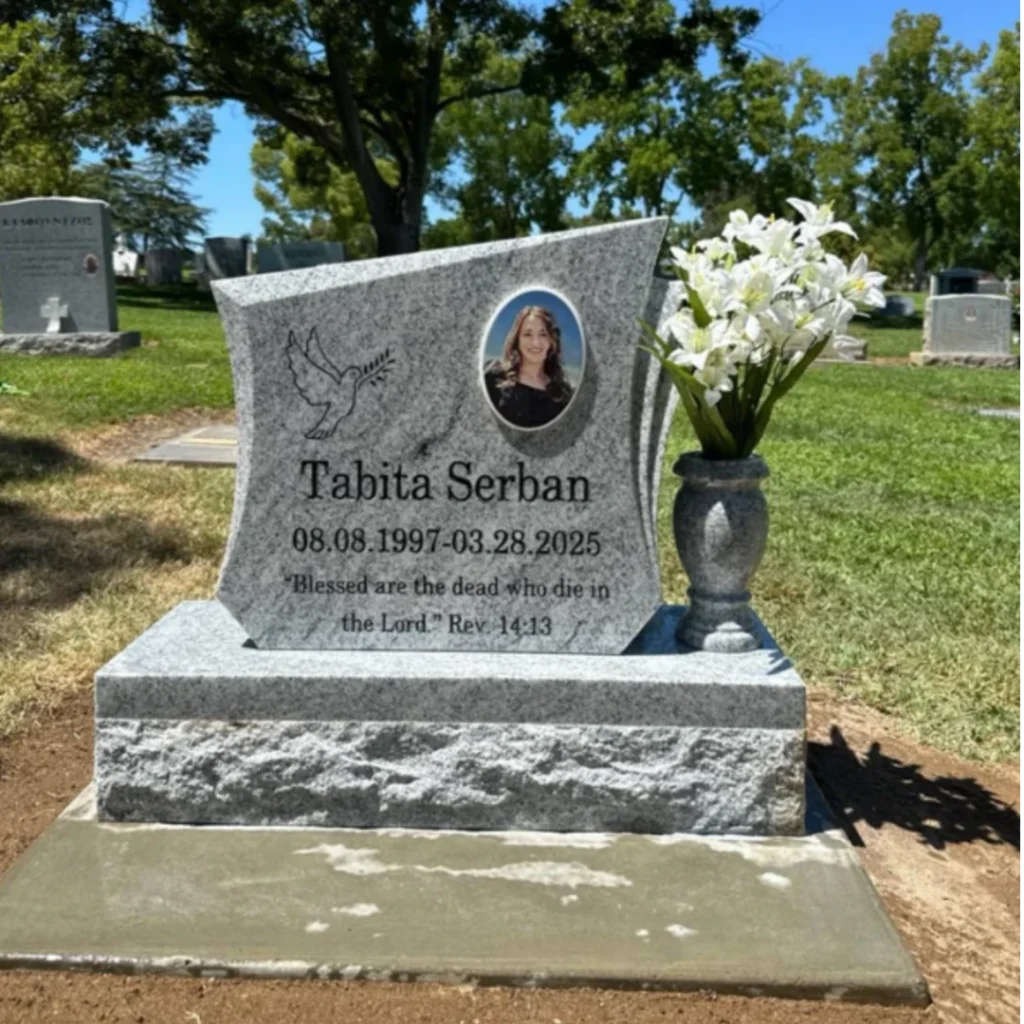
Upright, slant, bevel, flat, ledger, companion. Polished, honed, rock-pitched. Sandblast versus laser etch. The terminology intimidated my mother until I made her a cheat sheet, and here is the compressed version: uprights stand tall and cost the most; slants are wedges that sit low; bevels and flats live at or near ground level and cost the least; companion stones carry two names. Finishes are just texture choices. Sandblasting cuts deep letters that last centuries; laser etching draws photographic detail on dark granite. That paragraph is genuinely eighty percent of the vocabulary you need.
The remaining twenty percent is granite colors, and this is where I'll pass along the single best piece of advice we received, from a retired monument dealer whose posts I found on a trade forum: choose the granite in person or from an actual sample, never from a screen, because black granite alone comes in a dozen origins and price points and they photograph identically. We asked for samples. The difference between two "blacks" in sunlight was not subtle.
Lesson Four: The Pricing Fog Is Partly Real and Partly Fixable
Monument pricing frustrated me more than anything else in the process. Few companies publish full prices; many quote only after a consultation. I understand some of the reasons - every stone is custom, cemeteries add variables, installation varies by region - but the opacity still serves sellers more than buyers. What cut through it: getting every quote itemized (stone, engraving, base, foundation, delivery, installation, cemetery fees) and asking directly what was not included. The spread between our highest and lowest comparable quotes was thirty percent. Reviews helped here too; buyers are wonderfully specific about money when they feel either cheated or well-treated, and patterns across fifty reviews are hard to fake.
One more money note: the payment plans are real and normal in this industry. Financing a monument felt strange to me until I understood that the alternative, for many families, is a grave that stays unmarked for years. Nobody should feel odd about it.
What The End Looked Like
We ordered in May: a gray upright, forty inches, Dad's name in deep-cut letters, a carved oak branch because he planted them his whole life, and a line my mother chose from a letter he wrote her in 1974. The proof came in three days; we revised the branch once. The stone was set in July, and the company called to tell us before we drove out, which I now understand is a small industry courtesy that means everything - the first sight of the stone belongs to the family, not to chance.
If you are at the beginning of this and it feels enormous, it is, and it also isn't. The search that starts at midnight ends at a specific stone in a specific place with the right name on it. Take the forum advice about cemetery rules. Get samples. Itemize everything. And use the modern shape of the industry to your advantage - whether your consultation happens across a counter or across the country matters far less than it used to. We ended up working with the company whose website I'd found that first sleepless night, remembranceheadstones.com, and my mother visits the result every Sunday. She reports that the oak branch catches the morning light. Dad would have checked the joinery and approved.
Filed underGrief & loss