
Is Your Brain Tired — or Simply Overstimulated?
Why can an ordinary day leave us mentally exhausted even when we have done very little physical work? The answer may lie less in how many tasks we complete…

How Modern Life Exhausts Our Attention
You finish the day exhausted. Yet you have not run a marathon. You may not even have left your desk.
You answered emails, moved between meetings, checked messages, opened documents, responded to notifications, skimmed headlines, compared options, switched between tabs and perhaps asked an AI assistant to summarise something you did not have time to read.
Nothing seems particularly demanding in isolation.
So why can the mind feel so depleted by the end of an apparently ordinary day?
The answer may not simply be how much we are doing.
It may also be how often our attention is being asked to stop, redirect, reorient and begin again.
And that distinction matters, because one of the most important wellbeing challenges of modern life may not be a shortage of information, intelligence or technology.
It may be learning how to protect the cognitive resource that allows us to use all three: attention.
We confuse being busy with concentrating
Modern technology has removed enormous amounts of friction from everyday life. Information arrives instantly. Communication is continuous. Artificial intelligence can generate answers in seconds.
But our cognitive architecture has not suddenly acquired unlimited processing capacity.
Attention is selective. Working memory is constrained. When several demanding pieces of information compete simultaneously, the system has to prioritise what receives processing.
John Sweller's foundational work on cognitive load demonstrated that cognitive processing capacity is limited and that demands placed on this capacity can interfere with learning and understanding. (DOI)
This does not mean that checking an email somehow “fills up” the brain like a hard drive.
It means something subtler: mental work has processing costs.
And modern life repeatedly adds another cost — switching.
The hidden price of switching
We often describe ourselves as multitasking.
Most of the time, however, what we are actually doing is switching between tasks.
A message appears while you are writing.
You answer it.
Another notification arrives.
You check your calendar.
You return to the document.
You remember another unfinished task.
You open another tab.
Experimental research on task switching has consistently demonstrated measurable switching costs: changing from one task rule to another requires cognitive control processes and can increase the time needed to perform the next operation.
The switch may feel almost instantaneous.
Cognitively, it is not necessarily free.
Try this: create a switching audit
For one working day, do not try to change your behaviour.
Simply notice it.
For one or two hours, make a small mark every time you voluntarily or involuntarily move from one meaningful activity to another:
- document → email;
- email → messaging app;
- meeting → notification;
- report → news;
- conversation → phone;
- task → AI assistant → task.
The objective is not to produce a perfect number.
It is to make fragmentation visible.
Many people attempt to solve mental exhaustion by working faster when the more useful question may be:
How many times am I forcing my attention to restart?
Your previous task may follow you into the next one
There is another complication.
Stopping one activity does not necessarily mean that our attention has completely left it.
Researcher Sophie Leroy described this phenomenon as attention residue.
Across experiments, she found that when people switched away from one task — particularly an unfinished one — thoughts related to that task could persist and interfere with performance on the subsequent activity.
Think about what this means in everyday life.
You leave a difficult email unanswered and enter a meeting.
Physically, you are in the meeting.
Part of your cognition may still be negotiating the email.
You move from a budget discussion to a family message, from the family message to a presentation, from the presentation to a news alert.
The body changes context immediately.
Attention may arrive later.
Try this: use a “ready-to-resume” note
Before leaving an unfinished task, write three short lines:
Where I stopped:
What exactly was I doing?
What comes next:
What is the next concrete action?
When I will return:
At what point will I resume it?
This is more than an organisational convenience.
Subsequent research by Leroy and Theresa Glomb found that a brief ready-to-resume plan could reduce attention residue under interruption conditions and help people redirect attention to the next task.
You are effectively giving the unfinished task somewhere to go other than your working memory.
Notifications do not have to be answered to interrupt you
Another common assumption is that a notification matters only if we respond to it.
The evidence suggests otherwise.
In an experiment published in the Journal of Experimental Psychology: Human Perception and Performance, Cary Stothart and colleagues found that simply receiving mobile-phone notifications was enough to disrupt performance on an attention-demanding task. The researchers argued that notifications can generate task-irrelevant thoughts and attentional disruption even without active phone interaction.
That distinction is crucial.
A notification is not merely information waiting for you.
It is also a bid for your attention.
And modern digital environments can produce hundreds of such bids.
Try this: move from notification management to notification design
Instead of asking:
“How can I resist checking?”
ask:
“Why must this stimulus reach my attention in the first place?”
Consider separating notifications into three categories:
- Must interrupt me now — genuine time-sensitive communication.
- Can wait until I choose to check — most email, platforms and updates.
- Does not need access to my attention at all — promotional alerts, engagement prompts and low-value notifications.
The objective is not digital asceticism.
It is intentional accessibility.
Technology should be available when you need it without necessarily being permitted to summon you whenever it wants.
Working faster can hide the cost
One of the most interesting findings in interruption research is that disruption does not always make people visibly slower.
Gloria Mark and colleagues found that participants experiencing interruptions actually completed tasks faster in their experiment, without a reduction in measured quality.
That sounds positive — until the rest of the result is considered.
Participants compensated by working faster but reported greater stress, frustration, time pressure and effort.
This is an important wellbeing lesson.
Performance can sometimes hide strain.
A person may still answer every email.
Meet every deadline.
Attend every meeting.
Complete every task.
And yet the cognitive and emotional price of maintaining that performance may be increasing.
Output alone is therefore a poor measure of whether a way of working is sustainable.
The future may make this problem more important, not less
Artificial intelligence is likely to remove even more friction from knowledge work.
We can already generate drafts, summaries, alternatives, recommendations and analyses faster than most individuals could reasonably produce alone.
That creates extraordinary opportunity.
It also creates a paradox.
When the cost of producing information falls, the amount of information available to evaluate can rise.
When generating ten alternatives becomes effortless, deciding which alternative deserves attention becomes more important.
When answers become abundant, discernment becomes scarce.
The future wellbeing problem may therefore not be that we lack cognitive assistance.
It may be that our assistance produces more cognitive inputs than our attention can use intelligently.
AI can help us process information.
It cannot make human attention infinite.
Protect periods of cognitive continuity
A healthier relationship with attention does not require abandoning technology, deleting every app or spending the working day in silence.
It requires recognising that concentration benefits from continuity.
A practical experiment is to create one protected period each day in which:
- one cognitively important activity is selected;
- unnecessary notifications are silenced;
- email and messaging applications are closed;
- unrelated browser tabs are removed;
- interruptions are captured rather than immediately pursued;
- the session has a defined beginning and ending.
The precise duration matters less than the principle.
You are reducing the number of occasions on which your cognitive system must ask:
Where was I? What was I doing? What matters now?
Recovery is not the same as consuming different stimuli
There is another trap.
After sustained mental work, many of us “take a break” by changing screens.
We leave a spreadsheet and open social media.
Leave email and read the news.
Leave a video meeting and watch short videos.
The content has changed.
The attentional system may still be processing rapidly changing stimuli.
A genuine break can sometimes be much simpler:
- walk without consuming content;
- look outside;
- stretch;
- make a drink without bringing the phone;
- sit quietly for a few minutes;
- speak with another person without simultaneously checking a screen.
The objective is not to turn recovery into another performance optimisation technique.
It is to permit moments in which nothing urgently competes for selection.
Perhaps your brain is not asking you to do less
The most useful question may not be whether modern life is “too stimulating”.
Human beings are extraordinarily capable of learning, adapting, exploring and working with complex environments.
Nor should technology be treated as the enemy. Digital tools and AI can reduce unnecessary effort, expand access to knowledge and remove genuinely wasteful cognitive work.
The more interesting question is:
Which demands deserve access to our attention — and which have simply acquired it by default?
Protecting attention does not mean withdrawing from modern life.
It means participating in it more deliberately.
Because wellbeing is not merely the absence of stress or exhaustion.
It also includes having enough cognitive space to notice what we are doing, understand what matters and choose where our mind goes next.
Perhaps the challenge of the coming years will not be learning how to process more information.
It will be learning that not everything capable of reaching our attention deserves to keep it.
Remember: “Only knowledge sets us free!!”
See you soon!!
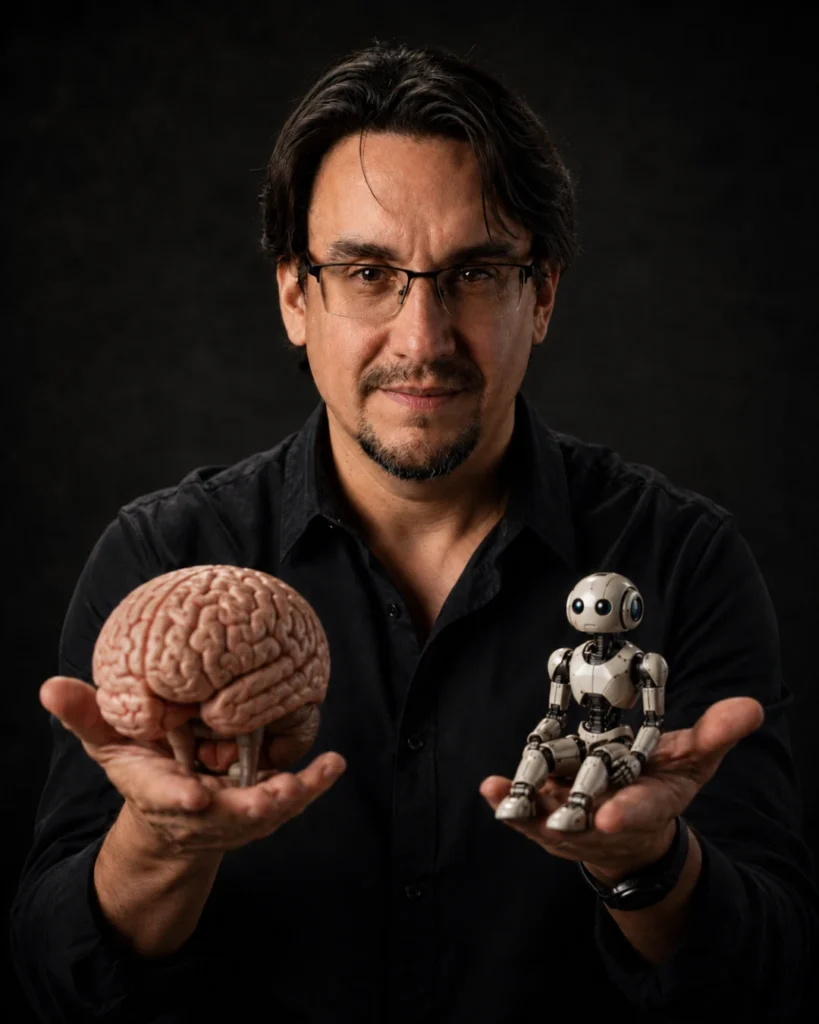
Prof. Alexandre Rodrigues, PhD
Professor and Consultant in Neuroscience and Artificial Intelligence applied to business.
References — APA 7th edition
Leroy, S. (2009). Why is it so hard to do my work? The challenge of attention residue when switching between work tasks. Organizational Behavior and Human Decision Processes, 109(2), 168–181. https://doi.org/10.1016/j.obhdp.2009.04.002 (ScienceDirect)
Leroy, S., & Glomb, T. M. (2018). Tasks interrupted: How anticipating time pressure on resumption of an interrupted task causes attention residue and low performance on interrupting tasks and how a “ready-to-resume” plan mitigates the effects. Organization Science, 29(3), 380–397. https://doi.org/10.1287/orsc.2017.1184 (PubsOnLine)
Mark, G., Gudith, D., & Klocke, U. (2008). The cost of interrupted work: More speed and stress. Proceedings of the SIGCHI Conference on Human Factors in Computing Systems, 107–110. https://doi.org/10.1145/1357054.1357072 (DOI)
Rubinstein, J. S., Meyer, D. E., & Evans, J. E. (2001). Executive control of cognitive processes in task switching. Journal of Experimental Psychology: Human Perception and Performance, 27(4), 763–797. https://doi.org/10.1037/0096-1523.27.4.763 (DOI)
Stothart, C., Mitchum, A., & Yehnert, C. (2015). The attentional cost of receiving a cell phone notification. Journal of Experimental Psychology: Human Perception and Performance, 41(4), 893–897. https://doi.org/10.1037/xhp0000100 (PubMed)
Sweller, J. (1988). Cognitive load during problem solving: Effects on learning. Cognitive Science, 12(2), 257–285. https://doi.org/10.1207/s15516709cog1202_4 (DOI)