The Biggest Wellbeing Crisis Isn't Mental Health. It's How We Design Our Neighbourhoods
What if loneliness, inactivity and stress are not simply personal problems, but consequences of the places we've built?
What if loneliness, inactivity and stress are not simply personal problems, but consequences of the places we've built?
For years we have talked about a mental health crisis.
Governments have invested in awareness campaigns. Employers have introduced wellbeing programmes. Apps promise mindfulness in minutes, while millions of people search for ways to reduce stress, anxiety and loneliness.
These are all valuable. But I can't help wondering if we are asking the wrong question.
What if one of the biggest contributors to our wellbeing isn't something happening inside our minds at all?
What if it is happening outside our front doors?
I have been thinking about this a lot recently as I prepare to move home after living in the same village for eighteen years. I have loved this house. From my front door I can walk across open fields, catch a train into London, and stroll to our wonderful little village shop. It has been a place that has supported my wellbeing in ways I probably took for granted.
Yet there has always been something that frustrated me.
The neighbouring village is only around 1.5 kilometres away. It should be an enjoyable walk. Instead, the country lanes are narrow, traffic travels at speed, and walking between the two villages often feels unsafe.
Every time I drive that short distance I wonder why there isn't a simple, accessible pathway connecting the two communities. Imagine a wide shared path lined with trees and wildflowers, with benches every few hundred metres where neighbours could stop for a chat, older residents could rest, parents with pushchairs could pause, and children could safely cycle between villages.
Two communities that are geographically close remain socially distant simply because we designed roads for cars rather than people.
Multiply that across thousands of communities and perhaps we begin to understand why connection often feels so difficult.
My parents have lived in their home for more than forty years. It is full of memories, surrounded by a beautiful garden and has been the heart of our family for decades. But time changes how we use our homes. The garden has become difficult for my father to access. Rooms that once bustled with family life now feel too large and impractical. Like many older couples, they have considered downsizing.
The challenge isn't simply finding a smaller house.
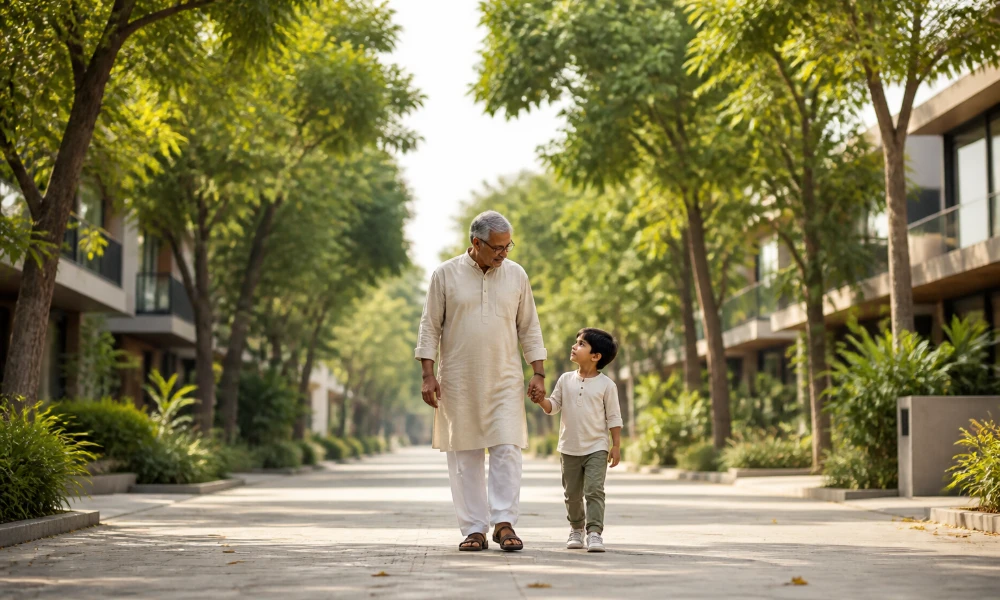
They are searching for somewhere that still offers what matters most: friendly neighbours, somewhere to walk every day, access to nature, local shops, and a genuine sense of belonging.
For many people, downsizing means sacrificing community in exchange for a newer property. That feels like the wrong compromise.
These experiences remind me of my years working in social housing.
I remember mothers struggling to carry pushchairs up flights of stairs because there was nowhere to leave them safely. Residents who relied on mobility scooters had no secure storage. Housing teams spent endless hours dealing with disputes over pushchairs left in communal hallways because they created fire risks. The arguments were understandable, but they all pointed to the same problem.
We hadn't designed buildings around the realities of everyday life.
The same pattern appears everywhere.
Garages are too narrow to fit modern cars, so they become storage rooms. Cars end up parked on roads never designed to accommodate them, making access difficult for ambulances, fire engines and refuse vehicles. Families have nowhere to store suitcases, bicycles, Christmas decorations or children's outdoor toys, so homes gradually become cluttered and overcrowded.
Teenagers often retreat to their bedrooms because there are few shared spaces at home and even fewer safe places to spend time outdoors. Parents juggle home working with family life in houses that were never designed for either. Overcrowding contributes to damp and mould, while high energy bills place additional pressure on households despite technologies such as heat pumps, solar panels and improved insulation becoming increasingly available.
Individually these sound like inconveniences.
Collectively they shape how we feel every single day.
Research consistently shows that where we live influences our health. Loneliness is associated with increased risks of poor physical and mental health, while access to green space has been linked with lower stress levels, improved mood and increased physical activity. Walkable neighbourhoods encourage people to move more as part of everyday life rather than relying solely on planned exercise. The environments we create can either support healthy behaviours or make them harder to achieve.
Yet we continue to treat many wellbeing challenges as though they exist independently of place.
We build housing developments to satisfy numerical targets, then wonder why residents struggle to build connected communities.
We consult local people, but too often consultation feels like a process of explaining what is already going to happen rather than genuinely asking what kind of place people want to live in. I witnessed this during my time in housing, and I saw it again when our own village objected to a proposed development. Looking back, I don't believe the disagreement was inevitable. Had the consultation genuinely invited collaboration rather than simply presenting plans, I believe developers and residents could have created something far better together.
The reality is that we know more than ever before about how environments influence health.
We understand the importance of daylight, nature, active travel, social connection, adaptable homes, energy efficiency and inclusive design. We have new construction methods, smarter materials and better technology than any previous generation of builders.
So why do so many developments still feel as though they belong to the last century?
Perhaps it is because we continue to judge success by how many homes we build rather than how well those homes enable people to live.
Imagine if planning applications were required to answer different questions.
How easy is it to walk safely to neighbouring communities?
Can residents remain in their homes if they become less mobile?
Where do children play independently?
Where do teenagers gather safely?
How will older residents remain connected?
Where can mobility scooters, bicycles and pushchairs be stored?
How will neighbours naturally meet each other?
Will this development reduce loneliness or unintentionally increase it?
These are not soft questions.
They are questions about health, resilience, community and the long-term success of places.
The homes and neighbourhoods we build today will shape lives for the next fifty or even one hundred years. We owe it to future generations to think beyond planning quotas and sales values.
I don't believe developers, planners or local authorities lack good intentions. Many genuinely want to create thriving communities while balancing viability, regulation and housing demand.
But perhaps it is time to widen the conversation.
Not simply asking, "How many homes can we build here?"
But asking, "What kind of life will these homes make possible?"
Perhaps the biggest wellbeing intervention we could make isn't another wellbeing app.
Perhaps it's designing neighbourhoods that quietly help people feel healthier, more connected and more supported every single day.
I'd love to hear your thoughts.
What changes would you like to see in the way we plan, design and build homes and neighbourhoods?
Let's open the conversation.
Filed underNature, Connection, Family & parenting, Home & garden sanctuary

About the author
Rachel BransonFounder & Editor in Chief
With over 30 years in publishing and a background in Naturopathic Medicine, she has made it her mission to challenge mainstream health narratives and empower people to take control of their wellbeing. Now expanding her vision across the Atlantic, Rachel is bridging UK and US audiences with inspiring stories, trusted insights, and pioneering partnerships that align with a new era of health innovation.