
The family home after the children cannot afford to leave
As adult children remain at home for longer, multigenerational living is returning. Rachel Branson asks why UK homes still fail to support privacy, care and…
Multigenerational living is quietly returning — and it is exposing how badly designed our homes have become
For many families, the childhood home was never designed to become the adult home.
It was designed around a familiar sequence: parents move in, children arrive, bedrooms fill, the family grows and, eventually, the children leave. The house then becomes quieter, emptier and perhaps larger than its owners need. At some point, the parents downsize and the cycle begins again elsewhere.
Except life no longer follows that neat pattern.
Young adults are remaining at home for longer because rents are high, deposits are difficult to save and buying a first home can feel almost impossible. Others return after university, divorce, redundancy, illness or the end of a relationship. Older parents may need increasing support, while their adult children are simultaneously trying to manage careers, childcare and the cost of running separate households.
Multigenerational living is returning, but many of us are attempting it in homes that were designed for a completely different version of family life.
The result is not always togetherness. Sometimes it is simply several adults trying to live independently in a building that offers them no independence at all.
When there are enough rooms, but still not enough space
My parents still live in our family home, although all of us moved away after college or university. For years, it worked exactly as a conventional family home was expected to work.
Then my sister found herself between properties while trying to buy her next home and moved back for around 18 months.
There was no shortage of bedrooms. On paper, the house was large enough. Yet it did not allow two adult generations to exist comfortably beneath the same roof.
The problem was not simply the number of rooms. It was how those rooms related to one another. There was no self-contained area, no second living space with a genuine sense of privacy, no way of moving through the house without continually entering someone else’s domestic life.
My sister had previously lived independently. My parents had become accustomed to living alone as a couple. Moving back together required everyone to surrender part of the rhythm they had created for themselves.
Perhaps, had the house been designed differently, the experience would have been different too.
Now my parents are considering downsizing. The property requires maintenance, the garden is a considerable commitment and parts of it are not easily accessible for my father. Yet they love the area. Their friendships and familiarity are rooted there.
None of us, however, would realistically return to live with them. The house does not support it, and the location does not provide everything several generations would need to live well together.
This is the contradiction at the heart of Britain’s family housing stock. We have homes with spare bedrooms, substantial equity and underused space, yet they are often incapable of supporting the people who might need them.
The adult child has returned, but the architecture has not changed
The number of young adults living with their parents is rising. In 2024, 3.6 million people aged between 20 and 34 in the UK lived in a family with their parents, compared with 3.3 million in 2014. That represents an increase of almost 10 per cent over the decade.
Among those aged 25 to 34, the proportion living with parents rose from 13 per cent in 2006 to 18 per cent in 2024, according to analysis by the Institute for Fiscal Studies.
These are not all young adults who have failed to launch. Many are working, saving and attempting to navigate a housing market that no longer corresponds with ordinary earnings. Across the European Union, the proportion of employed 25- to 34-year-olds living with their parents rose from 24 per cent in 2017 to 27 per cent in 2022.
We still talk about this as though it were an individual problem: the child who has not become independent, the parent who cannot persuade them to leave, the family that has somehow gone backwards.
But perhaps the deeper problem is spatial.
We have added another adult household to the home without changing the home itself.
A childhood bedroom does not become an adult apartment simply because the person sleeping in it is now 30. A shared family kitchen does not necessarily support two generations with different routines, relationships, diets and working patterns. A second bathroom may ease the morning queue, but it does not create autonomy.
The emotional strain of multigenerational living is often described as a problem of boundaries. Yet boundaries are much easier to maintain when the architecture gives them somewhere to exist.
Independence should not be measured in square footage
A friend of mine is single, successful and loves her independent life. She is frustrated by the assumption that one person should require only a small apartment or a compact house with box-like rooms and little or no garden.
She does not want excess for the sake of status. She wants a home that reflects the fullness of her life: space to work, entertain, spend time outside and eventually grow older.
Her mother now lives alone in the same town. Together, they maintain two households, two sets of bills, two gardens and two properties. Each has space the other may occasionally need, but neither home has been designed to allow them to combine their resources while preserving their independence.
Why should the only choices be living separately or sharing every domestic space?
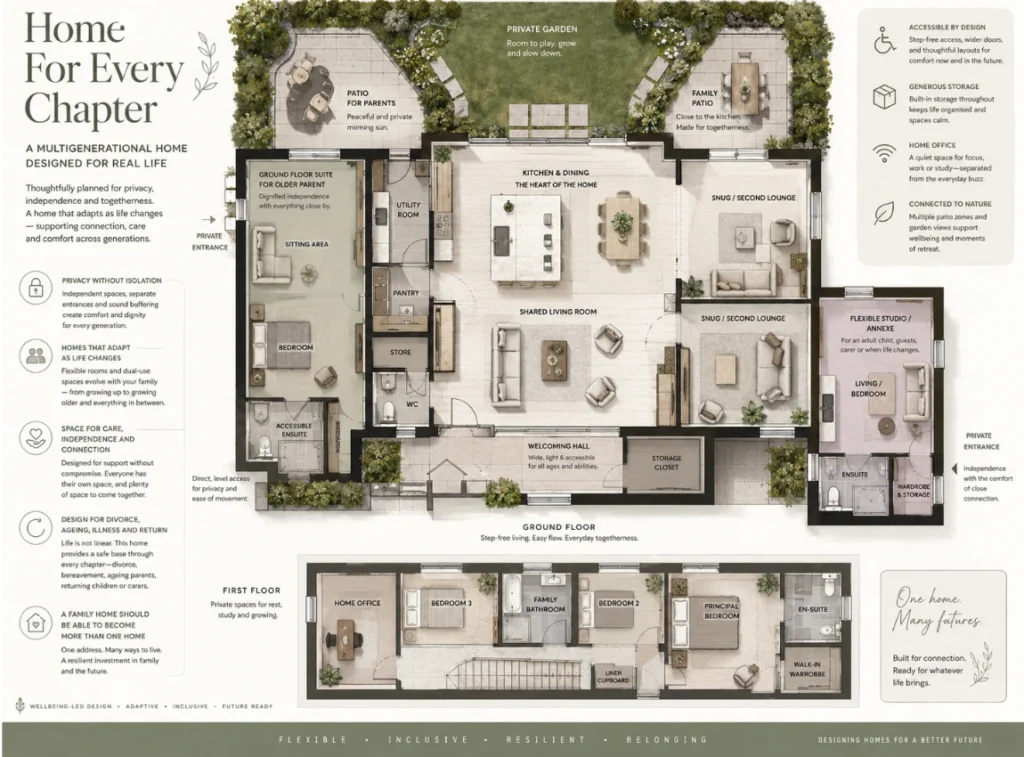
Why are we not building more homes that contain two private living areas connected by a shared heart? Why not create houses with two front doors, separate kitchenettes, flexible bedroom suites and a central garden? Why not design homes that allow a parent and adult child to live alongside one another rather than on top of one another?
Research into multigenerational housing has repeatedly identified the value of separate entrances, additional bathrooms, adaptable living areas and more than one place to cook or prepare food. It has also found that multigenerational households can provide companionship, childcare, financial resilience and greater security in older age, while tensions frequently arise when residents lack privacy, control or a sense that part of the home is truly theirs.
The aim should not be to squeeze more people into conventional houses. It should be to give each generation both connection and retreat.
What other cultures understand about family wealth
In Britain, adulthood is strongly associated with leaving home. Independence is often represented by a separate address, a separate mortgage and a separate set of possessions.
In many other cultures, multigenerational living is not viewed as a temporary failure or last resort. It is a recognised way of organising family, money, care and domestic life.
Globally, extended-family households remain the most common living arrangement, accounting for an estimated 38 per cent of the world’s population.
Across parts of southern Europe, it is normal for young adults to remain within the family home for longer. More than three quarters of people aged 20 to 29 live with their parents in Greece, Italy, Portugal and Spain, although affordability and employment insecurity exist alongside cultural preferences for stronger family interdependence.
Japan has a history of homes arranged with distinct areas or floors for different generations, while Singapore has used housing policy to encourage older people to live close to adult children, recognising that proximity can support both care and family connection. UK housing research has also highlighted American “NextGen” housing models, which provide a connected but semi-independent suite within the main home.
These arrangements are not universally harmonious, nor should we romanticise cultures in which family obligations can become restrictive. But there is something worth examining in the principle of pooling resources rather than automatically dividing them.
Two generations purchasing one thoughtfully designed property may be able to afford more collectively than either could achieve separately. One larger garden may provide more wellbeing than two tiny outdoor spaces. Shared energy systems, maintenance, childcare and transport may reduce costs and environmental impact.
Family wealth could be invested in adaptable space rather than lost repeatedly through moving fees, legal costs, renovations and duplicated household expenses.
The question is not whether everyone should live with their relatives. It is why so few people are given the option to do it well.
A home that can absorb the difficult chapters
Our homes tend to be designed around family milestones, but not family disruption.
They anticipate a couple, followed perhaps by children. They rarely anticipate an adult child returning after divorce. They do not easily accommodate a sibling recovering from illness, a widowed parent, a grandparent who can no longer manage alone or a family member who temporarily needs care.
Yet these experiences are not unusual deviations from life. They are life.
Research into multigenerational households has found that caregiving, financial pressures, changes in relationship status and companionship are all significant reasons families choose to live together. In one US study, a third of adults in multigenerational homes identified caregiving as a major reason for the arrangement, while others cited relationship changes or companionship.
Imagine instead a family home with a ground-floor suite that could begin as a home office, later become a teenager’s den, then an independent apartment for an adult child and eventually an accessible space for an older parent.
Imagine a dividing wall that could be added without major construction. A second external door already incorporated into the elevation. Plumbing positioned so a kitchenette or accessible shower room could be installed later. Bedrooms designed with enough space to support mobility needs. A garden that could be enjoyed without becoming an overwhelming burden.
A well-designed home would not need to predict precisely what happens to a family. It would simply need enough flexibility to respond.
Retirement communities should not become islands
I recently drove past an enormous new development for retired people. It appeared beautifully presented and will probably be expensive to live in. I am sure the homes themselves will be attractive and the communal facilities impressive.
But there was no obvious way to walk into the nearest town.
Residents may have community within the development, but they also risk becoming separated from the wider community around it. Without walkable streets, everyday shops, cafés, schools, workspaces and public life, older people can become concentrated by age and gradually rendered invisible.
There is value in specialist retirement housing, particularly when it provides accessibility, care, security and companionship. But we should be cautious about building later life as a destination removed from everyone else.
A healthy society should not file people into separate developments according to age: young professionals here, families over there, older people behind landscaped gates somewhere else.
New work on intergenerational communities argues that housing, planning and neighbourhood management can actively create opportunities for different ages to encounter and support one another. It also warns that an ageing population and a shortage of age-friendly, intergenerational homes make this increasingly urgent.
Older people should not have to choose between an unsuitable family home and a beautiful but isolated retirement compound.
They should be able to remain visible, useful and woven into daily life.
We need neighbourhoods that allow families to recombine
The answer may not always be one large house.
It could be two smaller homes on the same plot, connected by a garden. It could be adaptable terraces in which adjoining properties can share a flexible room. It could be courtyard developments that mix compact accessible homes, larger family houses and guest suites. It could be modular homes that expand and contract as households change.
It could also mean making it easier to divide existing houses safely and beautifully, creating two genuine homes rather than one family occupying an improvised annex.
Planning policy could encourage homes with future subdivision designed in from the beginning. Developers could offer a multigenerational layout alongside the usual three-, four- and five-bedroom house types. Mortgage providers could create more flexible products for family groups purchasing together. Legal agreements could clearly define ownership, contributions and what happens if one person wants or needs to leave.
Most importantly, we need to stop treating multigenerational housing as a niche.
Research commissioned for the UK housebuilding sector estimated that around 1.8 million British households already contained two or more adult generations, yet the dominant new-build model continued to assume a conventional nuclear family occupying a fixed layout.
The people are already living differently. It is the housing industry that has not caught up.
The family home should be able to become more than one home
My friend who owns a building company recently built a home that he shares with his parents. They live together in a beautiful property, but they each have their own space. He is nearby as his parents grow older, yet nobody has had to surrender their privacy.
That is the distinction we need to understand.
Living together should not require living the same life.
A successful multigenerational home allows family members to choose when to connect. It makes it possible to share a meal without sharing every meal, to help without constantly observing, and to offer care without turning one person’s home into another person’s institution.
It can hold a family through financial difficulty, divorce, illness, bereavement and ageing, not by forcing everyone into permanent dependence, but by making temporary support easier to give and receive.
For decades, we have treated the separate household as the ultimate symbol of success. Every adult should have their own property, their own appliances, their own garden tools, their own bills and their own spare room that is occupied only occasionally.
Perhaps there is another form of prosperity.
Perhaps it is a home large and flexible enough to share, but thoughtful enough to preserve independence. Perhaps it is family money invested collectively rather than eroded across several inadequate properties. Perhaps it is being close enough to care for one another without feeling crowded or controlled.
The return of multigenerational living is often presented as evidence that the housing system is failing younger people.
It is.
But it is also revealing something else: the family home itself has failed to evolve.
The challenge now is not simply to build more bedrooms. It is to design homes that understand privacy, dignity, adaptability and the many different shapes a family may take over a lifetime.
Because children do not always leave permanently. Parents do not remain endlessly independent. Relationships change, health changes and circumstances change.
Our homes should be capable of changing with us.
Filed underConnection, Family & parenting, Home & garden sanctuary

About the author
Rachel BransonFounder & Editor in Chief
With over 30 years in publishing and a background in Naturopathic Medicine, she has made it her mission to challenge mainstream health narratives and empower people to take control of their wellbeing. Now expanding her vision across the Atlantic, Rachel is bridging UK and US audiences with inspiring stories, trusted insights, and pioneering partnerships that align with a new era of health innovation.