Fluoride-Free Oral Care: A Clear-Eyed Guide to What Actually Works
More of us are reading the ingredients on a toothpaste tube the way we already read a food label. For some, that scrutiny ends with a decision: they want fluoride-free oral care. Perhaps it’s a young child who swallows more toothpaste than they spit out. Perhaps it’s a preference for fewer synthetic additives across the bathroom shelf. Whatever the reason, the question that matters is the same — if you take fluoride out, what do you put in its place?
More of us are reading the ingredients on a toothpaste tube the way we already read a food label. For some, that scrutiny ends with a decision: they want fluoride-free oral care. Perhaps it’s a young child who swallows more toothpaste than they spit out. Perhaps it’s a preference for fewer synthetic additives across the bathroom shelf. Whatever the reason, the question that matters is the same — if you take fluoride out, what do you put in its place?
Because here is the uncomfortable truth about most of the fluoride-free aisle: for decades, it simply didn’t work. Charcoal pastes, herbal gels and “detoxifying” powders promised much and protected little. Dentists rolled their eyes for good reason. If you removed the one ingredient with proven cavity protection and replaced it with flavour, you were brushing with hope.
That has changed. There is now a fluoride alternative with genuine science behind it — and understanding it is the key to going fluoride-free without gambling with your enamel.
Why people step away from fluoride
Fluoride works. That deserves saying plainly: it has half a century of evidence behind it, and public-health bodies recommend it because it demonstrably reduces tooth decay.
But it works pharmacologically, and like any active pharmacological agent it comes with dosing caveats. Children under six are advised to use only a smear or pea-sized amount because swallowing too much during the years teeth are forming can cause dental fluorosis — the faint white mottling on enamel. Parents are told to supervise brushing for exactly this reason.
For many households, that’s a manageable instruction. For others — especially those with toddlers who treat toothpaste as a snack — it’s a source of low-level worry at every brushing. Add the growing number of adults who simply prefer to minimise synthetic actives where a well-evidenced alternative exists, and you have a real audience with a real need, not a fad.
The mistake is not wanting a fluoride-free option. The mistake is choosing one that does nothing.
The ingredient that changed the conversation: hydroxyapatite
Your tooth enamel is roughly 97 per cent hydroxyapatite — a crystalline form of calcium phosphate. It is, quite literally, what your teeth are made of. Bone is mostly the same mineral.
Every day, your enamel loses and regains mineral in a quiet tug-of-war. Acids from food and plaque bacteria pull calcium and phosphate out of the enamel surface (demineralisation); your saliva slowly puts them back (remineralisation). Decay begins when the losses outpace the repairs for too long.
Synthetic hydroxyapatite — first developed for dental use in Japan, where it has been an approved anti-cavity ingredient since 1993 — supports the repair side of that cycle biomimetically. Instead of chemically hardening the enamel surface the way fluoride does, hydroxyapatite particles bind to the tooth, fill in microscopic surface defects, and act as a sacrificial reservoir of the very minerals enamel is built from. Under acid attack, the deposited mineral dissolves first, sparing the tooth beneath.
And unlike the herbal hopefuls of the old fluoride-free aisle, this one has been put through proper trials. Randomised controlled studies over the past decade — including an 18-month head-to-head caries trial — have found well-formulated hydroxyapatite toothpastes comparable to fluoride pastes at preventing new cavities. Other studies report repair of early white-spot lesions, reduced sensitivity (the particles plug the exposed tubules that make teeth twinge), and a gentle cosmetic brightening as surface defects fill in. In 2023, the EU’s Scientific Committee on Consumer Safety concluded that nano-hydroxyapatite is safe in toothpastes and mouthwashes at the concentrations used.
Crucially for the families driving this trend: swallowed hydroxyapatite is just calcium phosphate. It is digested like the mineral it is. There is no fluorosis-style dosing anxiety, no supervised-smear arithmetic.
Building a fluoride-free routine that actually protects
Going fluoride-free safely is not about one heroic product. It’s a small system, and each part matters.
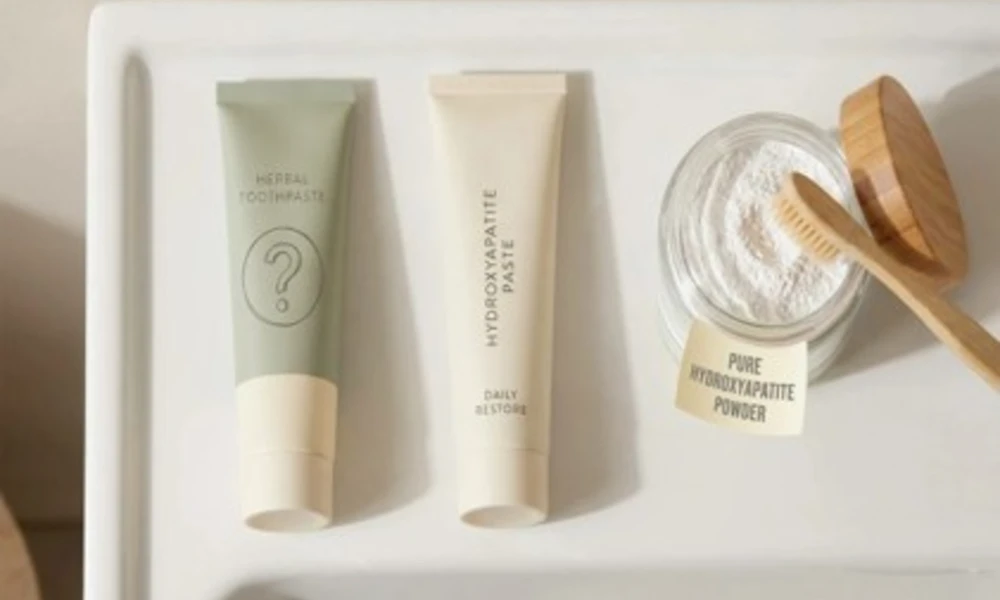
Choose a serious hydroxyapatite product. This is the load-bearing decision. Look for hydroxyapatite named plainly on the ingredient list and positioned as the active ingredient, not a trace addition for marketing. Concentration matters: trials of effective pastes have typically used around ten per cent, which has become the industry’s informal benchmark — many “hydroxyapatite” products contain far less. Formats vary, too. Most people start with a toothpaste, but there is a growing case for pure powder: a handful of specialist makers — such as the European brand Natural Answer Products — supply hydroxyapatite as a 100 per cent pure powder with no fillers, foaming agents or preservatives, which you dip a wet brush into or add to your existing routine. The appeal is transparency: one ingredient, nothing to scrutinise, and you control how much you use.
Keep the mechanics honest. No active ingredient rescues a rushed routine. Two minutes, twice a day, with a soft brush; clean between teeth daily. Hydroxyapatite needs contact time with enamel to bind — so as with fluoride, spit, don’t rinse.
Starve the other side of the tug-of-war. Remineralisation can only win if demineralisation isn’t constant. Frequent grazing on sugary or acidic foods keeps enamel under near-permanent attack. It’s less about how much sugar you eat than how often; give your saliva a fighting chance between exposures.
Keep your dentist in the loop. Tell them you’ve gone fluoride-free and why. A good dentist would rather help you do it well — and monitor your enamel — than have you do it quietly with a charcoal paste that does nothing. If you’re at elevated risk of decay, they may advise keeping fluoride in the mix, and that advice is worth taking seriously.
Fluoride-free oral care: your questions answered
Is fluoride-free oral care safe? It can be — if the routine still actively supports remineralisation. Fluoride-free with hydroxyapatite is an evidence-backed approach. Fluoride-free with nothing in fluoride’s place is simply unprotected teeth.
Does hydroxyapatite really work as well as fluoride? Clinical trials to date have found well-formulated hydroxyapatite products comparable to fluoride for cavity prevention, alongside benefits for sensitivity and early enamel lesions. The evidence base is younger than fluoride’s fifty-year record, but it is real, growing and peer-reviewed.
Is nano-hydroxyapatite safe to swallow? The EU’s Scientific Committee on Consumer Safety reviewed exactly this question and concluded in 2023 that nano-hydroxyapatite is safe in toothpastes and mouthwashes. Swallowed, it is digested as calcium phosphate — the same mineral family found in dairy and in your own bones.
Powder or paste? Paste is convenient and familiar. Pure powder offers a single-ingredient formula with no foaming agents, sweeteners or preservatives, and lets you control the dose — a natural fit for the ingredient-conscious. Either way, the ingredient doing the work is the same one your enamel is made of.
Going fluoride-free used to mean choosing beliefs over evidence. It doesn’t any more. Choose the mineral your teeth already know, keep the routine honest, and your smile needn’t compromise for your principles.
Filed underDental, Cosmetic & aesthetics, Herbal medicine, Family & parenting