
There comes a season in life when time begins to feel different.
Not faster or slower — simply different. The years behind us no longer feel distant, and the years ahead no longer feel abstract. For many, this shift arrives quietly in midlife, not as a dramatic crisis, but as a gentle, insistent whisper: Is this all there is — or is something deeper unfolding?
Midlife has long been framed as a period of loss: the loss of youth, certainty, roles, and momentum. Yet beneath the cultural stereotypes lies a far richer truth. Midlife is not merely a biological milestone. It is a philosophical threshold — a moment when our relationship with time, identity and healing subtly but profoundly changes.
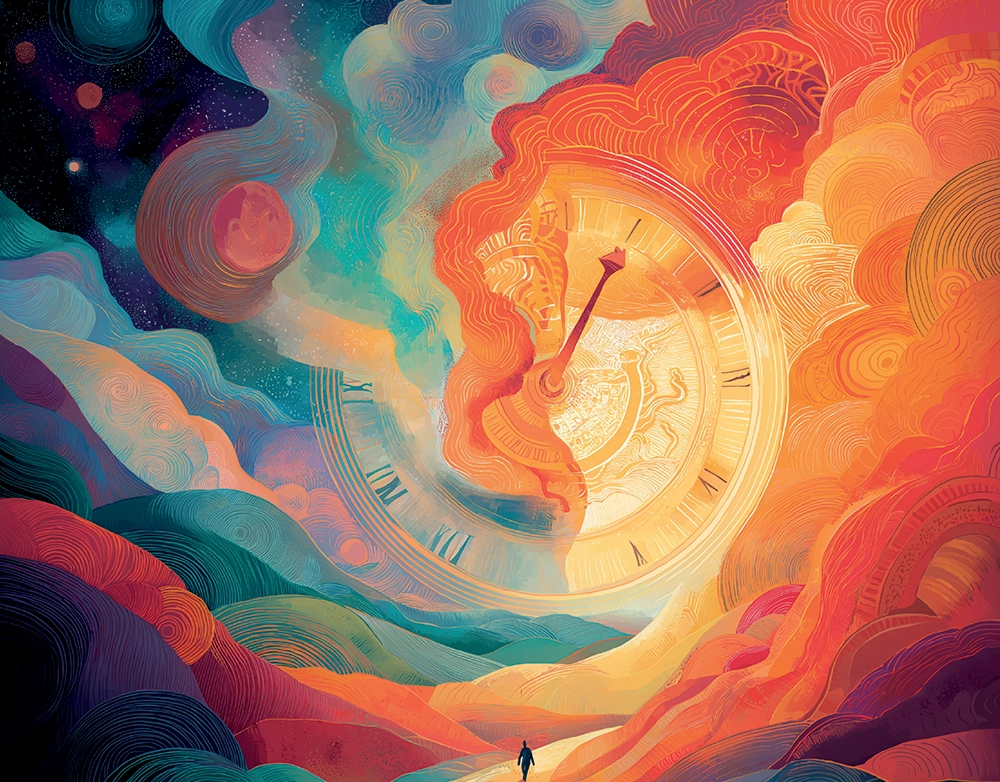
When Linear Time Begins to Loosen
In our earlier years, time feels generous. The future stretches endlessly ahead, full of imagined versions of ourselves. We live with the quiet assumption that there will always be another chapter, another opportunity, another reinvention.
At midlife, that illusion gently dissolves. For the first time, the future becomes finite. The life we imagined, the life we lived, and the life still possible suddenly sit side by side. We begin to sense that time is not just something we pass through — it is something shaping us in return.
Philosophers have long questioned whether time truly flows, or whether only our awareness moves through it. Modern physics, too, suggests that past, present and future may exist simultaneously — that time may be more like a vast landscape than a straight road. While this can feel abstract, its emotional truth becomes unmistakably real in midlife. We feel memories with new intensity. We mourn paths not taken. We re-evaluate the stories we’ve been living by.
Time, once quietly invisible, becomes felt.
The Body as the Keeper of Time
For many, the awakening of midlife is first experienced through the body. Energy fluctuates. Sleep patterns change. Hormones shift. The body, which once seemed to carry us effortlessly forward, begins to speak in subtler — and sometimes louder — ways.
This is not simply decline. It is transition. The body is the vessel through which we experience time, and when the body changes, time becomes visible. In youth, the body hides time. In midlife, it reveals it.
This revelation can feel unsettling. We are suddenly aware of impermanence not as an idea, but as a lived reality. And yet, this awareness carries an unexpected gift: it invites us into a more intimate relationship with ourselves.
The Quiet Identity Death of Midlife
Psychologically and spiritually, midlife often initiates a subtle death — not of the body, but of an identity.
The self we built in early adulthood is shaped largely by adaptation: who we needed to be to belong, succeed, survive and be loved. Roles take centre stage — partner, parent, professional, provider. Ambition and proving carry the momentum.
At midlife, something begins to shift beneath those structures. The old motivations lose their charge. The questions change. No longer “What should I become?” but rather, “Who am I beneath everything I’ve become?”
This can feel like restlessness, dissatisfaction, or a quiet grief that has no obvious name. It may appear as a longing for depth, truth, creativity, solitude or meaning. Many mistake this for a crisis to be fixed. In reality, it is often a reorientation of consciousness.
Midlife asks us not to accumulate more identity, but to gently shed what no longer fits.
Healing in a World Where Time Is Not Linear
One of the most profound insights emerging from both neuroscience and philosophy is that the human nervous system does not experience time in a strictly linear way. This is perhaps most clearly revealed through trauma — where the past is not remembered as “then” but lived as “now.”
Yet healing, too, is non-linear.
We do not heal by erasing the past. We heal by transforming how the past lives within us. Memory remains, but its emotional weight shifts. Identity loosens its grip around old wounds. Behaviour reorganises. The future quietly changes as a result.
In this way, healing does not simply move forward in time; it reshapes time within us. What once defined us begins to inform us instead. The nervous system no longer lives in reaction. The present becomes more spacious. Choice returns.
From a philosophical perspective, this mirrors the idea that while our higher awareness may exist beyond time, our humanity grows through time. Midlife becomes the place where these two dimensions meet — where who we have been encounters who we truly are.
Why Certain Encounters Feel “Fated” at Midlife
It is no accident that many people experience catalytic relationships, sudden losses, or spiritual awakenings around midlife. Psychologically, defences soften. The unconscious becomes more accessible. Life no longer tolerates what is deeply misaligned.
From a non-linear perspective, these encounters can feel strangely inevitable — as if something long waiting within us has finally been activated. Time compresses. Years of patterning meet their turning point in a single season.
These moments are rarely comfortable. But they are profoundly meaningful. They are invitations to evolve beyond the identity that once kept us safe but can no longer let us grow.
The Second Half of Life: From Proving to Presence
In the first half of life, much of our energy goes toward building a place in the world. In the second half, the invitation is different. We are no longer asked to prove our worth — we are asked to inhabit it.
Post-midlife time often feels less urgent, less performative, and more distilled. We begin to value resonance over recognition, depth over accumulation, truth over appearance. We simplify not out of loss, but out of clarity.
This is not a return to youth. It is an arrival into something quieter and more authentic: a self that is less defended, less borrowed, and more whole.
A New Way of Seeing Time
Perhaps the great revelation of midlife is not that time is running out, but that time has always been more mysterious than we imagined. It is not merely a sequence of years to be filled with achievement. It is the medium through which consciousness becomes embodied, through which the soul learns to live.
Midlife is the moment when many of us stop living toward an imagined future and begin living from an encountered truth. The outer world may appear unchanged, yet inwardly, the axis of meaning has shifted.
We are no longer simply moving through time.
We are learning how to inhabit it.
The Subtle Gift of Midlife Awakening
To stand at midlife is to stand at a quiet crossroads. One path leads back toward the familiar, the comfortable, the habitual. The other leads inward — toward the deeper currents that have been calling, often unnoticed, for years.
There is nothing to force here. No reinvention required. Only a willingness to listen differently.
For those who accept the invitation, midlife does not mark a descent into decline — it becomes a passage into coherence. A soft but irrevocable return to self.
And perhaps that is the greatest healing of all: not the removal of pain, but the remembrance of who we are beyond the story of time.