
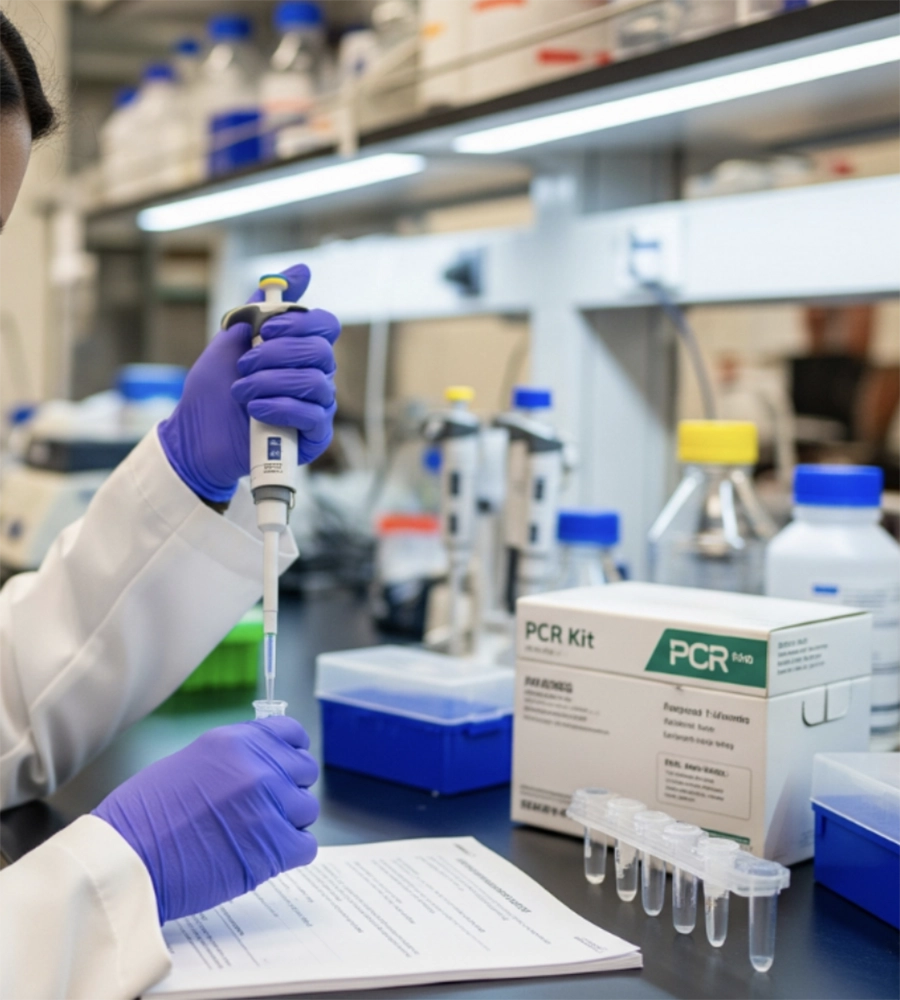
The Polymerase Chain Reaction (PCR) has been described as one of the most important advances in molecular biology, and it is employed as a tool in a variety of fields, such as diagnostics, genetic testing, forensics and food safety. But even with top-of-the-line Polymerase Chain Reaction kits close at hand, the process depends on accuracy and good laboratory habits. Small errors can cause a complete amplification failure, variable data, or incorrect data, respectively.
In this post, we are going to review the top PCR experiment mistakes—and how to do things right!
Inadequate Sample Quality and Preparation
One of the most common sources of PCR failure is poor-quality nucleic acid. Contaminants such as proteins, ethanol, phenol, or salts from extraction buffers can inhibit the DNA polymerase enzyme. This leads to weak or no amplification.
How to avoid it:
- Use validated extraction protocols.
- Check DNA purity with spectrophotometry (A260/A280 ratio ~1.8 for DNA, ~2.0 for RNA).
- Avoid freeze-thawing samples multiple times—aliquot your stock instead.
Contamination in Reagents or Workspace
Because PCR is so sensitive, even small amounts of DNA contamination (whether from aerosols, skin contact, or carryover product) can result in false positives or strange bands on your gel.
How to avoid it:
- Use separate pipettes and filter tips.
- Prepare reactions in a DNA-free, unspotted environment.
- Pre and post-PCR areas should be separate to avoid cross-contamination of amplified DNA into subsequent reactions.
- Use UV irradiation or 10% bleach to sterilize work surfaces.
Incorrect Reagent Handling and Pipetting Errors
Small-volume pipetting is prone to errors, and even minor miscalculations in reagent amounts can skew results. PCR components like MgCl₂, dNTPs, and polymerase enzymes must be precisely measured and thoroughly mixed.
How to avoid it:
- Always prepare a master mix for multiple reactions to reduce variability.
- Use properly calibrated pipettes.
- Mix the solution gently and briefly spin it down to ensure all the reagents are well combined.
False Thermal Cycling Conditions
Even the best PCR reagents won’t work if the thermal cycling program isn’t optimized. The annealing temperature, extension time, and number of cycles all need to suit the template and primers.
How to avoid it:
- Determine the correct annealing temperature using the primers’ Tm values.
- Use a gradient PCR to fine-tune annealing conditions if needed.
- For long targets, increase extension time (generally 1 min per kb).
Using Expired or Degraded Reagents
Polymerases, dNTPs, and other PCR components lose activity over time if they’re repeatedly thawed and frozen or left out of cold storage.
How to avoid it:
- Store all reagents at their recommended temperatures (usually -20°C).
- Do not use reagents past their expiration date.
- Keep separate aliquots of the enzymes to prevent the need of freezing and thawing the whole tube.
Low-Quality Primers or Poorly Designed Primers
One of the most important elements of a PCR reaction is primers. Primer-dimers, non-specific amplification, or no product at all can result from poor design.
Typical problems include:
- Primers’ secondary structures.
- Unsuitable melting points (Tm).
- Complementarity between primers leading to dimers.
How to avoid it:
- Use reliable primer design tools like Primer3 or NCBI Primer-BLAST.
- Store primers at -20°C and avoid repeated freeze-thaw cycles.
Absence of Proper Controls
Skipping positive or negative controls makes it difficult to distinguish between technical failures and true results.
How to avoid it:
- Always include a positive control to confirm the PCR is working.
- Include a no-template control to check for contamination.
- Use them consistently for every batch of reactions.
Wrapping It Up
Although a Polymerase Chain Reaction (PCR) kit is a robust and valid method, it does demand close attention to detail. Small mistakes like incorrect primer design, inaccurate reagent handling, or thermal cycling mishaps can contaminate your results. By understanding and avoiding these common mistakes, researchers can greatly improve the accuracy, reliability, and reproducibility of their PCR-based experiments.