What Nature-Based Settings Actually Do for the Reflection Process
You sit down to think something through: a decision, a loss, a version of your life you're ready to leave behind.
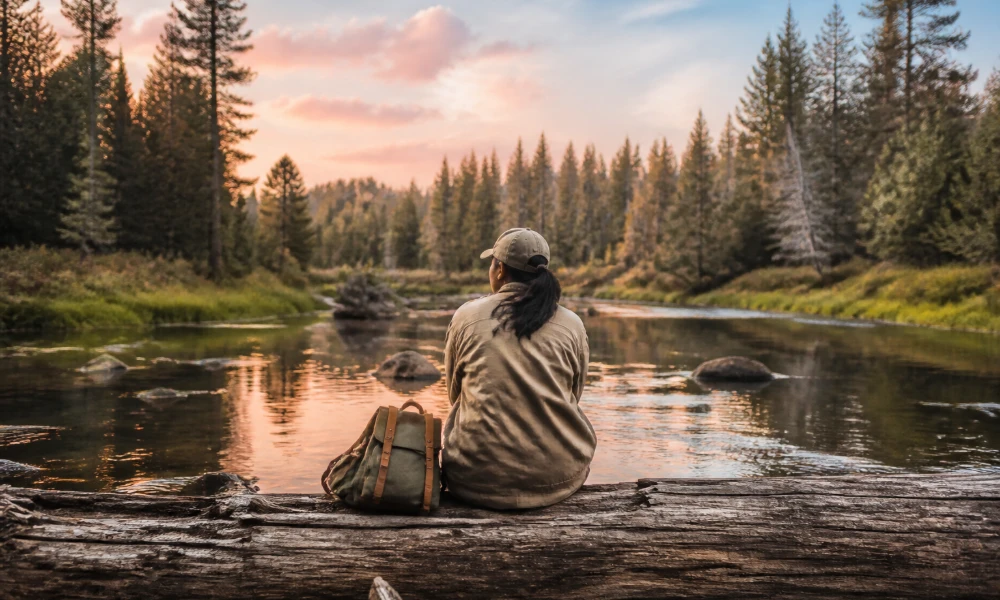
You sit down to think something through: a decision, a loss, a version of your life you're ready to leave behind. The room is quiet, the laptop closed, and the thoughts still circle instead of settling. That's not a willpower problem. Your nervous system reads a room before your mind starts working, and a room built for tasks rarely signals that it's safe to actually feel something.
TL;DR: Nature-based settings lower physiological stress markers, quiet the mental noise that blocks honest self-reflection, and create an openness a closed room rarely produces. Research on attention restoration and outdoor psychotherapy points to the same mechanism: remove the walls, and the mind stops performing and starts processing. That's the science behind why deep reflection work increasingly happens outside instead of at a desk.
Why Your Brain Treats a Forest Differently Than a Room
Your brain runs on something researchers call directed attention: the effortful focus you use to sit still, filter distractions, and hold a hard conversation with yourself. Task-heavy environments drain that resource fast. Natural environments replenish it, the basic claim behind Attention Restoration Theory, first proposed by researchers Rachel and Stephen Kaplan.
The effect shows up in the body, not just in self-reports. A 2019 study on urban nature experiences measured salivary cortisol, the stress hormone, before and after short outdoor sessions. Cortisol dropped fastest during the first 20 to 30 minutes outside, whether people sat or walked, a measurable shift toward the calmer state real reflection depends on.
It's also why the wooded, river-fed settings used at a psilocybin retreat in Oregon aren't a styling choice. They're doing physiological work before a session even starts.
The Setting Changes What You're Willing to Say
Reflection isn't only a mental task. It's a social one too, even alone, because most of us carry an internal audience: the version of ourselves that edits, judges, and performs. Walls tend to reinforce that audience. Open landscapes tend to quiet it.
A qualitative study in Frontiers in Psychology followed clients doing outdoor psychotherapy and found that nature's neutrality- it doesn't judge, react, or interrupt- made people willing to sit with feelings they usually avoid indoors. One participant described a hard emotional stretch the way a marsh moves through a season: uncomfortable, but never permanent. Researchers also noted that walking beside a therapist, rather than sitting across from one, lowered the sense of being watched.
That's the real function of a nature-based setting during reflection work. It doesn't just relax you. It removes the audience.
Why a Few Hours Outside Isn't the Same as a Few Days Immersed
A walk in the park helps. Multi-day immersion does something different: it gives the nervous system enough time to fully downshift and stay there, instead of resetting the moment you're back in traffic. Short breaks make a solid daily habit, but they rarely produce the sustained state needed to work through a major decision or a pattern you've avoided for years.
That's the logic behind structuring reflection work across several days in one setting, rather than a single afternoon outdoors. Confluence Retreats' private 3-day retreats are built around that idea: enough time for the initial restlessness to pass and the real reflection to begin, supported by preparation and integration around it.
What This Means If You're Actually Trying to Reflect on Something
None of this means you need a forest to think clearly. It means the setting you choose does more work than you probably give it credit for. A kitchen table under fluorescent light asks your brain to stay alert and guarded. A trail, a porch, or a stretch of river asks it to soften instead.
If you're facing something that needs real reflection, not a to-do list you're rearranging, the research points to a simple adjustment: change the room, extend the time, and let your nervous system do what it already knows how to do outdoors. The setting isn't decoration. It's part of the process.
FAQs
What makes nature settings better for reflection than indoor spaces?
Natural environments restore the mental focus that task-heavy indoor spaces drain, a mechanism environmental psychologists call attention restoration. Outdoor settings also lower measurable stress markers like cortisol and reduce the self-conscious performance indoor settings tend to trigger.
How long do you need to spend outside before you notice a difference?
Physiological changes start within the first 20 to 30 minutes outdoors. Deeper reflection, tied to a decision or a long-standing pattern, usually needs more sustained time, often hours or several days.
Is nature-based reflection backed by real research, or mostly wellness marketing?
It's backed by peer-reviewed research. Attention Restoration Theory has decades of environmental psychology behind it, and outdoor psychotherapy studies show measurable shifts in stress hormones and how openly people process emotion outside compared to indoors.
How does a psilocybin retreat setting factor into the reflection process?
Legal, supervised psilocybin retreats in Oregon are typically built around remote, natural settings on purpose. The forest or river environment lowers physiological stress before a session begins and supports the open reflection the process is designed around.
Filed underStress & burnout, Women's health & hormones, Counselling & talking therapy, Nature, Retreat