Whenever we’re doing cosmetic dentistry, the shape, size, and color of the final teeth are incredibly important. Yet one of the most common points of confusion for patients is this: What shape should I choose for my veneers?
While the answer is ultimately simple, it can be difficult to arrive at from a patient’s perspective. The goal of any cosmetic dental procedure—whether it’s veneers, composite bonding, orthodontics, or even surgery—is the same: to create a smile that blends naturally and beautifully into the patient’s face.
What we don’t want is for someone’s first impression to be, “Wow, your teeth are really white!” or “Those are some amazing veneers!” If your teeth are the first thing people notice about you, then we haven’t done our job properly.
The Goal: A Harmonious, Balanced Smile
Your smile should be the focus of your mouth—but not so dominant that it distracts from your other facial features. In the ideal interaction, someone sees you, is struck by your beauty, makes eye contact, and notices your harmonious features. Then, when you smile, they might think, “Wow, you also have a beautiful smile.”
That’s the hallmark of good cosmetic dentistry: it enhances your face, not just your teeth. It’s not worth investing in cosmetic treatment if all you get is “nicer, whiter teeth.” It is worth it if the result is a more balanced, beautiful face—where your teeth work in harmony with your lips, eyes, cheeks, and jawline.
Designing Veneers Around You
So how do we decide on the right shape?
It comes down to your face, your personality, and your natural tooth structure.
In nature, people’s teeth develop shapes that reflect their lifestyle and personality. For example:
- Someone with a stronger, more angular face often naturally grinds their teeth more, creating slightly sharper and more square-shaped edges.
- Someone with a softer face and demeanor tends to have rounder, more youthful teeth.
When designing veneers, we use these natural cues to match or enhance your facial aesthetic:
- If a patient has an angular face, we may design their veneers with sharper edges to reflect and support that strength.
- If a patient is softer in appearance and personality, we round those edges to keep the look gentle and harmonious.
- And if someone has a soft face but a bold, confident personality, we may intentionally introduce a bit more edge to the veneers to pull that strength forward.
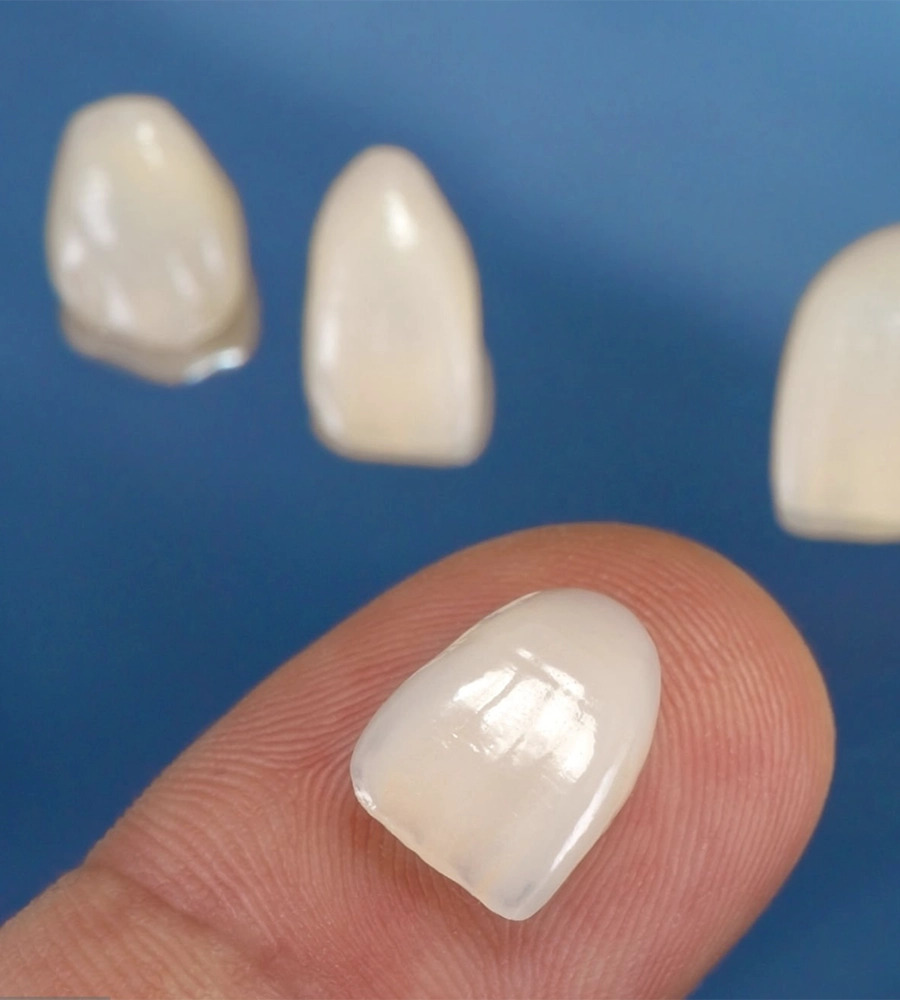
The shape of the teeth also involves how triangular, rectangular, or oval each tooth appears. Typically, we aim to match what the patient naturally had, because the more the veneers look like their real teeth, the more natural the result.
Even if the teeth are a few shades whiter, we still don’t want it to look like they’ve had veneers. This is where translucency and texture come in—details that mimic natural enamel and give life to the smile.
Why Patients Shouldn’t Choose Shape Alone
The truth is: most differences in tooth shapes are so subtle that it’s hard for a patient to decide without seeing it in their own mouth. That’s why we take a collaborative approach.
When we do veneers:
- We first evaluate your face, personality, and natural teeth.
- Then we create temporary veneers that reflect the shape and style we think will best suit you.
- You come back the next day with the temps still in, and we evaluate together.
We can then tweak the shape, length, or contour of any tooth—quickly and painlessly—until you’re thrilled with the look. Most of the time, our experience lets us get it right on the first try. But if not, that’s okay—we’ll adjust until it’s perfect.
Final Control, Beautiful Results
This process gives patients full control over how their smile looks, without requiring them to make abstract design choices before seeing how it plays out on their face.
Because at the end of the day, the goal of a new smile is not just to improve the teeth—it’s to make the entire face more attractive, without drawing attention away from the eyes, lips, and natural beauty of the patient.
Let me know if you’d like to include diagrams or before-and-after photos for visual examples, or if you want this formatted for your website, brochure, or social media post.
- About the Author
- Latest Posts

Dr. Andrew Higgins is a dedicated and highly skilled dentist committed to providing high-quality, patient-centered care. A graduate of Virginia Commonwealth University School of Dentistry , Dr. Higgins further honed his expertise through an Advanced Education in General Dentistry residency in the United States Navy. As a Naval officer, he served seven years delivering dental care to military personnel at home and abroad. After his time in service Dr Higgins practiced in Washington State and Orange County providing general dental care for families as well as quality cosmetic procedure. Most recently he acted as a hospital attending at the Department of Veterans Affairs, continuing his mission of excellence in dental care for fellow veterans.
With a passion for lifelong learning, Dr. Higgins stays at the forefront of the latest advancements in dentistry to offer state-of-the-art treatments. His expertise includes full-mouth rehabilitation, veneers, white tooth-colored fillings, and high-technology dentistry. A strong advocate for conservative dental care, Dr Higgins focuses on minimally invasive techniques to preserve and enhance their patients’ oral health. Above all, he is dedicated to creating a comfortable and stress-free experience for every patient.
Outside of dentistry, Dr. Higgins enjoys weight training, playing piano , and exploring the outdoors with his husband. An avid traveler, he loves discovering new places and cultures. At home, they cherish their time with their three beloved dogs—two Labradors and a Boxer.