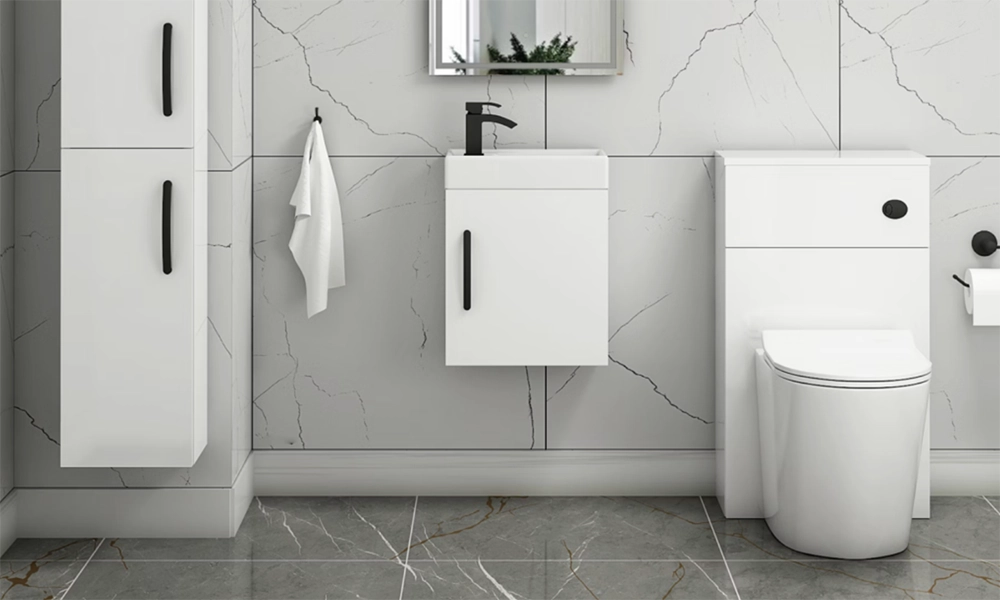
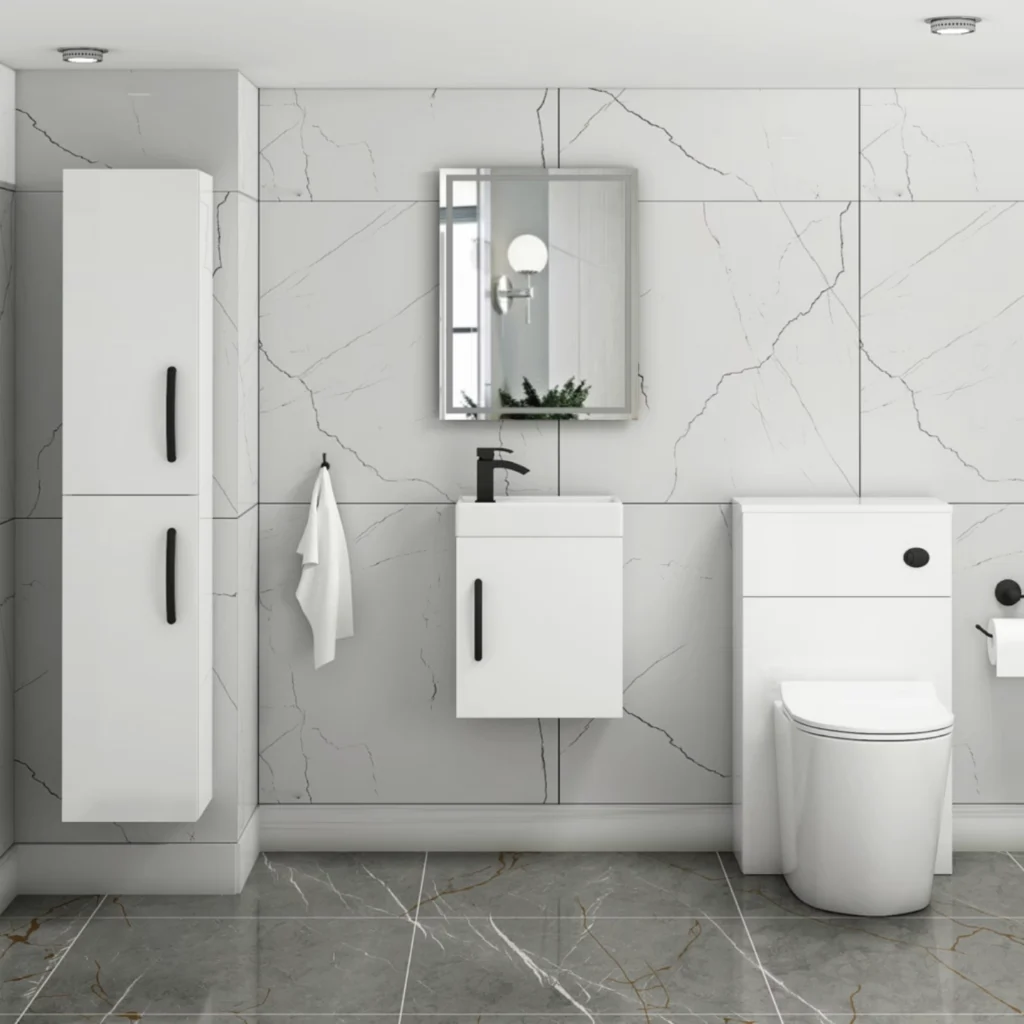
Modern cloakroom vanity units have shrunk significantly without losing functionality. You can now find “Ultra-Slim” units with a depth (projection) of just 210mm and a width of 400mm. These are designed to fit in “dead zones” like the space behind a bathroom door, narrow hallways, or under-stairs cupboards. To maximise the feeling of space, a wall hung vanity unit is recommended, as keeping the floor clear tricks the brain into perceiving a larger room.
In the UK “space” is more than just an aesthetic; it is a financial asset. Whether you are living in a characterful Victorian terrace, a narrow 1930s semi, or a modern “shoebox” new build, every square inch of floor area matters.
For decades, the “downstairs loo” or a cloakroom was a neglected utility space, often housing a bulky, dust-gathering pedestal sink and exposed copper pipes. But as we move to , the trend has shifted. Homeowners are now looking to turn these tiny rooms into “Jewel Boxes”, small, high-impact spaces that blend luxury with extreme functionality.
The secret to this transformation? The Cloakroom Vanity Unit. Thanks to engineering breakthroughs in “short-projection” porcelain, you can now fit a fully functional bathroom storage with sink in places previously thought impossible.
Here are five places in your home where you didn’t know you could fit a vanity unit, and the design “hacks” to make them work.
1-Use Corner Vanity Units to Maximise Under-Stairs Space
Converting the void under the stairs is the #1 way to add value to a UK home. However, the sloped ceiling (the “rake”) usually makes a standard pedestal sink impossible to use without bumping your head. The strategy is to use a corner cloakroom vanity unit that is specifically designed for corners. It works like a charm because by tucking the vanity into the corner where the ceiling height is at its lowest, you free up the “full height” area for the user to stand comfortably. Pair this with a wall-mounted tap. By removing the tap from the basin rim and putting it on the wall, you can use an even shallower vanity unit, saving another 50mm of precious standing room.
2.Install a Cloakroom Vanity Unit at the End of a Hallway
If you have a long, wide hallway that ends in a window or a blank wall, you are sitting on a potential “Micro-Ensuite.” Many UK homeowners are partitioning the final metre of their hallway to create a guest toilet. The side-tap slimline Unit. In a space that is only 900mm wide, a standard sink blocks the walkway. A “Side-Tap” unit is wider than it is deep (e.g., 450mm wide but only 215mm deep). By moving the tap to the left or right of the basin, the unit stays flush against the wall, leaving the hallway feeling open and unobstructed.
3. Fit Wall-Hung Cloakroom Vanity Units in Door Clearance Zones
Open your cloakroom door. Look at the wall it swings toward. In 90% of UK homes, that wall is empty because people assume anything placed there will block the door from opening. The strategy is to use a small wall-hung vanity unit. If you have a gap of at least 250mm between the door frame and the wall, a slimline unit can live there. Because the unit is “hidden” by the door when you first enter, the room feels completely empty and spacious. It is the ultimate “minimalist” hack for a tiny square room.
4. Recess a Cloakroom Vanity Unit into a Stud Wall
If you are building a new partition wall (stud wall) for your cloakroom, you aren’t limited to the surface of the plasterboard. You have a 100mm cavity inside that wall just waiting to be used. Choose the semi-recessed wall-hung unit. You can actually “nest” a wall-hung vanity units into the wall cavity. By sinking the back of the unit into the wall, a 300mm deep vanity suddenly only projects 200mm into the room. This creates a sleek, high-end look usually only seen in boutique hotels. It turns a standard product into a custom architectural feature.
5. Convert Landing Storage into a Cloakroom Vanity Unit Space
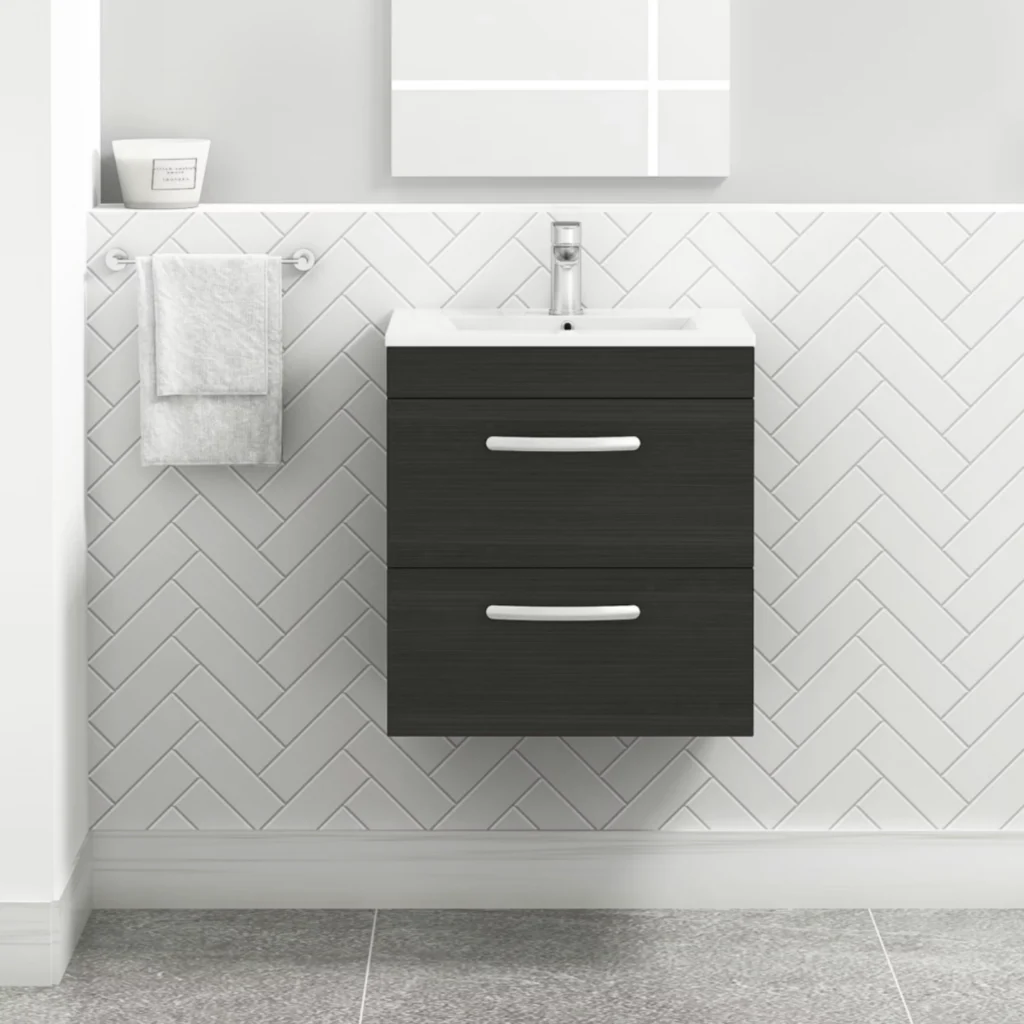
In many 1930s semi-detached homes, there is a small “storage cupboard” on the upstairs landing. As families grow, these are increasingly being converted into a second toilet to solve the 7:00 AM “bathroom queue” crisis. You may prefer a Compact Floor-Standing Cloakroom Unit. While wall-hung is the “king of style,” floor-standing is the “king of convenience” for landing conversions. These units hide the new pipework that has to run through the floorboards, saving you from having to build expensive and ugly “boxing-in” around the pipes. Despite their tiny footprint, these units provide enough storage for 4-6 toilet rolls and cleaning supplies—exactly what you need for a secondary loo.
Comparison: Which Unit is Right for Your Secret Spot?
| Location | Recommended Unit | Min. Depth Required | Best Feature |
|---|---|---|---|
| Under-Stairs | Corner Vanity | 350mm | Uses low-ceiling corners. |
| Narrow Hallway | Side-Tap Slimline | 210mm | Keeps walkways clear. |
| Behind Door | Wall-Hung Slim | 250mm | “Hidden” storage. |
| Stud Wall | Wall-Hung (Recessed) | 150mm (projected) | Boutique hotel look. |
| Landing Cupboard | Floor-Standing | 300mm | Hides messy plumbing. |
Match the Cloakroom Vanity Unit to the Available Space
Why do we almost always recommend a Wall-Hung Vanity Unit for these tight locations? It’s based on a psychological principle called visual floor area.
Your brain calculates the size of a room by looking at how much floor it can see. The moment you place a pedestal sink or a floor-standing cabinet, you break the “line of sight” to the wall. The room immediately “shrinks.” By choosing a wall-hung unit, your eyes see the tiles extending all the way to the skirting board. This simple “floating” illusion can make a tiny $1m \times 1m$ cloakroom feel significantly more breathable and less claustrophobic.
Final Thoughts
Fitting a bathroom vanity into a tiny space is an engineering challenge, which means the quality of the unit matters more than ever. In the humid environment of a small, often poorly ventilated cloakroom, standard MDF units will quickly “blow” and peel.
Look for units with high-moisture resistance and soft-close hinges. Because the unit is small, every detail from the feel of the handle to the finish of the basin—is under a magnifying glass. Invest in a “Jewel Box” piece, and your tiniest room will become your home’s biggest selling point.