Picture a single breath—yours, mine, or that of a stranger born centuries ago. It begins, it ends, and the cycle repeats across billions of lives. What does it mean to exist in this moment between birth and death?
What does it all mean for us—those managing a current physical existence with all the joy and heartbreak it brings? We are wrapped in an amnesic state that focuses our attention on the here and now, preventing us from spending time contemplating who we may have been before or concerning ourselves with the inevitability of death. That’s a remarkable achievement.
Who were you before you were born? Who will you be after you die? The expanse of time surrounding a life is far greater than the duration of a life itself. Will the enormous stretch of time after we die be the same as the vast expanse before we were born?
There are approximately eight billion people alive today, and in just 120 years or less, every one of them will have been replaced. Every one of them will have died. The planet will be filled with entirely new people, and I find that thought profoundly striking.
Where does our sentience come from? We know and understand that we are alive for a very short time, but we don’t know why. Is God an answer? Perhaps, but people have worshipped many gods. Major religions revere different deities, each demanding adherence to distinct social and political structures and issuing different commands for us to live by. They can’t all be the same, yet they cannot truly be different either, as only one belief can be correct, or is that a conclusion borne from a limited understanding of our existence?
We are born into a body that perceives itself as an individual. Our connection with others must be learnt; we even need to discover that we have connections we can use to communicate, relying on senses beyond the obvious. To all intents and purposes though we feel alone—inside our own minds, which can absorb and believe ideas about the world and ourselves that affect how we feel, how comfortable we are, and how happy, content, or settled we might be. The nature of this solitary existence, living within our own minds alongside the difficulty of forming meaningful connections, is a struggle for some.
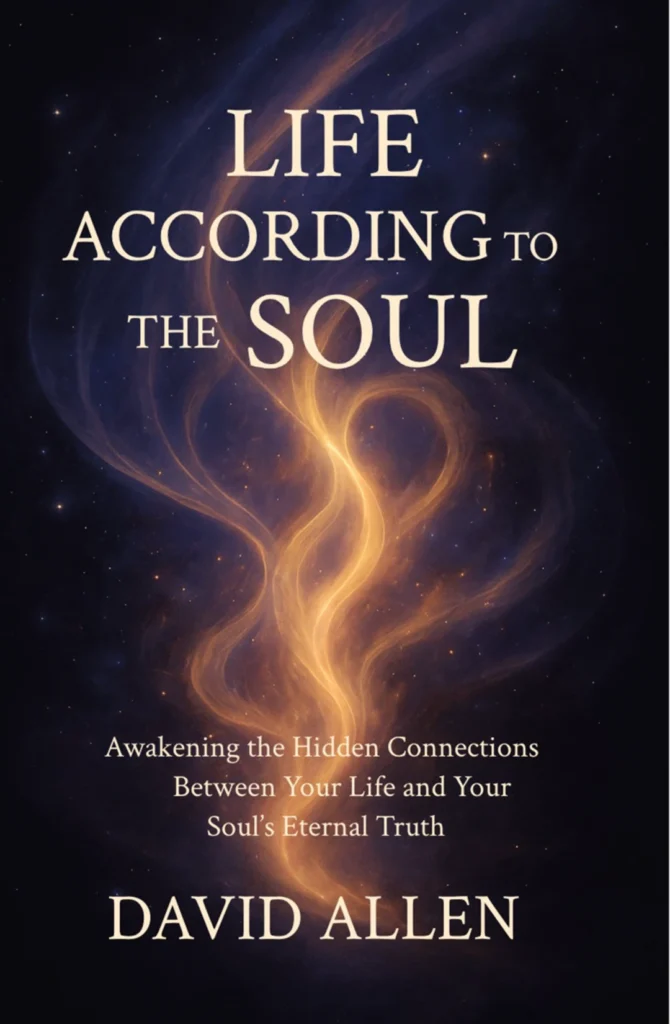
The purpose of Life According to the Soul isn’t merely of academic interest. It’s time for me to build upon the knowledge already out there and show people that we aren’t alone—that the sentience we all possess is the sentience of the soul, with its ability to keep us connected. With such understanding, the traumas of existence become more comprehensible. The isolation of the mind and the relentless loneliness of insulated thought can merge with the connectivity of the soul, putting existence into perspective. These questions have driven my work for decades, leading me to a realization that now compels me to share my findings.
That’s why I decided to write this book now, eighteen years after my investigative work in this area began, and ten years after it concluded. The time feels right. I strive to listen, to acknowledge guidance, to embrace spontaneity, and to heed the inner voice or thought that one morning says, ‘Do this.’ The loneliness of the mind can be eased by the connectedness of the soul, and we can receive guidance and help once we’ve learnt to listen.
These insights come from thousands of hours of testimony—stories of past-life memories, spiritual awakenings, and moments of profound connection shared by ordinary people like you and me. The amnesic state we are born into is superficial, but memory is permanent, woven into the fabric of all existence. By opening a door to the past, people can revisit their memories to reset their perspective, gain understanding, and forge a new relationship between the physicality of human biology—with all its flaws—and the everlasting peace of soul existence.
From these revelations you will learn that we are two moulded into one: a physical human body merged with an immortal soul. The body provides us with physical pleasure and pain, along with the senses of touch, taste, sight, and hearing, and an emotional spectrum driven by how we feel about things—an influence that exerts extraordinary power over our behaviour. Our immortal self provides the higher sentience of life: the awareness of our own existence, our compassion, and our capacity to care and love.
One part of us does indeed die. That extraordinarily complex biological construction returns to dust and joins the earth, mingling with the dust of all who came before. But the sense that we are—that I am—is the part that lives on, in a different form, in a different realm, with a different perspective. When you gaze at the vastness of a cloudless sky, at the millions of stars in an endless universe, and wonder how it all works, the inner understanding of ‘I am’ becomes clearer, if only for a moment—until the pull of physical reality ends such fleeting speculation.
The limitations of textual expression cannot convey emotions or the sense of ‘being there’ that people express. When in a past life, for example, people have the ability to either see the action from a distance as if it were an immersive film or become that person again which can bring with it the physical feelings and sensations as well. Such an example is graphically revealed in Chapter 6, where the most extraordinary feelings of sexuality and sensuality of a man are expressed by a woman, the client in deep hypnosis, when she was incarnated as a man. This is probably the ultimate in experiencing things from a different perspective. It is emotional and genuine expressions such as this that mark these experiences out as truly real.
It seems a long time ago now but in 1968 a practising hypnotherapist and member of the American Counselling Association, Dr Michael Newton PHD and during a quite normal therapy session with a client he began to get responses that pointed to something quite different. There had been some early and isolated reports stemming from 1923, then being brought into popularity by Brian Weiss in the late 1980s, but through the 60s and 70s it was a pretty niche area.
If people can recount experiences of themselves as other people in former lives, then how does a person get from one life to another. For example, If I were to recount a life as a soldier in WW1, or a baker in 1915, or a nurse in 1936 (female) then what happened when that person died and how did I then become to be me, today? Not to mention a million other questions that also arise.
Something stirred in Michael Newton. Enough to stimulate a passion to find out the answers. From 1968 until 1994 Michael focussed on these questions, day after day, session after session and after 26 years and thousands of case studies he published Journey of Souls followed by Destiny of Souls in 2000. The term for what happens between one life, and the next is now called Life Between Lives (LBL).
Michael wanted to document what happens. His work was specifically to build a map and a picture of a spiritual realm. What are souls, what do they do, how are new lives decided, how do souls grow, etc? To properly express that, his books are heavy on his narrative and explanation supported by examples from session transcripts. It’s important to realise that although he declares conclusions in his books, with one, or perhaps two examples from client transcripts, his conclusions are backed by hundreds of examples of the same thing being told to him by hundreds, sometimes thousands of different people. When he describes how the next life is chosen and supports that with an example of testimony from a session, that isn’t the only one. His conclusion and his explanations have hundreds of similar testimonies backing it.
Because his work was exploratory it had to be constructed this way. It’s important that future work adds something as opposed to covering well-trodden ground.
Life According to the Soul has a completely different set of objectives and is structured with those in mind. I wanted to relate the memories and experiences of others in such a way as to connect them to modern everyday life and the traumas and troubles we all must cope with from time to time. In practical terms this means that Life According to the Soul is very light on narrative from me and very heavy on direct transcripts. In essence, I wanted people to tell my readers directly and I only interject to explain if something isn’t automatically clear or to aid the connection between the experience related and your own life.
It is structured to ease the reader into a different world. The process begins with real memories as a rehearsal to recovering spiritual memories and the switch from one to the other is a critical point in the process. It is also exciting and heart pounding as one moved gently from our physical plane to the extraordinary world beyond. It’s a guided journey to understanding yourself and your place in the greater scheme of things.
We truly do have a great deal to learn.
Written By David Allen, Author of Life According to the Soul
- About the Author
- Latest Posts

Our Editorial Team are writers and experts in their field. Their views and opinions may not always be the views of Wellbeing Magazine. If you are under the direction of medical supervision please speak to your doctor or therapist before following the advice and recommendations in these articles.