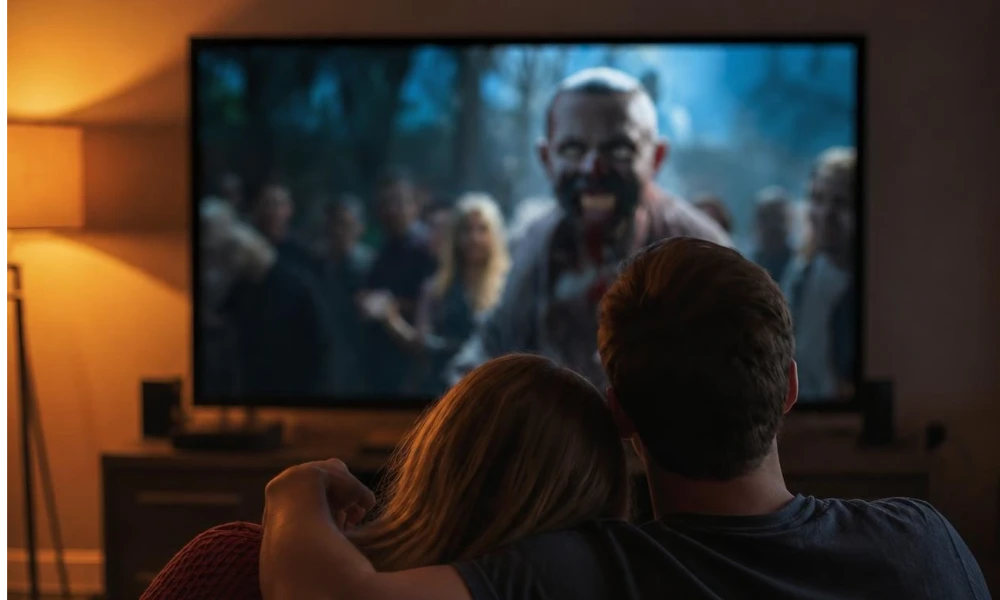
My favourite kind of film? Probably a good rom-com. But I also have a soft spot for zombie-apocalypse films, dystopian dramas and shows like Squid Game. I was a big fan of The Walking Dead too, and there was something strangely addictive about watching characters navigate impossible situations while I sat safely on the sofa with a hot chocolate.
It might seem like an odd combination. One minute I’m watching a predictable love story unfold and the next, I’m completely invested in a fictional world where everyone is fighting for survival. So, what does our choice of entertainment say about us, and why do we crave such different experiences?
Watching films and TV series is more than simply passing the time. The stories we choose can influence our emotions, offer escapism and give us something we need, whether that is comfort, laughter, suspense or excitement.
So, why do we love watching survival stories? Psychology suggests that suspense, controlled fear, curiosity and experiencing danger from a safe distance may all play a part.
A comedy might lift your mood, while a romance can offer comfort and connection. Meanwhile, a thriller provides suspense and a dystopian story can transport you into a world far removed from your own.
Why are we drawn to survival stories?
From zombie films to dystopian dramas, survival stories have a powerful pull. They put characters into situations where the stakes are clear and every decision matters.
Part of the appeal may be controlled fear. When we watch something frightening, we can experience tension and excitement while knowing that we are actually safe. The threat belongs to the characters on screen, not us.
There is also the anticipation of not knowing what happens next. Will they escape? Who can they trust? Who will make the wrong decision?
Suddenly, watching a film or series becomes a little like solving a puzzle. When the frightening scene ends, there can also be a satisfying sense of relief. The tension disappears and your everyday surroundings suddenly feel reassuring again.
There are several reasons survival stories can be so engaging:
– Controlled fear: We can experience tension while knowing we are safe.
– Curiosity: We want to discover what happens next.
– Problem-solving: We try to work out how characters will escape or survive.
– Escapism: The story takes our attention away from everyday concerns.
– Emotional release: The tension can be followed by relief when the danger passes.
Could watching the apocalypse make you more resilient?
Interestingly, my enjoyment of zombie films might not be quite as strange as I thought.
In fact, research published during the COVID-19 pandemic looked at 310 people and explored whether entertainment preferences were associated with psychological resilience and preparedness.
The researchers found that horror fans showed greater psychological resilience during the pandemic. They also found that people who enjoyed “prepper” genres, including zombie, apocalyptic and alien-invasion films, reported greater preparedness.
The researchers suggested that frightening fiction may act as a form of mental simulation. Watching fictional characters face threats could give us an opportunity to imagine how we might respond to difficult situations and practise dealing with uncomfortable emotions in a safe environment.
Of course, this does not mean watching The Walking Dead will prepare you for an actual zombie apocalypse. The research found associations rather than proving that watching these films causes resilience.
Still, it is an intriguing idea.
Why do zombie films keep us watching?
Zombie stories are rarely just about zombies.
Behind the chaos are questions about survival, relationships and human behaviour. Who would you trust if society collapsed? Would strangers help one another? What would you protect first?
The genre also lets us imagine ourselves in an extreme situation without actually having to experience one.
What would I do?
It is an entertaining thought experiment, particularly when you are watching from the comfort of your sofa.
There is also something oddly refreshing about watching characters worry about finding food, shelter and safety when your own biggest problem might be an overflowing inbox.
For a couple of hours, life becomes very simple: survive the zombies.
Why are we curious about frightening things?
Psychologists have explored something known as morbid curiosity, our tendency to seek information about things that are dangerous, unpleasant or frightening.
It might sound rather dramatic, but being curious about the darker side of life does not necessarily mean you want to experience it yourself. After all, humans are naturally interested in things that are unusual, threatening or difficult to understand.
A 2024 study involving 558 participants explored why people enjoy frightening film scenes. Researchers found that fearfulness and morbid curiosity were positively associated with excitement and enjoyment. Interestingly, sensation-seeking was not a significant predictor in their final analysis.
So, enjoying horror does not necessarily mean you are simply chasing an adrenaline rush.
You might just be curious.
What about the rom-com?
This is where my own viewing habits become slightly more complicated.
While survival films give us suspense and uncertainty, rom-coms offer almost the opposite experience. Usually, we know the characters will overcome their problems, find each other and reach some version of a happy ending.
That predictability can be part of the appeal.
After all, sometimes you don’t want to spend two hours wondering who is going to survive. Sometimes you just want a laugh, a bit of romance and a story that leaves you feeling good.
This is where films can become part of our everyday wellbeing rituals. Choosing what to watch can be a small way of responding to how we feel. After a difficult day, a familiar film might provide exactly the distraction or lightness we need.
What does your favourite film say about you?
Perhaps our favourite films do not give us a simple personality profile.
A person who loves horror can still crave a cosy rom-com. Someone who enjoys Squid Game can also want a gentle Sunday-night film. And someone who spends Friday evening watching zombies may simply enjoy a good story, rather than secretly preparing for the apocalypse.
Maybe our viewing choices tell us less about who we are and more about what we are looking for.
Comfort. Excitement. Connection. Laughter. Escapism.
So, the next time you settle down to choose a film, perhaps ask yourself one question:
What do I actually need from this story tonight?
- About the Author
- Latest Posts