I was introduced to artist Sonia Hayes by a friend who suspected we’d “speak the same language.” Within minutes of meeting, I realised her story was far more than an artist’s bio—it was a testimony to courage, intuition and the radical act of learning to trust oneself after life has unravelled. Sonia’s path through grief, complex trauma and cancer has not been a straight line; it’s a spiral—returning to old wounds with new tools, meeting fear with curiosity, and making art as a way to live, not just to survive.
This is Sonia’s story—shared to offer hope to anyone facing a life-altering diagnosis, and to illuminate how creativity, self-advocacy and compassionate boundaries can become medicine for the soul.
The first fracture: a childhood loss that shaped everything
Sonia’s life split in two when she was three. Her twin brother died in a home accident—an unfathomable loss that left her with complex PTSD she couldn’t yet name. “I grew up achieving, masking, pushing ahead,” she says, “but trauma sat under everything like an underground river.”
At university she developed undiagnosed shingles that left scarring and a lingering sense that conventional healthcare didn’t always hold every answer. Years later, recurrent kidney infections kept her on a carousel of antibiotics—until a therapist sent her to a kinesiologist. “It was my first experience of something shifting in minutes after years of struggle,” she recalls. The infections never returned. More importantly, a seed was planted: healing can be multi-dimensional, and self-education matters.
“To make difficult medical decisions, you have to have practiced trusting yourself. That trust is built long before the crisis.”
When illness arrives in threes
Cancer cast a long shadow over Sonia’s family. Her mother faced breast cancer in 2005. In 2018, her sister, Heather, received a rare lung cancer diagnosis; in 2020, her brother was told he had advanced disease. “I moved to the UK from South Africa to be with my sister. I believed deeply that there were things we could do to help her feel better, to live better, to retain dignity.”
Then, in 2021, Sonia received her own diagnosis of endometrial cancer. The timing was brutal: lockdown, caregiving, and an abusive relationship had narrowed her life to crisis management. “It felt like the floor disappeared,” she says. “I was exhausted, frightened—and yet something steady inside me whispered: Choose with your whole self.”
The choice to become an active participant
Sonia’s cancer was low-grade, which gave her time—time to research, to gather a team, to ask second opinions, to explore supportive therapies, and to decide what felt right for her body and mind. “People assume difficult decisions are made in an instant,” she says. “In truth, they’re shaped by years of learning to hear yourself and to back yourself.”
She worked with a trusted homeopath and counsellors, and began to dismantle stressors she could control: leaving a toxic relationship, reducing environmental triggers, addressing long-held trauma, walking daily in nature, meditating, changing products and diet, and creating a home rhythm that nourished her nervous system. She also kept a clear line with oncology for monitoring. “I had to find a way to be responsible, to listen to data, and to listen to my body. That partnership mattered.”
“Everybody had an opinion about what I should do. The hardest work was quieting the noise so I could hear my own.”
Art as medicine, studio as sanctuary
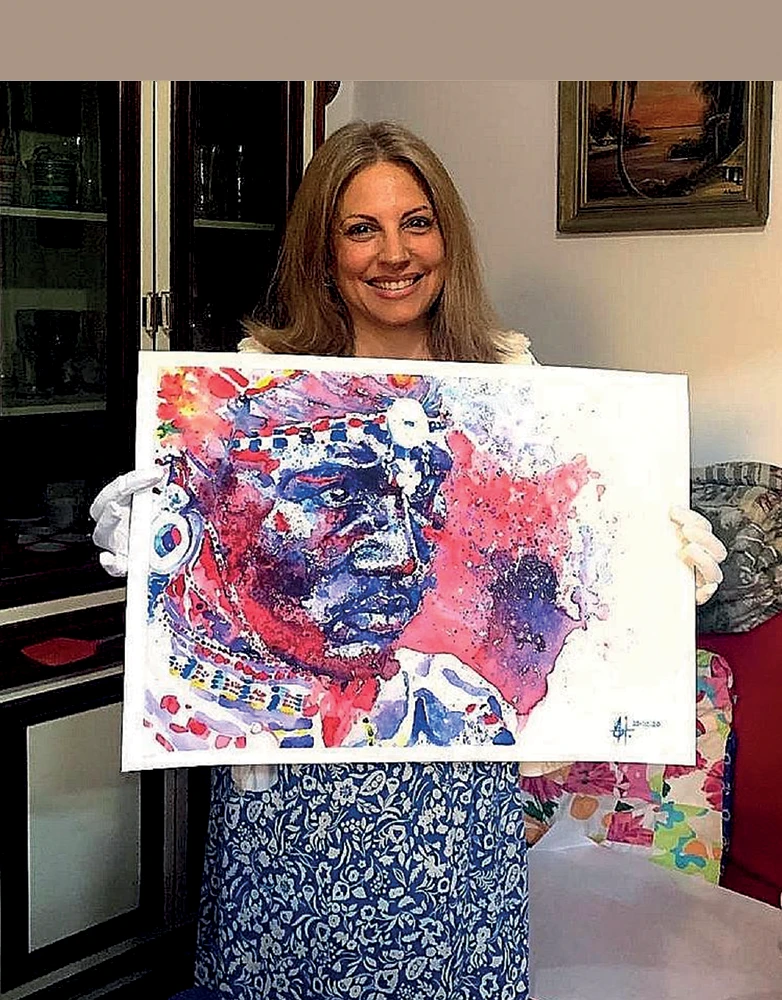
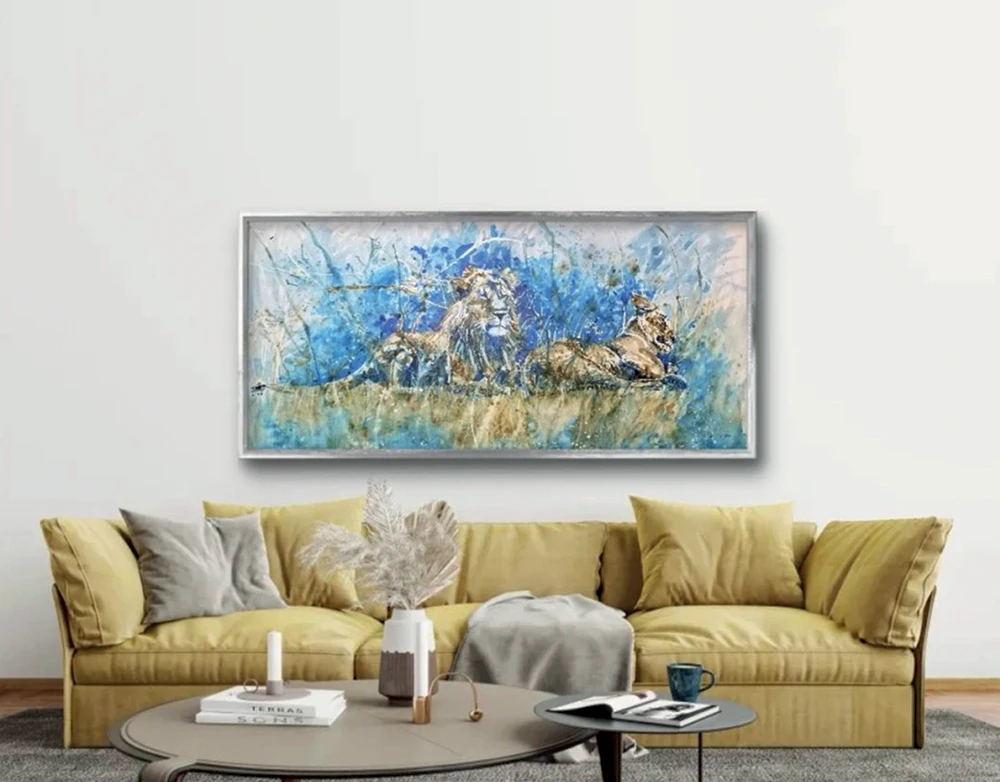
Sonia holds a Fine Art degree, but for twenty years worked as an interior designer. During treatment and recovery, she returned to the canvas—first tentatively, then with soaring commitment. “Every therapist said, ‘Do art.’ It wasn’t a hobby; it was a lifeline. Painting let emotions move through my body when words could not.”
She built a daily practice: mornings in silence, tea, breath, a walk under trees; then the studio—colour, form, and gesture becoming a somatic conversation. “Art helped me meet grief without drowning in it. I painted to metabolise the unsayable—the ache of losing my twin, the sorrow of my sister’s illness, the fear and fury of a diagnosis, the miracle of small good days.”
Love, boundaries, and the courage to edit your life
Healing required Sonia to re-write her personal agreements. “I had to get serious about boundaries,” she says. “In my darkest year, I removed what was making me ill—habits, relationships, expectations, even the way I spoke to myself.” She learned to decline conversations that depleted her, to step away from people who confused aloofness with self-protection, to honour the energy it takes to be an empath in a noisy world.
This editing wasn’t an act of rejection—it was an act of devotion. She created space for slowness, for better sleep, for nourishment and rituals that felt luxurious in their simplicity.
Sonia’s sister, Heather, died last year. The loss is fresh, the love enduring. “Grief taught me honesty,” she says softly. “I don’t pretend strength I don’t have.” She describes friendship now as soul ecology: “We’re not meant to be everything to everyone”
Today, Sonia’s days are humbler—and richer. There’s the kettle, the quiet, the canvas. She teaches occasional workshops and her own work continues to evolve.
“I asked myself a hard question,” she says. “If you had five years, what would you do with them? The answer was immediate: Paint. Love. Walk under trees. Tell the truth. So that’s my compass.”
What helped (Sonia’s practical pillars)
While every path is individual, Sonia’s experience offers gentle, transferable ideas. She emphasises these are personal choices, not prescriptions:
- A collaborative care team. Oncology follow-up and monitoring paired with supportive therapies (talk therapy, trauma-informed work, creativity, nature).
- A nervous-system first routine. Breathwork, slow walks, journalling, regular sleep and meals.
- Creative practice as processing. Painting became structured time to move emotion and reconnect with purpose.
- Healthy boundaries. Reducing exposure to stressors and choosing relationships that feel safe, reciprocal and kind.
- Self-education. Reading widely, asking questions, seeking second opinions, and keeping notes.
- Meaning. Reframing life around what matters: relationships, beauty, service, and the work of the soul.
If you’ve just heard the words no one wants to hear, Sonia offers this:
- Breathe before you decide. Unless there’s an immediate emergency, you can usually take a little time to gather information and ask questions.
- Build your circle. Appoint a friend to take notes in appointments. Seek a second opinion if you need clarity.
- Ask what nourishes you—in body, mind and spirit. Simple rituals—warm food, fresh air, gentle movement, creativity—are not luxuries. They’re scaffolding.
- Protect your peace. Limit conversations that spike anxiety. Curate whose voices you let into the room.
- Let beauty do its quiet work. Music, gardens, galleries, candles, baths, books. Beauty steadies the nervous system and reminds us why we’re healing.
About the Artist
Sonia Hayes grew up in Africa and travelled to the UK regularly to visit her family. This gave her a strong affinity for wildlife and natural landscapes, which has remained central to her work.
DISCOVER: soniahayesart.com