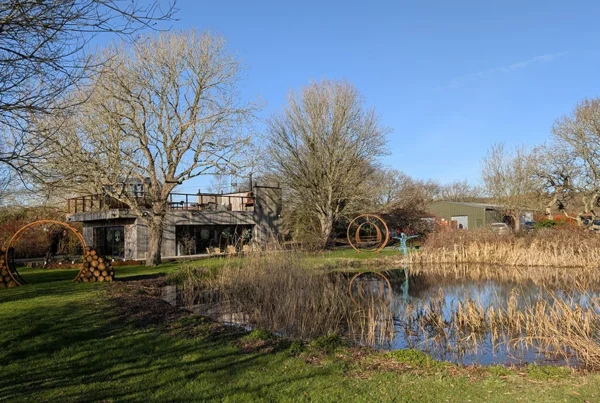
People often imagine an ashram as a place set apart from real life, almost outside of time. Then they arrive and discover something more ordinary, and for that reason more powerful. The bells ring early. Tea is served. Someone sweeps a path. A door opens. Mats are unrolled in the half-light. The day does not announce itself with drama. It simply begins, and by beginning in the same way, day after day, it starts to work on a person.

That is usually the first surprise. Life in a residential yoga setting is not built on grand moments. It is built on repetition. Wake. Wash. Sit. Breathe. Move. Eat. Help. Rest. Return. At home, even people who care deeply about practice often live in fragments. A little yoga when there is time, a hurried meal, a restless evening, another morning already slipping away. In an ashram, the pieces are brought back into relation with one another. The body feels that. The mind does too.
An Ashram Day Begins Before the World Wakes
A true ashram changes the day by changing its order. Before anything else has a chance to scatter attention, there is already a shape to follow. Morning practice usually comes early. Not because early rising is a badge of virtue, but because dawn has its own clarity. The mind has not yet filled itself with noise. The body, stiff and honest at that hour, does not pretend.
From there, the day unfolds with a kind of quiet logic. Meditation may be followed by pranayama, then asana. Meals are simple and taken at their proper time. Work, if it is part of the place, is folded into the rhythm rather than treated as something separate from practice. There may be silence in certain hours, chanting in others, studying later in the day, and evening practice before sleeping.
What matters is not the exact timetable. One center may rise earlier than another; one may give more room to study, another more emphasis to service. What matters is that the hours are no longer random. They begin to speak to one another. A calm morning sits differently in the body by late afternoon. A simple lunch changes the quality of evening practice. A little silence in the day has a way of following a person into the night.
The First Real Change Is Usually Mental
People sometimes expect the body to respond first. They assume they will notice looser hips, deeper breathing, better posture. Those things may come. But often the first real shift is subtler than that.
It happens when the mind realises it is no longer being fed every few minutes. No phone in the hand. No background chatter at all hours. No constant reaching for stimulation because a quiet moment has opened up. At first, this can be surprisingly uncomfortable. Restlessness becomes visible. So does habit. A person notices how quickly thought runs ahead, how often attention slips, how much of ordinary life is lived in mild internal acceleration.
Then, gradually, something softens. The mind does not become blank. It becomes less crowded. It stops flinching toward the next thing quite so often. And because that mental movement slows, the body begins to change as well. Breathing deepens without being forced. Sleep feels heavier and cleaner. Meals land differently. Fatigue becomes easier to recognise before it turns into collapse.
Looking for Yoga Ashram Europe Means Choosing a Rhythm
Anyone searching for yoga ashram in Europe is really choosing more than a location. They are choosing a pace, a tone, and a way of entering practice.
Some places feel rooted in traditional discipline. The day is clearly held, the expectations are simple, and the atmosphere has very little excess around it. Others are gentler in texture. The structure is still there, but it breathes more. There may be more spaciousness in the day, a softer transition between silence and conversation, or a less formal atmosphere around meals and shared life.
This is why the right place is not always the one that looks most beautiful in photographs. It is the one that meets the person honestly. Someone coming in exhausted may need steadiness without severity. Someone else, tired of comfort and drift, may need stronger edges. A good stay is not built on fantasy. It is built on fit. When the rhythm suits the nervous system, practice can begin to go deeper almost by itself.
What Daily Practice Teaches the Body?
The body learns differently when practice is no longer occasional. At home, many people begin again and again. A class here, a pause there, a few good intentions, then a week overtaken by everything else. In a residential setting, the learning becomes continuous. Breath is not rediscovered from scratch each time. The body does not have to remember the practice anew every few days. It stays in conversation with it.
That continuity matters. It is often what allows a person to notice where effort is wasted, where tension is habitual, where movement has been cut off from breath for so long that even simple postures feel strangely new. The benefits, when they come, are not only about flexibility or strength. They are about regulation. Better pacing. Better timing. A quieter response to strain.
That said, a thoughtful yoga environment should never push miracle language. Practice may support balance, steadiness, sleep, mood, mobility, and a more grounded relationship with the body, but it is not a substitute for medical care. Pain, injury, pregnancy, or chronic conditions still require intelligence and adaptation. Serious practice does not ignore limits. It learns how to move within them.
Why Ashram in Greece Feels Different?
There is something about ashram in Greece that many people respond to immediately, even before they can explain it. The light is wider. The air feels less enclosed. The landscape seems to leave more room around thought.
That sense of openness can make a great difference, especially for people who are drawn to yoga but wary of anything that feels too close, too severe, or too heavy with seriousness. In Greece, the setting itself often helps the body unclench. But that should not be mistaken for shallowness. Practice still asks what it always asks: attention, patience, repetition, and the willingness to meet oneself without much theatre.
Perhaps that is why the experience can stay with people so strongly. The days may feel lighter on the surface, but they still carry depth. You wake, practice, eat simply, rest, return. And slowly, without force, a different way of living starts to feel possible.
What Follows You Home?
The real effect of this kind of life is not always obvious while you are still inside it. It may seem, at first, that nothing much is happening beyond a quieter schedule and a few simpler days. Then you return home and notice that something in you has become less willing to rush. You sit down to eat and feel the difference between hunger and habit. You wake in the morning and remember, almost physically, what it was like to begin the day without immediately scattering your attention. The change is rarely dramatic enough to tell as a grand story. It is smaller than that, and usually more lasting.
Perhaps that is why time in an ashram stays with people in such a particular way. Not because it offers an escape, but because it briefly restores a more sensible order between breath, movement, rest, and thought. For a few days, life is no longer chopped into pieces. And once a person has felt that kind of inner coherence, even briefly, it becomes much harder to forget.
- About the Author
- Latest Posts

Our Editorial Team are writers and experts in their field. Their views and opinions may not always be the views of Wellbeing Magazine. If you are under the direction of medical supervision please speak to your doctor or therapist before following the advice and recommendations in these articles.