Marina Efraimoglou: The Healing Vision Behind Euphoria Retreat
Marina Efraimoglou, did not arrive in wellness through hospitality or opportunism, but through illness, self-enquiry, resilience and a profound personal…
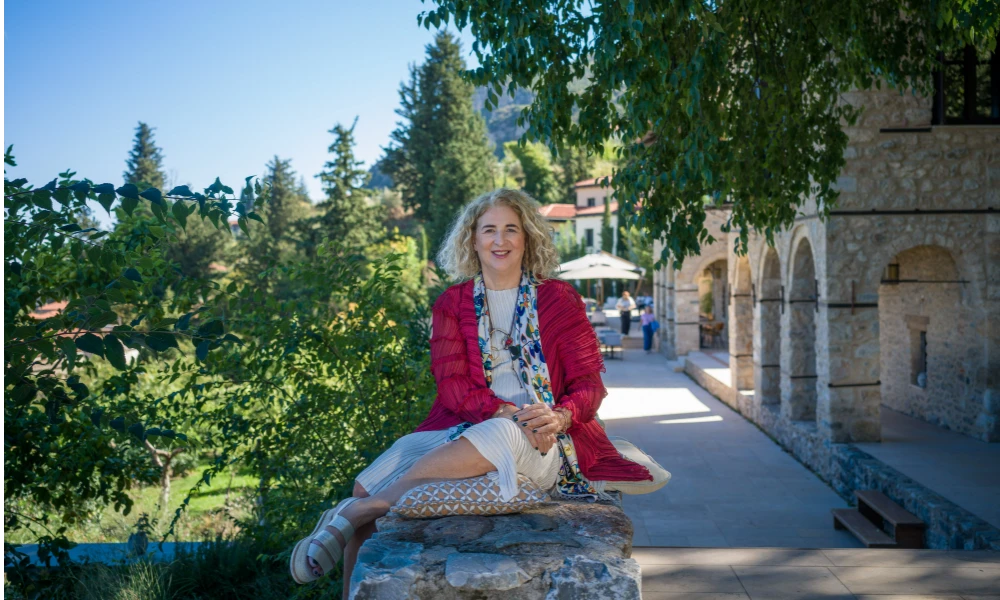
There are some wellness destinations that are created from market trends, and others that seem to rise from something far deeper: a life interrupted, a soul reawakened, a calling that refuses to disappear. Euphoria Retreat, set in the foothills of Mount Taygetus beside the UNESCO World Heritage site of Mystras in Greece, belongs firmly to the latter. Its founder, Marina Efraimoglou, did not arrive in wellness through hospitality or opportunism, but through illness, self-enquiry, resilience and a profound personal search for what it really means to heal.
Born into a large Greek family, the eldest of five children, Marina describes herself as having been raised with expectation, ambition and a certain masculine drive. She was a good student, a good athlete and, by her twenties, a high-achieving woman in the intensely male world of banking and trading. She became a chief trader, married young, and appeared to be following the path of success laid out before her. Then, at 29, everything changed. Marina was diagnosed with non-Hodgkin lymphoma, a diagnosis that came as a devastating shock and one that took her to Memorial Sloan Kettering in New York for experimental chemotherapy.
What followed was not simply a medical journey, but the beginning of an inner awakening. While undergoing treatment, Marina found herself instinctively placing her hands on her body, visualising healthy cells moving towards the cancer cells and imagining illness leaving her body when she was physically sick from chemotherapy. It was not something she had been taught, but something intuitive, almost primal, rising from within. “It brought up a part of me that I didn’t know I had,” she recalls. For a woman who had identified as competitive, determined and Type A, cancer revealed another language: surrender, gratitude, prayer and the possibility of accepting life exactly as it was, while still choosing to live.
That distinction became central to her philosophy. Marina remembers saying, in essence, that she was grateful for the life she had already had and could accept dying, but that she deeply wanted to live. It was not denial, nor was it passive resignation. It was an acceptance of reality combined with the free will to set an intention. Looking back, she sees this as profoundly important. Healing, for her, was never about fighting the body or rejecting what was happening, but about entering into a different relationship with life itself.
During that period, she also experienced an intensity of love and support from family and friends. Her sister was studying in New York, making the practicalities of treatment easier, and the family became very close through the experience. Marina speaks of that time as “bittersweet”, an unusual word for such a frightening chapter, but one that captures her ability to hold pain and grace together. The treatment was brutal, but it opened a door to tenderness, connection and spiritual enquiry that would ultimately redirect the course of her life.
On returning to Greece, Marina did not retreat from business. In fact, with two friends she founded a small investment and securities firm that became one of Greece’s success stories of the 1990s. The company grew, went public, and in 2000 Marina was named Business Person of the Year, becoming the only female CEO of a publicly listed bank in Greece at the time. Yet alongside the professional achievement, another life was unfolding. Because of the cancer, she began exploring detox retreats, fasting, yoga, meditation and ways to rebuild her immune system. She also began giving a percentage of company profits to NGOs, describing the idea as being “a banker with a conscience”.
A turning point came in 1999, when she visited Golden Door in the United States and experienced a more holistic approach to wellbeing, one that included yoga, energy work and deeper inspiration. She knew then that this was what she wanted to do next. Around the same time, the Athens earthquake struck. When the stock market reopened after the disaster, instead of falling, it continued to rise in a frenzy of speculation. Marina watched the greed around her and felt a profound disconnection. “What am I doing here?” she remembers thinking. Within a year and a half, she began stepping away from the banking world.
What followed was a long period of retraining and study. Newly divorced, with time and financial freedom, Marina travelled the world attending workshops and learning from leading teachers. Eventually, her path led her to energy medicine, Taoism and Traditional Chinese Medicine. She became a doctor of Chinese Medicine and began studying Greek mythology and ancient philosophy. With her close collaborator Mary Vandorou, whom she met in 2007, she began creating workshops and retreats that blended the Five Elements of Chinese Medicine with Greek myth, philosophy, movement, meditation and emotional healing. This fusion would later become the foundation of Euphoria Retreat.
In 2007, Marina bought the land that would become Euphoria, though the journey from vision to opening was long and far from simple. Because the site is close to Mystras, a UNESCO World Heritage area, permissions took years, and the Greek financial crisis added further delay. Building eventually began in 2016, and Euphoria Retreat opened in 2018. Marina laughs when people call her patient. “I’m not patient,” she says. “I’m resilient.” The distinction matters. Euphoria was not built quickly or easily, but with persistence, clarity and trust that the energy of the place would not allow the vision to be abandoned.
The location itself is central to the retreat’s identity. Euphoria sits outside Sparta, beside the Byzantine city of Mystras and beneath Mount Taygetus, a mountain long associated with strength, mystery and spiritual presence. Marina speaks of the masculine energy of ancient Sparta balanced by the softer feminine presence of a nearby monastery dedicated to Mother Mary. The land includes pine, cypress and olive trees, with a 250-year-old mansion at its heart. It is not the Greece of beach clubs and whitewashed islands, but a more grounded, mythic, deeply Mediterranean landscape. “The land spoke to me,” Marina says.
There is also something deliberately unpretentious about Euphoria’s relationship with the surrounding village. The retreat borders real life. Within five minutes, guests can walk to the village square, drink coffee, hear people talking loudly, watch locals smoke, laugh and gather. Marina likes this proximity because, for her, healing should never become elitist or detached from ordinary life. Euphoria may be a luxury retreat, but it is not designed as an escape from humanity. It is a place where transformation is meant to be approachable, tangible and possible to integrate once guests return home.
This philosophy is reflected in the way Euphoria treats choice. Alcohol and coffee are available, even if they may not be recommended during certain programmes. Guests are guided rather than controlled. Marina is wary of wellness environments that create guilt, deprivation or intimidation. Her approach is rooted in the ancient Greek idea of freedom with responsibility. The guest is not a patient to be ordered, nor a sinner to be corrected, but a human being invited into greater awareness.
That balance between freedom, science and soul is what makes Euphoria particularly compelling at a time when longevity has become one of wellness travel’s dominant conversations. Marina is not dismissive of technology; far from it. Euphoria’s medical programmes include advanced diagnostic testing, metabolic assessments, blood, saliva, urine and stool analysis, VO2 max testing, glucose and ketone monitoring, biofrequency assessments, heavy metal and mineral testing, ECGs and personalised consultations before guests even arrive. The retreat also uses therapies such as red light, cryotherapy, ozone therapy and the Human Regenerator, a technology combining cold plasma and pulsed electromagnetic fields.
Yet Marina is equally clear that technology must serve the human being, not replace the human journey. She is interested in machines and measurements only when they are genuinely useful, tangible and appropriate for the length and purpose of a retreat stay. She gives the example of hyperbaric oxygen therapy, which she admires, but chose not to install after consulting a leading expert who explained that meaningful medical protocols require a far longer and more intensive commitment than most spa guests could realistically undertake. This discernment is refreshing in a wellness world often seduced by novelty.
At Euphoria, even the most medical programmes are designed to include emotional, energetic and spiritual dimensions. Treatments such as Sanctuary for a Busy Mind, guided meditation, muscular transformation sessions, Chinese Medicine and workshops on the emotional aspects of health sit alongside diagnostics and scientific interventions. Marina believes that metabolic health, stress, sleep, hormones, immunity and emotional patterns cannot be meaningfully separated. The body is not a machine to be optimised in isolation, but part of a larger story.
This is especially relevant in Euphoria’s evolving work with weight loss, metabolic health and those using modern weight loss medications. Marina is interested in supporting people beyond the quick fix, helping them understand how nutrition, exercise, hormones, stress and emotional behaviour intersect. She is particularly passionate about exercise, noting that many high-achieving women and Type A personalities are doing too much of the wrong kind of training, raising cortisol and undermining the very results they seek. The aim is not to overhaul someone’s life overnight, but to identify the two or three realistic changes that can create meaningful, sustainable transformation.
That practical wisdom runs throughout Marina’s thinking. She knows from her own experience that people rarely change everything at once. Lasting wellbeing is more likely to come from inspiration, clarity and small adjustments that can be lived. A guest may arrive exhausted, confused or metabolically out of balance, but the goal is not perfection. It is to leave with a clearer understanding of what their body needs, what their life is asking of them and what simple changes might begin to restore vitality.
In June 2026, this philosophy will be brought to life through the return of Euphoria Retreat’s Wellbeing Festival, Macrozoe: The Greek Path to Longevity. Following the success of last year’s inaugural event, the festival will gather international experts, teachers and practitioners for a rich programme of movement, yoga, biohacking, mindfulness, nutrition, scientific discussion, music, dance and human connection. For Marina, the festival is not simply an event but an expression of what longevity truly means: not merely extending lifespan, but living fully, joyfully and with purpose.
There is something deeply Greek in this interpretation of longevity. Macrozoe is not the cold ambition of “not dying”; it is the art of living well. It includes food, movement, learning, beauty, community, laughter, dance and intergenerational wisdom. Marina’s plans for the festival extend beyond the retreat itself into the local community, with public events including yoga, music, dancing in the village square and a traditional Greek panigiri. She speaks warmly of involving local women and even her 89-year-old mother, a wonderful cook and living example of vitality, in sharing the Greek tradition of treating guests with food, coffee, herbs and hospitality.
This generosity of spirit is perhaps what most distinguishes Euphoria from many modern wellness destinations. Yes, it has diagnostics, doctors and sophisticated technology. Yes, it offers structured programmes, retreats and expert guidance. But beneath all of this is something older and more human: the idea that healing happens in relationship, through care, warmth, myth, nature, nourishment, self-knowledge and belonging.
Euphoria’s Odysseus Journey retreat, particularly timely with renewed cultural interest in The Odyssey, captures this beautifully. Through the metaphor of the ancient hero’s journey, guests are invited to reflect on their own life narrative, their choices, their longings and the way home to themselves. It is a fitting symbol for Marina’s life’s work. Like Odysseus, she has travelled through danger, ambition, loss, discovery and return. Euphoria is not simply the business she built; it is the landscape of everything she learned along the way.
For Marina Efraimoglou, wellness is not a trend, a treatment menu or a performance of purity. It is a lived philosophy, born from illness, shaped by ancient wisdom and refined by modern science. It is the courage to accept reality while still choosing life. It is the discipline to build a business with both heart and structure. It is the humility to know that healing must be personal, practical and free. Above all, it is an invitation to remember that longevity is not only about how long we live, but how deeply, consciously and joyfully we inhabit the life we have.
DISCOVER: euphoriaretreat.com
Filed underCancer, Weight management, Women's health & hormones, Meditation & mindfulness, Yoga & Pilates, Retreat, Connection, Longevity
About the author
Rachel BransonFounder & Editor in Chief
With over 30 years in publishing and a background in Naturopathic Medicine, she has made it her mission to challenge mainstream health narratives and empower people to take control of their wellbeing. Now expanding her vision across the Atlantic, Rachel is bridging UK and US audiences with inspiring stories, trusted insights, and pioneering partnerships that align with a new era of health innovation.