Mounjaro and Wegovy worked. Now what about the loose skin?
GLP-1 medications like Mounjaro and Wegovy produce rapid weight loss that often leaves loose skin on the abdomen, arms, and inner thighs. A practical look…

For the first year of the GLP-1 boom, most of the conversations in dermatology offices were about facial hollowing, the thing the press has been calling Ozempic face. That part is still happening. The newer wave of conversations is about the body: patients who dropped 30, 50, sometimes 80 pounds on semaglutide (Wegovy, Ozempic) or tirzepatide (Mounjaro, Zepbound), and are now looking in the mirror at upper arms, abdomens, and inner thighs that did not snap back the way they hoped.
It is not a complication, exactly. It is, however, a predictable downstream effect of rapid fat loss, and for a lot of patients it shows up at the same time their primary care doctor is congratulating them on their A1C.
Why the skin sags
When fat is lost gradually, over years, the dermis and the elastic structures underneath it usually have time to retract along with it. The mechanism is not perfect, especially after 40, but it tends to keep up. Rapid loss, the kind GLP-1 medications produce when the patient responds well, does not allow that adaptation. Subcutaneous fat compartments empty out faster than the overlying skin can remodel.
The pattern is well documented in the bariatric surgery literature, which has been studying this for two decades. The majority of patients losing more than fifty pounds rapidly develop clinically significant skin redundancy somewhere on the body, with the abdomen and upper arms as the most common sites. GLP-1 patients are now hitting that same threshold without the surgery, and at scale.
Where it shows up
The skin compartments that lose fat earliest also show laxity earliest:
- Abdomen. The lower abdomen and flanks usually show the most visible change. Skin that was stretched over abdominal adiposity for years often remains stretched even after the underlying volume is gone.
- Upper arms. The "bat wing" presentation, especially from the elbow up to the mid-bicep, is one of the most common complaints from this patient group.
- Inner thighs. Skin laxity here is functional as well as cosmetic, since chafing increases when loose skin folds touch.
- Face. Volume loss in the malar (cheek) and temporal areas is the well-known Ozempic-face presentation. This is technically a different problem, volume loss rather than skin redundancy, and tends to be addressed with biostimulators and fillers rather than tightening devices.
For the body areas, exercise does not help. Strength training rebuilds the muscle underneath, which can make the contour look better, but it does not address the loose skin envelope itself. Topical creams have no plausible mechanism for the depth involved. The options that do work are either surgical (excision, brachioplasty, abdominoplasty) or energy-based.
The case for non-surgical body tightening
Surgical excision remains the most definitive intervention when laxity is severe. For mild to moderate cases, which is where many GLP-1 patients land, especially those under 50, non-surgical energy devices have a real role.
The category breaks into three rough buckets:
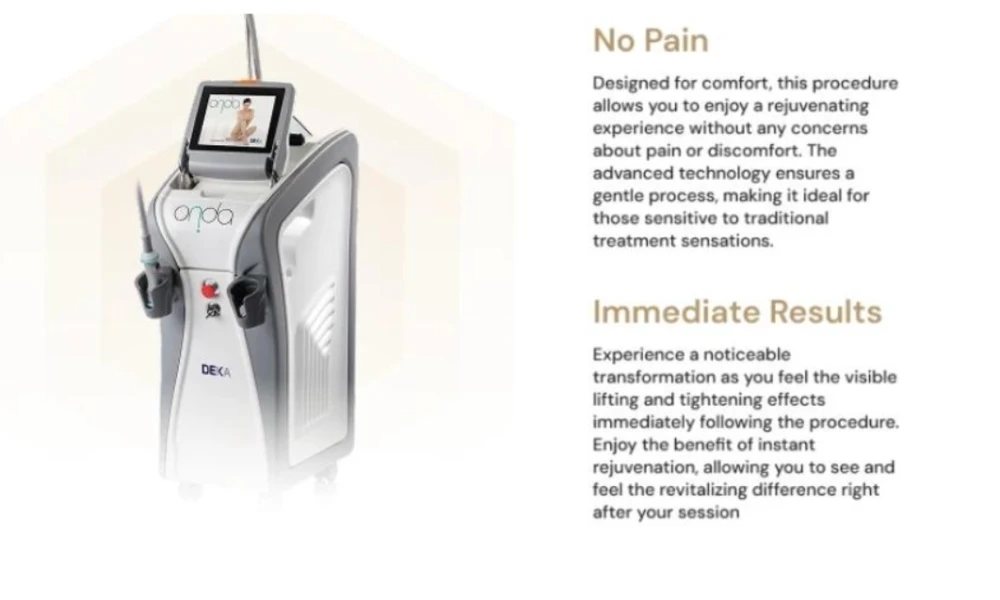
- Microwave-based devices, like Onda from DEKA, deliver electromagnetic energy in the 2.45 GHz range to subcutaneous tissue at a depth of roughly 1.5 cm. The energy targets both the fat layer and the overlying dermis, with thermal effect that triggers collagen contraction and remodeling over the months after treatment.
- Monopolar radiofrequency, like Thermage FLX, heats the dermal layer through capacitive coupling. It is widely used on the face and works on the body as well, particularly for laxity that sits closer to the skin surface.
- Microfocused ultrasound (MFU-V), like Ultherapy, targets deeper structures and is primarily a facial lifting device. It is not the right tool for body laxity in most cases.
Of the three, Onda is getting the most attention for post-weight-loss body laxity specifically, because its energy depth and dual fat-plus-dermis effect line up with what GLP-1 patients present with: emptied subcutaneous compartments under skin that needs to contract.
How Onda treatment actually works
A typical Onda protocol for body skin laxity runs three to four sessions, spaced four to six weeks apart, with each session lasting between thirty and sixty minutes depending on the area treated. The patient feels intermittent warmth during the treatment. Most people do not describe it as painful, though they do describe it as distinctly warm. A cooling handpiece manages the surface temperature.
Downtime is minimal. Patients usually return to normal activity the same day. Mild redness in the treated area for a few hours is common, occasional bruising can happen, and a small percentage of patients experience transient nodules under the skin that resolve over several weeks.
Results build gradually. Initial tightening is sometimes visible within four weeks, but the meaningful collagen remodeling unfolds over three to six months as the dermal response matures. This is one of the areas where patient expectations need to be managed carefully. Anyone expecting a same-day result is going to be disappointed.
Pricing varies considerably by region and by area treated. In Seoul, where the procedure is widely used as part of structured post-weight-loss programs at clinics that have published this kind of protocol, single-session pricing for an area such as the abdomen typically falls in the mid three-figure USD range, with package pricing for the full multi-session course. Clinics with documented practice in this specific patient profile, such as the microwave-based body skin tightening protocols at a Seoul dermatology clinic, often combine Onda with adjunct modalities depending on whether the patient also has facial volume loss.
When Onda is not the right answer
Honest clinical practice means acknowledging where this category of device falls short.
The first situation is severe laxity. If a patient has lost eighty or a hundred pounds and is presenting with skin redundancy that hangs in folds, no energy device is going to produce a result comparable to surgical excision. The realistic role of microwave or RF tightening in those cases is sometimes as a pre-surgical optimization, sometimes as a post-surgical refinement, but not as a primary intervention. A consultation with a board-certified plastic surgeon, in parallel with the dermatologic consultation, makes sense early.
The second situation is active weight loss. Treating skin that is still going to change is treating a moving target. Most experienced clinicians want the patient to be weight-stable for at least eight weeks, ideally three months, before starting an energy-device course. This is a frustrating conversation to have with someone who has finally arrived at the body they wanted. The result of treating too early, though, is often a second course six months later when the contour has shifted again.
The third situation is patients with deeper structural issues, such as significant diastasis recti or true ptosis after pregnancy plus weight loss. These cases need surgical assessment, not device-based optimization.
Patients who present with combined face and body laxity, which is increasingly common in the GLP-1 era, are usually best served by a coordinated plan that addresses each region with the appropriate modality. A post-GLP-1 facial and body recovery protocol from a Seoul board-certified dermatologist typically sequences biostimulators or fillers for the facial volume loss, monopolar RF or MFU-V for facial laxity, and microwave devices like Onda for the body areas, with treatment intervals chosen to allow the collagen response in each region to mature before the next intervention.
What to ask at the consultation
A few questions worth raising when seeing a dermatologist about post-GLP-1 skin laxity:
- What is the actual depth of effect of the device being proposed, and does it match the layer where my laxity sits?
- Am I weight-stable enough to be treated now, or should we wait?
- How many sessions are realistic for the result you would expect in my case?
- What does the side-effect profile look like for my skin type?
- If the result is incomplete, what is the next step: more sessions, a different modality, or a surgical referral?
A clinician who answers these directly, including the parts that involve being honest about the device's limits, is usually a better partner than one who promises a complete result from a single course.
The bigger picture
GLP-1 prescribing volume keeps climbing year over year, and aesthetic dermatology is going to see this patient profile in growing numbers for at least the next several years. The clinics that will serve these patients well are the ones that have honest protocols, that combine devices appropriately, and that are willing to send patients to surgery when surgery is the right answer. The ones that try to treat everything with whatever device they happen to own are going to produce a lot of disappointed patients.
For the patient who has done the hard work of losing the weight on a GLP-1 medication and is now staring at an arm or an abdomen that has not followed along, the realistic message is this. There are options. The options work better when they are matched to the specific pattern of laxity. And a consultation with a clinician who treats this presentation regularly is the right first step.
References
- Bariatric surgery literature on post-weight-loss skin redundancy (Obesity Surgery and related journals, multiple studies over two decades).
- US Food and Drug Administration. 510(k) clearance documentation for the DEKA Onda Coolwaves system, body contouring indication.
- American Society for Laser Medicine and Surgery and American Academy of Dermatology practice positions on non-invasive body contouring and skin tightening devices.
Filed underWeight management, Cosmetic & aesthetics