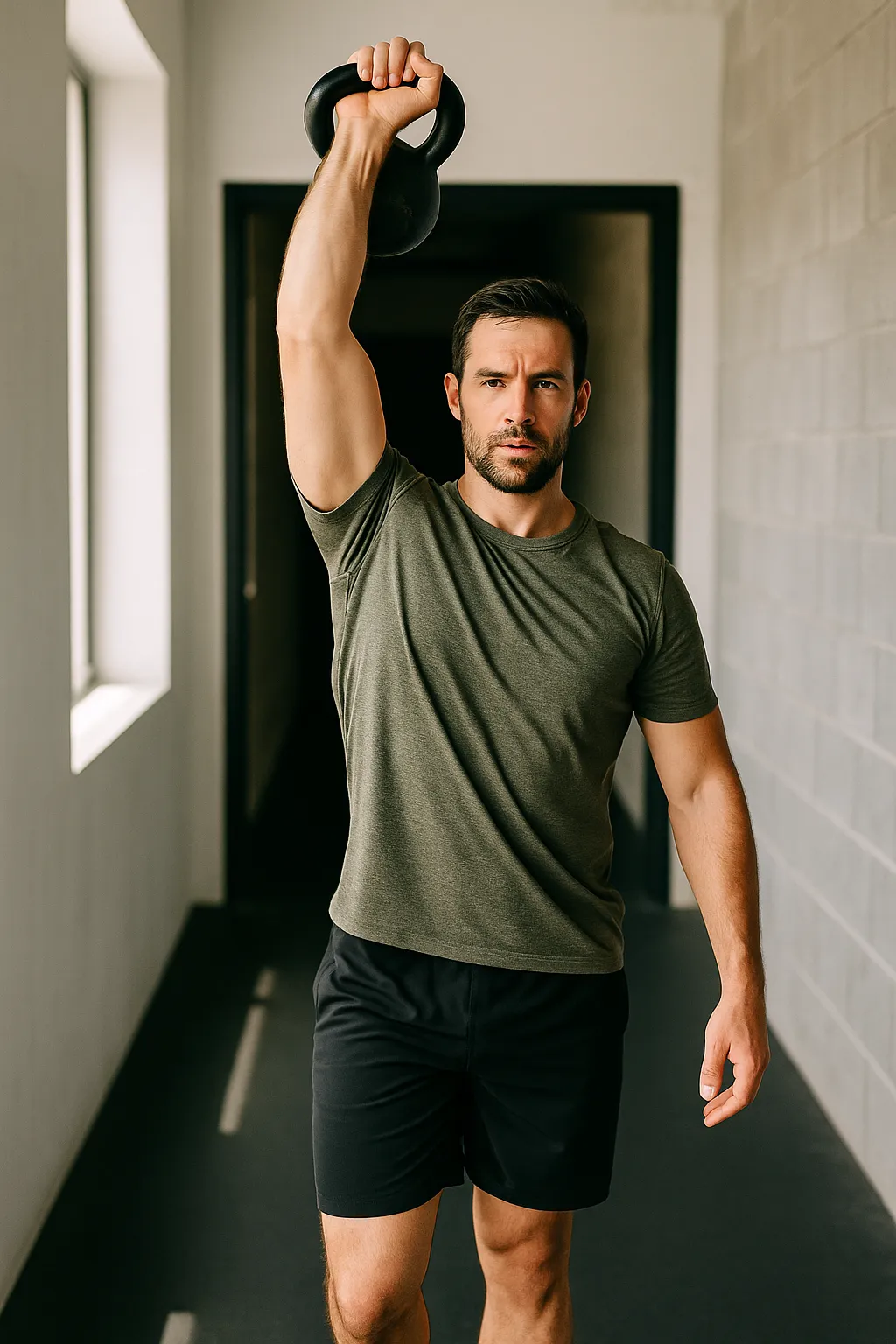
When it comes to functional strength, few exercises offer the total-body benefits of the overhead carry. It’s not just about walking with weight overhead — it’s about moving with intention, precision, and control.
This seemingly simple exercise challenges your core, shoulders, posture, and mental focus in every rep.
What Is the Overhead Carry?
The overhead carry involves holding a weight overhead — dumbbell, kettlebell, barbell, or sandbag — and walking a set distance or time. It’s used in strength training, rehab, and athletic conditioning for good reason.
Benefits of Overhead Carries
- Improves Shoulder Stability
Supports rotator cuff health and strengthens stabiliser muscles often neglected in pressing movements. - Enhances Core Strength
Resisting spinal extension and rotation under load builds serious core integrity. - Reinforces Posture
Teaches alignment — a stacked rib cage over pelvis — and reduces slouching. - Boosts Grip and Focus
Gripping and balancing overhead weight forces concentration and hand strength. - Carries Over to Real Life
Lifting kids, storing luggage, moving boxes — it’s all easier with strong overhead control.
How to Do It
- Choose a moderate weight: You should be able to maintain overhead lockout for at least 30 seconds.
- Engage your core: Ribcage down, glutes on, eyes forward.
- Walk with small, controlled steps: Avoid overstriding.
- Keep the arm fully extended and shoulder packed.
- Start with 3 sets of 20–30 metres per arm (if unilateral).
“The overhead carry doesn’t just build strength — it builds presence.” — Wellbeing Magazine
Variations to Try
- Single-arm kettlebell carry: Trains anti-rotation and balance.
- Double dumbbell carry: Even loading; great for total-body strength.
- Barbell overhead walk: More technical but great for strength athletes.
- Bottoms-up kettlebell carry: Adds a grip and stability challenge.
Where It Fits in Your Training
Use overhead carries as:
- A warm-up primer for pressing days
- A conditioning finisher
- A movement break during long sedentary periods
Explore more ways to build real-world strength in our Body section.
- About the Author
- Latest Posts

Richard Branson is a fitness and wellbeing enthusiast with a passion for HYROX, cycling, and technology. He shares insights at the intersection of performance, wellbeing, and innovation.