Why Unstructured Outdoor Play Is Essential for Children's Mental Health
Children's mental health has become one of the most talked-about topics in parenting, education, and medicine over the past decade, and for good reason.…
Children's mental health has become one of the most talked-about topics in parenting, education, and medicine over the past decade, and for good reason. Rates of anxiety, depression, and emotional dysregulation in kids are climbing. One contributing factor consistently turns up in the research, and it's one that families can actually do something about at home.
The connection between play and mental health
A study published in the Journal of Pediatrics found that the rise in mental health disorders among children and teens is closely tied to a decades-long decline in opportunities for independent, self-directed play away from adult oversight. The researchers concluded that although well-intentioned, the drive to guide and protect children has gradually stripped away the kind of independence that healthy development actually requires.
That finding points not just to screen time or academic pressure as the culprits, but to the loss of something more fundamental: the freedom to play without adult direction.
What unstructured actually means
Unstructured play is play that children direct themselves. No coach, no curriculum, no parent narrating what's happening or suggesting what comes next. It's the kind of play that happened naturally for previous generations in backyards and parks, with little adult involvement.
The psychological benefits of regular physically active outdoor play are well established. Better mood, fewer symptoms of anxiety and depression, lower fatigue, and improved sleep quality all show up consistently in the research. What makes unstructured outdoor play particularly valuable is that it delivers these benefits while also building something that screens and organized activities can't: a child's sense of agency over their own experience.
The anxiety connection
Research from the Kids Mental Health Foundation has found that outdoor time reduces symptoms of anxiety and depression in children, improves focus, and builds emotional resilience. Perhaps more surprisingly, researchers have also found that overly safe and heavily supervised play environments may actually contribute to increased anxiety in young people rather than reducing it.
This is counterintuitive for many parents. The instinct is to protect children from risk, but the evidence suggests that managed risk in play is part of how children learn to regulate fear and build confidence. A child who has climbed something difficult and made it to the top carries that experience forward. It becomes internal evidence that they can handle challenges, which is precisely the resource that anxiety depletes.
Emotional regulation starts outside
Studies have shown that after engaging in unstructured outdoor play, children demonstrate improved attentional control in subsequent classroom sessions compared to children who had indoor play sessions of the same length. The self-directed nature of outdoor play supports the development of emotional skills, including empathy, cooperation, and positive interaction with others.
The implications for the school day are significant, but the daily pattern at home matters just as much. Kids who have regular access to unstructured outdoor play tend to be calmer after school, easier to manage indoors, and better able to handle frustration without it escalating.
What the backyard can do that organized activities can't
Organized sport and structured classes have genuine value, but they don't replace unstructured play because they don't offer the same conditions. A child at training is following instructions.
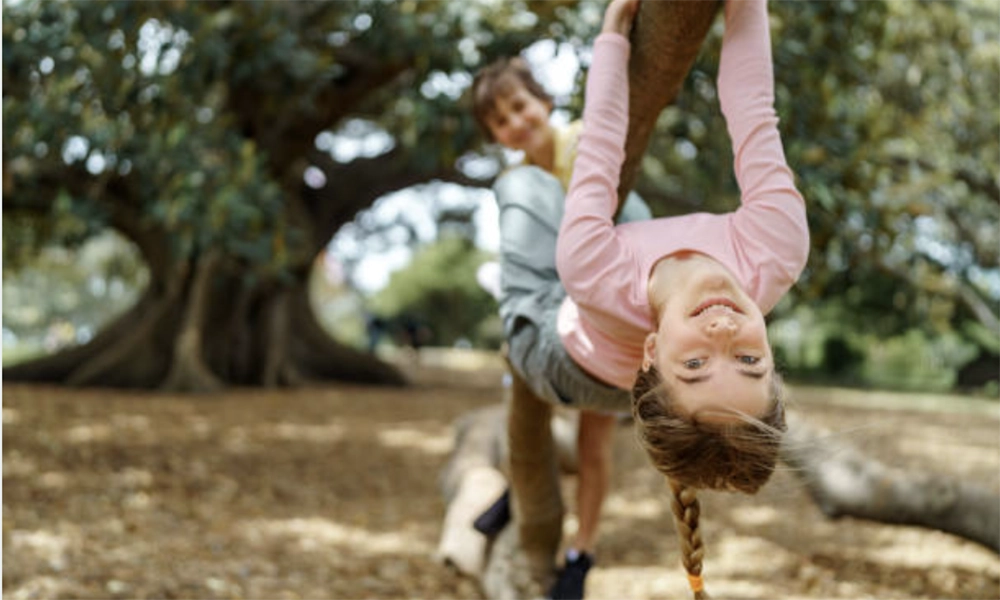
A child alone in a backyard with a climbing frame is making all their own decisions. That distinction is where the mental health benefit lives. You can’t get much better than jungle gyms for outdoor play when you want to create an environment for independent, self-directed play. Vuly Play has some of the best jungle gyms out there! Their range of climbing equipment is designed with exactly this in mind, with options that suit different ages and yard sizes.
They offer enough physical challenge to hold attention and enough open-endedness to allow kids to invent their own games, set their own goals, and navigate their own risks within a safe environment.
The nature element amplifies everything
A large body of research has confirmed that being outside in natural environments reduces measurable stress markers, including heart rate, blood pressure, and cortisol levels. Even a modest backyard with some grass, a tree, and decent play equipment offers more of this than any indoor environment. The combination of fresh air, natural light, and physical freedom does something to the nervous system that simply doesn't happen inside.
This effect appears to be especially pronounced for children who already carry higher levels of stress or have existing behavioural or attention challenges, meaning the kids who need it most tend to benefit the most from it.
The role of parents is to create the space, then step back
The most helpful thing parents can do is build an outdoor environment that invites this kind of play and then resist the urge to manage it. Research consistently shows that allowing children time in high-quality unstructured outdoor play is more likely to support academic attention, social skills, and emotional regulation than additional structured instruction.
Set up the space, make sure it's safe, and let kids take it from there. The resistance to stepping in is often the harder part for parents, but it's also where a significant portion of the benefit comes from.
Final thoughts
Unstructured outdoor play isn't a nice-to-have. The research is increasingly clear that it is one of the most important contributors to children's mental health and emotional development. Building a backyard that supports it, with good equipment, safe surfaces, and enough space to move freely, is one of the most meaningful things a family can invest in right now.
Filed underAnxiety, Depression, Family & parenting