Wellbeing is often associated with the things we deliberately do to feel better: eating nourishing food, exercising regularly, spending time outdoors, getting enough sleep, practicing mindfulness, or creating more balance in our routines. Yet some of the most important elements of wellbeing are not activities we schedule at all. They are the ordinary moments that make everyday life feel connected—a conversation over breakfast, a friend’s laughter, a grandchild telling a story, music playing in the kitchen, or the familiar voice of someone we love.
Hearing is woven into all of these experiences. We rarely notice it when it works effortlessly, but when hearing becomes more difficult, everyday communication can begin to require more energy. A person may find themselves concentrating harder in restaurants, asking family members to repeat themselves, turning up the television, or quietly withdrawing from conversations they once enjoyed. These changes can be gradual, which makes them easy to dismiss, but they can influence how comfortably a person participates in social and family life.
This is why hearing deserves a broader place in the wellbeing conversation. It is not simply a question of whether someone can hear a particular sound. It is also about whether they can comfortably participate in the relationships, routines, and experiences that give life meaning.
Wellbeing Is About Connection, Too
There is a tendency to think of wellbeing as something individual: how well we sleep, how much we exercise, how healthy our diet is, or how calm we feel. But human wellbeing is also deeply relational. Our sense of belonging often comes from small exchanges with other people, and communication is at the center of those exchanges.
When hearing becomes challenging, conversations can require greater effort. A busy restaurant, for example, combines multiple voices, background music, movement, dishes, and other environmental sounds. A family gathering can create a similar challenge because several people may speak at the same time. Even when a person can technically hear, following the conversation may become tiring.
Recent Wellbeing Magazine coverage has similarly framed hearing as part of social connection and overall wellbeing, noting that hearing difficulties can make communication more effortful and that personalized hearing care can help people remain engaged in everyday social situations.
That perspective changes the question. Instead of asking only, “How much hearing have I lost?” it can also be useful to ask, “Which parts of my life are becoming harder because listening takes more effort?”
The Emotional Side of Listening
The emotional impact of hearing difficulties can be subtle. Someone who repeatedly misses parts of conversations may become hesitant to participate. They may laugh along without hearing the joke, nod even when they have missed a sentence, or avoid asking for clarification because they do not want to interrupt the flow of conversation.
None of these moments seems particularly significant on its own. Together, however, they can change how someone feels about social situations. A dinner that once felt relaxing can become tiring. A group conversation can feel overwhelming. A person may gradually choose quieter environments simply because they are easier to manage.
This is one reason hearing support should not be viewed purely as an audio problem. The ability to communicate comfortably can influence confidence, independence, and willingness to participate. Supporting hearing does not guarantee that every conversation will become effortless, but appropriate technology can reduce some of the barriers that make everyday listening difficult.
Technology Is Becoming Part of Everyday Wellbeing
Wellbeing technology works best when it fits naturally into life. A smartwatch can track activity without interrupting a walk. A sleep device can collect information while someone rests. Similarly, hearing technology should ideally support communication without constantly reminding the user that they are wearing a device.
Modern hearing aids have become considerably smaller and more adaptable. The Retekess TE103 CIC Smart Hearing Aid, for example, uses a completely-in-canal design intended to sit discreetly inside the ear. Each hearing aid weighs approximately 2.3 grams, making it small enough to become an unobtrusive part of an everyday routine.
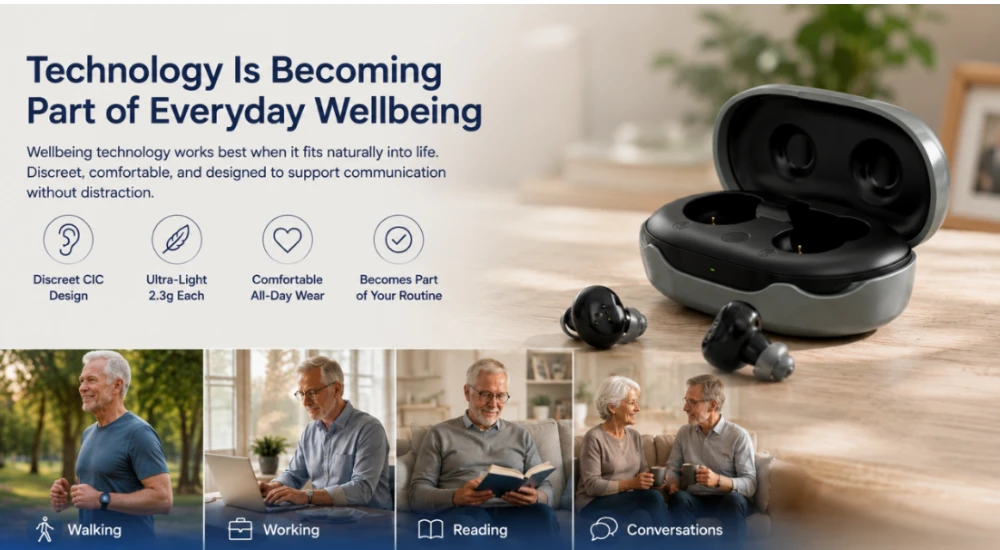
This matters because comfort is part of consistency. A hearing aid that feels natural to wear is more likely to become part of someone’s routine. And when technology becomes part of a routine, its value can be measured not by how often the user thinks about it, but by how easily they can focus on everything else.
A Brand Built Around Communication
The idea of connection is also relevant when considering the company behind a hearing product. Retekess has been focused on wireless audio communication since 2008, developing communication solutions for environments such as tourism, museums, factories, education, training, and events. The company’s current published figures include more than 150,000 customers across 115+ countries, more than 10,000 travel businesses, and more than 395,000 tour guide devices sold in 2025. Retekess also reports a team of more than 500 people and a 95.33% customer satisfaction rate.
That history is relevant to the conversation about hearing because the fundamental challenge is similar: helping people communicate clearly in real-world environments. The scale is different—the TE103 is a personal hearing device rather than a professional group communication system—but the broader focus remains communication.

The move from professional wireless communication to personal hearing technology also reflects a broader evolution in consumer technology. Audio is no longer something people simply receive. Increasingly, it is something technology can personalize around individual needs and environments.
Listening Should Adapt to Real Life
A person’s listening environment can change several times during a single day. A quiet morning at home is different from lunch with friends. Television listening creates different requirements from an outdoor walk, and a family gathering can be more challenging than a one-to-one conversation.
The Retekess TE103 offers four listening modes—General, Restaurant, TV, and Outdoor—to reflect these different situations. General Mode is designed for everyday listening, Restaurant Mode is intended for focused conversations in more challenging environments, TV Mode is designed around television listening, and Outdoor Mode is intended to reduce wind noise. The device also includes an automatic memory function that retains the previous setting.
This kind of adaptability fits naturally with the philosophy of wellbeing. People do not live in one environment, and their needs do not remain identical throughout the day. Technology becomes more useful when it can move with the person rather than forcing the person to work around it.
Personalization Can Make Technology Feel More Natural
The same principle applies to personal preferences. Wellbeing is rarely one-size-fits-all, and neither is hearing.
The Retekess TE103 can be adjusted through the SOUNDWEAR app, allowing compatible users to control volume, change listening modes, monitor battery levels, and customize settings such as gain, frequency response, bandwidth, and noise reduction.
The importance of this kind of control is easy to understand. Someone who spends most of their time in a quiet home environment may have different preferences from someone who frequently travels, attends restaurants, or spends time outdoors. Personalization gives the user a way to respond to those differences.
Rather than thinking of the hearing aid as a fixed piece of equipment, it becomes part of a broader personal routine—something that can be adjusted as circumstances change.
The Quiet Convenience of Rechargeable Technology
Good wellbeing habits tend to be sustainable because they are easy to repeat. The same is true of hearing technology.
The Retekess TE103 provides approximately 20 hours of use on a single charge, while its charging case provides three additional charging cycles for a stated total usage time of approximately 80 hours. The case also includes directional sound pickup, allowing it to function as a remote microphone when placed near a television, radio, or speaker. An automatic drying function is also built into the case to support routine device care.
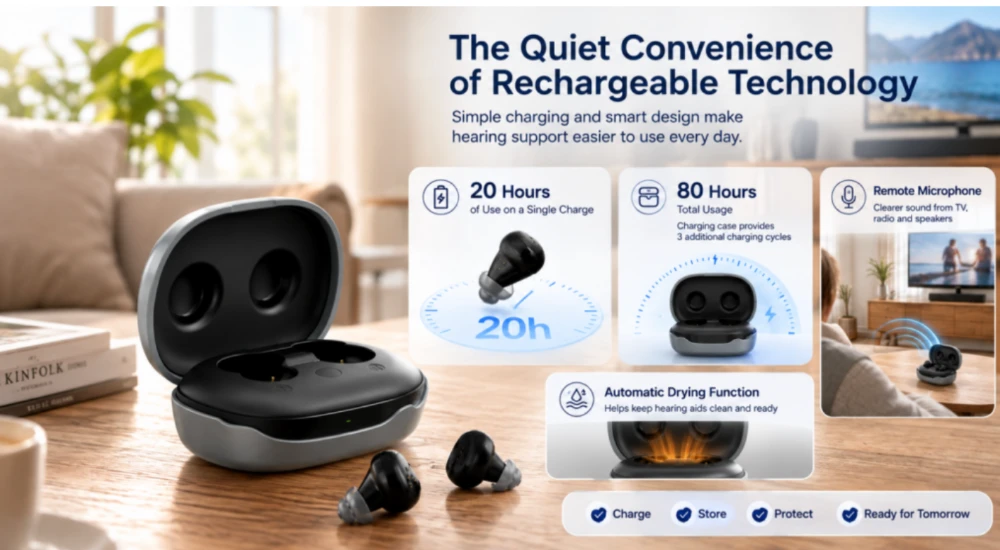
These features may not sound as emotionally significant as better conversations or greater confidence, but they support the habits that make those outcomes possible. When charging and maintenance become simple, the device is easier to incorporate into everyday life.
Hearing, Confidence, and the Small Moments That Matter
The value of hearing support is often found in moments that would never appear on a product specification sheet.
It is hearing a friend’s story without constantly trying to fill in missing words. It is following a conversation around a dinner table. It is listening to a favorite program in the evening. It is hearing a family member speak from another room. It is being able to stay present rather than spending the entire conversation trying to decode what was said.
These moments may seem ordinary, but wellbeing is often built from ordinary moments.
For adults with mild to moderate hearing loss, an appropriate hearing aid can be one practical tool for making those moments easier to experience. It should not be viewed as a replacement for professional hearing care, particularly when hearing changes suddenly or are accompanied by symptoms such as pain, drainage, dizziness, or significant differences between the ears. But when a hearing aid is appropriate, modern designs can offer support without requiring a person to change who they are or how they live.
Listening Is Part of Living Well
Wellbeing is not always about adding another activity to the calendar. Sometimes it is about removing a barrier from experiences that already matter.
Hearing support belongs in that category.
A conversation with a friend, a family dinner, a walk outdoors, a favorite television program, or a story shared across generations can all become more enjoyable when communication feels comfortable. As hearing technology becomes smaller, more personalized, and easier to use, it is increasingly possible to think about hearing support not simply as an assistive product, but as part of a broader approach to everyday wellbeing.
The ultimate goal is not to make the technology noticeable. It is to make the moments around it easier to experience.
When the device fades into the background and the conversation comes forward, that may be the clearest sign that hearing technology is doing what it is meant to do.
- About the Author
- Latest Posts

Our Editorial Team are writers and experts in their field. Their views and opinions may not always be the views of Wellbeing Magazine. If you are under the direction of medical supervision please speak to your doctor or therapist before following the advice and recommendations in these articles.