Usually not, with one large exception. Standard drug panels don’t test for muscimol, the active compound in the Amanita muscaria mushroom gummies and vapes sold legally, and they don’t test for psilocybin either. But many “mushroom” products are blended with hemp-derived THC, and those will trip the marijuana line like any other THC edible or vape. The answer lives on the ingredient label.
What does a standard drug test actually look for?
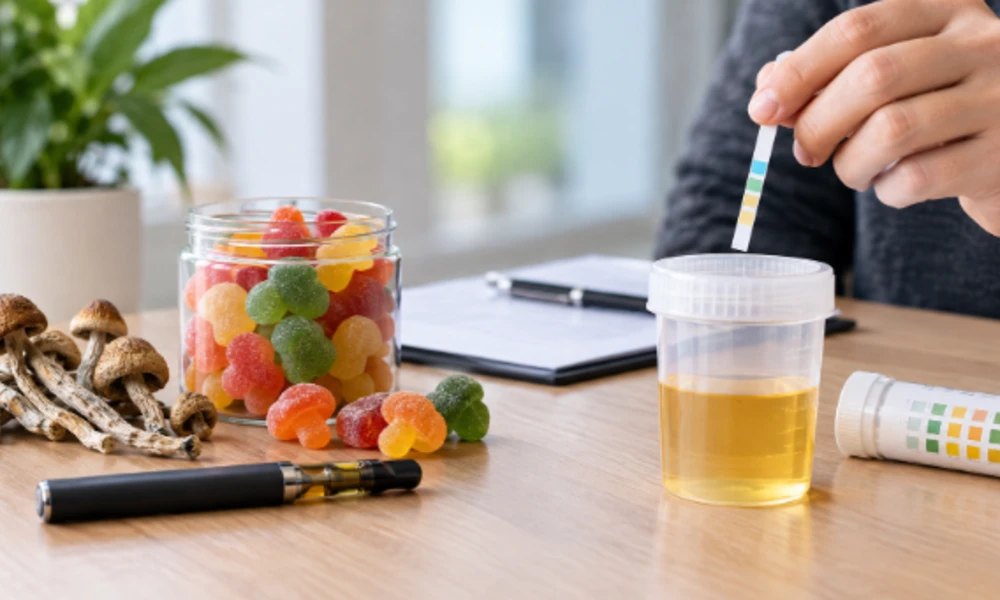
Less than people assume. The federal workplace panel, updated by HHS in the Federal Register in January 2025 and effective July 2025, screens urine for a marijuana metabolite, a cocaine metabolite, amphetamines including MDMA, opioids such as codeine, morphine, hydrocodone and oxycodone, PCP, and fentanyl.
That’s the list. Most private employers use a similar five- or ten-panel test built around the same drug classes, sometimes adding benzodiazepines, barbiturates or methadone.
Nothing on any of those panels detects muscimol. Nothing detects psilocybin. A mushroom gummy made only from Amanita extract, or a functional blend of lion’s mane and cordyceps, has no target on the sheet.
Can a lab test for psilocybin if it wants to?
Yes, but it has to ask for it specifically. Labcorp lists a psilocin screen and confirmation urine test as an individual specialty order, run by liquid chromatography mass spectrometry with a seven to fourteen day turnaround. It exists for forensic and clinical cases, not routine employment screening, and an employer would have to order it deliberately and pay for it separately.
Two more points. Psilocybin mushrooms are Schedule I, so the legal gummies at a smoke shop shouldn’t contain them in the first place; anything sold openly is Amanita-based or a functional blend. And I couldn’t find any routine commercial urine screen for muscimol at all. The 2026 narrative review in Frontiers in Pharmacology notes that there aren’t even recognized testing standards for muscimol concentration in products, let alone in people.
The exception: mushroom products that contain THC
This is where people get caught. A meaningful share of mushroom gummies and disposables are blends. “Shroom and D9” gummies pair mushroom extract with hemp-derived delta-9 THC. Mushroom disposables often carry THCA, delta-8 or THC-P alongside muscimol.
Those products contain a tetrahydrocannabinol, and the body handles it the same way it handles cannabis. Delta-9 THC breaks down into the carboxy-THC metabolite that every marijuana test is built to find. Heated THCA becomes delta-9 THC, so a THCA-blend vape ends up in the same place. Whether a mushroom gummy shows up on a drug test therefore has almost nothing to do with the mushroom and everything to do with what was blended into it.
Elyxr’s explainer on how mushroom gummies are legal is useful here, because the legal basis for each product type also tells you what’s in it: Amanita products rely on muscimol not being scheduled, while THC blends rely on the hemp definition. Its guide to whether mushroom gummies are safe covers what else tends to be in a blended product, which is the part the flavor name never mentions.
What to check before a test
| Product type | Active ingredient | Standard panel result | Specialty test |
| Amanita muscaria gummy or vape | Muscimol, ibotenic acid | Not detected | None routinely available |
| Functional mushroom gummy | Lion’s mane, cordyceps, reishi | Not detected | Not applicable |
| Mushroom and delta-9 gummy | Muscimol plus hemp-derived THC | Marijuana line positive possible | Standard THC confirmation |
| Mushroom and THCA or THC-P vape | Muscimol plus cannabinoids | Marijuana line positive possible | Standard THC confirmation |
| Psilocybin (illegal) | Psilocybin, psilocin | Not on standard panels | Labcorp 791012 or similar |
Read the certificate of analysis, not the flavor name. A lab report for a THC-free mushroom product should include a cannabinoid panel showing non-detect. If the only number on the report is muscimol, the absence of THC hasn’t been tested, only assumed.
How long could a THC blend stay detectable?
That depends on the person and the amount, and this article isn’t going to invent a number. What can be said with confidence is that the THC metabolite is fat-soluble and clears slowly compared with most drug classes, which is why cannabis has the longest detection windows on a standard panel. A single mushroom-and-THC gummy is not the same exposure as daily use, but it’s the same molecule.
A passing drug test isn’t the same as a safe product, either. The FDA has said Amanita muscaria and its constituents aren’t recognized as safe in food, and muscimol acts on the same GABA-A receptors as alcohol, so a clean panel says nothing about whether the gummy was a good idea.
One more mechanical point. Workplace tests run in two stages: a cheap immunoassay screen that reacts to a drug class, then a mass spectrometry confirmation on anything that screens positive. Immunoassays exist for THC, opioids, amphetamines and the rest of the panel. There is no immunoassay for muscimol, and psilocin requires the specialty LC-MS test above, so neither can produce a false positive by accident. The only way a mushroom product fails a test is by containing something the panel already hunts.
For anyone facing a test, the practical rule is simple. Muscimol-only products don’t register. THC blends do. And “mushroom” on the label tells you nothing about which one you have.
FAQ
Do Amanita muscaria gummies show up on a drug test?
No. Muscimol and ibotenic acid aren’t included on standard drug panels, and no routine workplace screen for muscimol exists.
Will a mushroom vape fail a THC test?
Only if it contains cannabinoids. Mushroom disposables blended with THCA, delta-8 or THC-P produce the same THC metabolite as cannabis. A muscimol-only vape won’t.
Can you be tested for psilocybin?
Yes, with a specialty test such as Labcorp’s psilocin urine screen, but it isn’t part of standard panels and must be ordered separately. Legal mushroom gummies shouldn’t contain psilocybin anyway.
- About the Author
- Latest Posts

Our Editorial Team are writers and experts in their field. Their views and opinions may not always be the views of Wellbeing Magazine. If you are under the direction of medical supervision please speak to your doctor or therapist before following the advice and recommendations in these articles.