Is the Light Adjustable Lens Estero's Best Bet for Custom Cataract Vision?
Imagine stepping onto the pickleball court and seeing every line sharp and bright—no glasses, just Florida sunshine. That clarity is the promise of the…
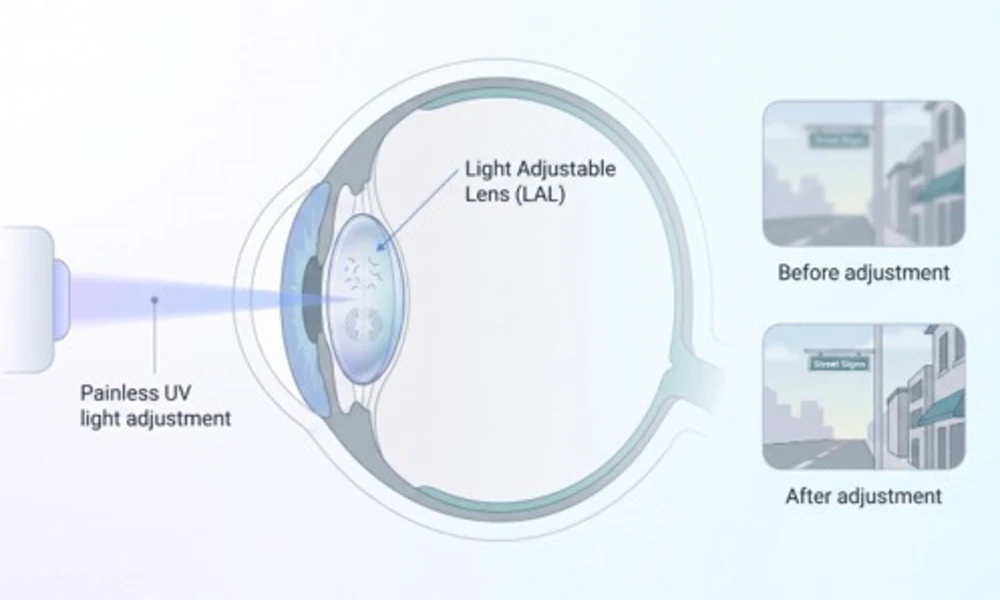
Imagine stepping onto the pickleball court and seeing every line sharp and bright—no glasses, just Florida sunshine. That clarity is the promise of the FDA-approved Light Adjustable Lens: an implant your surgeon can fine-tune, after cataract surgery, with painless ultraviolet light. Offered here in Southwest Florida, it’s built for people who won’t settle for “good enough” eyesight.
Ahead, you’ll learn how it works, why active retirees love it, and the trade-offs to weigh before you book.
What Is A Light-Adjustable Lens?
A light-adjustable lens (LAL) is an artificial lens that replaces the cloudy natural lens removed during cataract surgery.
This tiny silicone disc contains light-sensitive molecules that reorganize when they absorb a controlled dose of ultraviolet light. Picture a camera lens you can still edit after the shutter closes.
During brief office visits, your surgeon shines a precise UV beam into the lens. The light subtly reshapes its curvature, fine-tuning your prescription until the world looks razor-sharp. When you are satisfied, a final “lock-in” treatment seals the shape for good.
The Food and Drug Administration cleared the LAL system in 2017, confirming its safety and effectiveness for adult cataract patients with healthy retinas, according to the FDA’s Premarket Approval database.
How the Adjustment Journey Unfolds
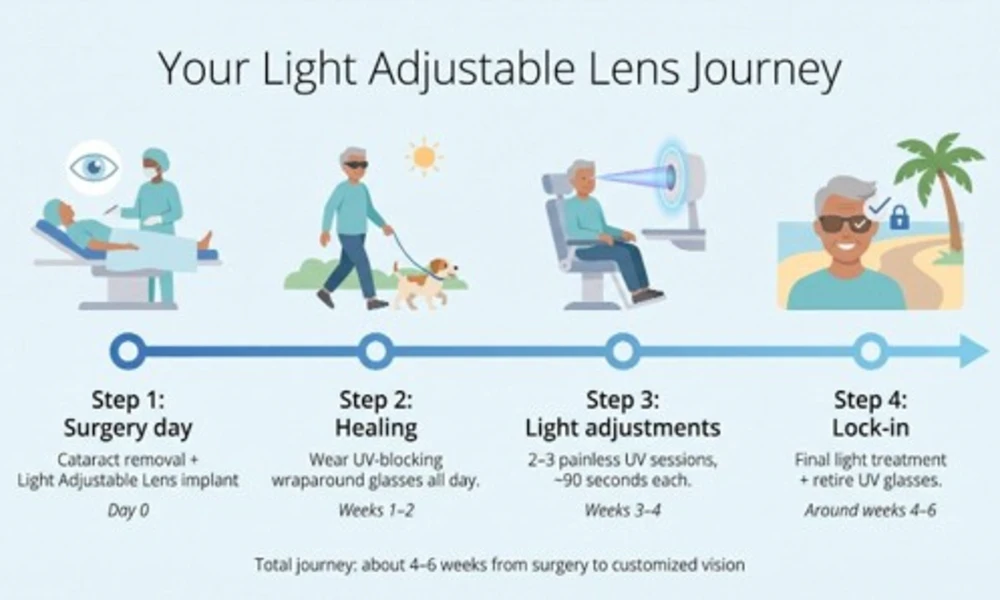
Step 1: Surgery Day, Swapping in the Adjustable Lens
You arrive for routine cataract surgery. The surgeon removes the cloudy natural lens with the same small-incision method used in millions of cases each year, then slides the Light Adjustable Lens into the capsular bag where a standard implant would sit. The entire procedure lasts about 15 minutes. EyeWiki notes that the placement “is similar to any other standard IOL implantation procedure,” so recovery feels just as quick. You leave with dark sunglasses, lubricating drops, and the knowledge that the fine-tuning begins once the eye settles.
Step 2: Healing, Life Behind UV-Blocking Glasses
For the first couple of weeks, the lens is a blank canvas. Any stray ultraviolet light could shift its shape before adjustment. Wear wraparound UV-protective glasses every waking minute—from your morning dog walk to scrolling on the lanai. EyeWiki advises keeping the shades on “through the healing and light-treatment process, till 24 hours after the final light treatment.” Most people adapt fast: stash a spare pair in the car and another by the door. In bright Southwest Florida, one uncovered errand can trigger unplanned polymerization and reset the timeline, so treat the shades like medicine.
Step 3: Fine-Tuning, Two or Three Quick Light Sessions
About three weeks after surgery, you sit at the Light Delivery Device for the first adjustment. The lights dim, you focus on a blue target, and a narrow UV beam treats the lens for roughly 90 seconds. No extra drops, no scalpels, no downtime. Most patients need just two or three sessions, spaced a few days apart, to dial in sphere and cylinder power within fractions of a diopter. The pause between visits lets you test-drive vision—drive at dusk, read a menu, line up a putt—then report back. If distance is crisp but the crossword blurs, the next session nudges one eye toward near focus. The tweaks hold because they happen inside the eye.
Step 4: Lock-In, Sealing the Prescription for Good
When you love your test-drive vision, the surgeon delivers a final full-surface light treatment that polymerizes every photosensitive molecule and freezes the optics. The visit feels like an adjustment, just slightly longer. Twenty-four hours later, the rules relax. You can retire the wraparound shades, put on your favorite polarized pair, and return to beach walks without worry. RxSight guidelines confirm that 24 hours after lock-in, the UV glasses can come off, and customized vision is yours. From surgery day to lock-in usually spans four to six weeks—a modest commitment for clear, tailored eyesight and no surprise glare down the road.
Why Active Floridians Love an Adjustable Lens
Sharper, Glasses-Free Distance Vision
The chief perk is precision. In a 2025 registry study published in the National Library of Medicine, 92% of Light Adjustable Lens patients achieved 20/20 uncorrected distance vision, with no readers or contacts in sight. Snead Eye Group’s published outcome data echo those results, noting that patients who choose the Light Adjustable Lens at its Southwest Florida clinics are more likely to reach 20/20 vision without glasses than peers who receive a fixed-focus implant.
Mid-course tweaks make the difference. Rather than hope pre-surgery calculations land perfectly, the surgeon refines the implant after healing. Tiny shifts, often under half a diopter, clear residual blur and erase astigmatism that standard lenses leave behind.
For Southwest Florida retirees, that means spotting dolphin fins on sunrise walks, reading boat numbers without squinting, and driving Tamiami Trail at night with confidence. The result feels high-definition and avoids the halos that can follow multifocal lenses.
Patients often say it feels like fresh LASIK because the optics sit inside the eye where dryness and corneal changes cannot erode the outcome. Since accuracy rivals modern refractive surgery, you skip the prospect of a post-op laser touch-up.
Tailored Fixes for Astigmatism and Past LASIK Eyes
Astigmatism can blur scoreboards, street signs, and subtle breaks on the green. Traditional toric lenses help, yet they may rotate off axis.
The Light Adjustable Lens avoids that slip. After healing, the surgeon applies UV light to chosen meridians, correcting up to three diopters of cylinder with surgical precision. FDA Post-Approval data show 92.5% of patients finish with half a diopter or less of residual astigmatism.
If you had LASIK or radial keratotomy years ago and current lens math feels uncertain, adjustability shines brighter. You and your doctor test-drive vision, then lock it only when the view feels right. Clinical data show 97% of these complex eyes land within half a diopter of the target, far better than standard monofocals.
Bottom line: prior corneal surgery and stubborn astigmatism no longer force compromise. The UV tweak restores clarity, so you see the ball, the horizon, or the channel markers with ease.
Blended Vision Flexibility for Life’s Mixed Distances
Cataract patients usually choose between distance vision with reading glasses and multifocals that can add night halos. The adjustable lens offers a smarter third choice.
During trial adjustments, the surgeon can set one eye slightly toward near focus while leaving the other at distance. You live with the blend for a few days, then decide if it feels natural. If it does not, the next session fine-tunes the balance.
Because the LAL begins as a true monofocal, you keep sharp contrast and avoid glare rings from multifocals while still gaining enough near power to skim a menu without pulling out readers. It is personalization similar to tweaking driver loft or bike-seat height until your eyes and brain agree, “That’s perfect.”
The Trade-Offs: What to Weigh Before You Commit
More Visits, More Homework
Choosing an adjustable lens keeps you engaged for about a month, not a day. Standard cataract surgery often ends with one post-op check. The LAL path adds two or three quick light-treatment visits plus a final lock-in. Each appointment is brief, yet you still need to drive (or get a ride), clear your calendar, and tolerate dilated pupils for an hour afterward.
For many Estero retirees, this schedule is easy; the clinic sits ten minutes down US-41. Snowbirds or frequent travelers should map the timeline honestly. If you plan to head north after Thanksgiving or sail the Mediterranean next month, book surgery early enough to finish every adjustment before departure.
The takeaway: patience and punctuality earn custom vision. If you enjoy being part of the process and can attend every follow-up, the extra effort pays off. If your calendar shifts often, a fixed-focus implant may suit life better, even if the optics land slightly shy of perfect.
The UV-Glasses Stretch
For four to six weeks, you join the “UV club,” wraparound shades on whenever daylight appears. The rule is firm. RxSight guidelines note that skipping protection can trigger random polymerization and disrupt the schedule.
In practice, the routine is more of a nuisance than a hardship. Keep a pair by the bed, another in the golf cart, and a backup in the car. Friends may offer a “Hollywood” joke, but most forget the glasses after day three.
Still, honesty matters. If you garden from dawn to lunch or crew a sailboat all weekend, ask whether nonstop eyewear feels realistic. Those who dislike sunglasses may find the requirement irritating. Everyone else treats it as a short-term contract for clearer sight.
Premium Upgrade Means Premium Price
Medicare covers the cataract operation itself, but anything beyond a basic monofocal lens is out-of-pocket. The Light Adjustable Lens sits firmly in that premium tier. Most Southwest Florida practices quote an additional $3,000 to $4,000 per eye, a fee that includes the lens, light-treatment sessions, and lifetime lock-in of your prescription.
Payment plans help; many clinics let you spread costs over 12 to 24 months, or you can use a health savings account. Still, it is significant money, and no insurer currently steps in. If several thousand dollars per eye feels steep, choose a standard lens and budget for glasses. If custom vision ranks high on your list, treat the cost like granite counters or leather seats: optional, but enjoyed every day once installed.
Not Every Eye Qualifies
An adjustable lens performs well only in a healthy visual system. Significant macular degeneration, advanced glaucoma, or corneal scars limit potential sharpness, so the FDA excludes those eyes. Your surgeon will perform a thorough exam, including retinal scans, before approving the implant.
Medications that increase sun sensitivity, such as doxycycline or amiodarone, also raise concerns because they complicate the UV-light protocol. Share your medication list upfront. The doctor may recommend a different premium lens that avoids UV exposure.
The quick filter is simple: if your eye can reach 20/20 with a normal implant, it can probably benefit from a Light Adjustable Lens. If retinal disease, optic-nerve damage, or corneal haze caps potential below that, the adjustable upgrade adds cost without benefit.
Where to Get an Adjustable Lens in Southwest Florida
Snead Eye Group, with offices in Fort Myers, Naples, Cape Coral, and Bonita Springs, was among the first local practices to adopt the UV-light delivery system. You meet Dr. Brad Snead for the initial work-up and return to the same office for every light session, so there is no shuttling between facilities.
Larger regional centers, including Newsom Eye in Tampa and Bascom Palmer in Miami, also offer the technology, yet for most Estero residents the drive down US-41 is shorter than a Costco run. If your current ophthalmologist does not list the Light Adjustable Lens on the website, ask directly. Some doctors partner with Snead Eye Group for the adjustment phase while handling surgery closer to home.
Booking is simple: schedule a cataract consult, mention your interest in the adjustable lens, and bring a medication list plus your latest glasses prescription. The clinic will check retinal health, measure corneal shape, and outline financing so you know the full cost before setting a surgery date.
Finish the visit with a realistic timeline—plan four to six weeks in town with flexible mornings for adjustments, and you leave with a clear plan and, soon enough, a clearer vision.
Clear Vision Ahead
The Light Adjustable Lens is not hype. It is a proven, FDA-cleared way to sculpt eyesight after cataract surgery, blending surgical predictability with post-op personalization that no other implant provides.
Yes, you commit to a few extra clinic visits, a month of UV shades, and a premium price. In return, you test-drive focus, erase residual astigmatism, and lock in vision that matches life under the Southwest Florida sun.
If that equation feels right, book a cataract consult with an ophthalmologist who offers the technology. Bring your calendar, medication list, and a willingness to be an active partner during the adjustment appointments.
When the journey ends, and the glasses come off for good, you enjoy every shoreline, scorecard, and sunset exactly the way you choose: crisp, vibrant, unmistakably yours.
Filed underEye health, United States