At a time when life can feel increasingly fragmented, where we are often more connected to our screens than to the person standing next to us in a pizza shop, Louise Moriarty is doing something radical. She sits. She listens. And then, she writes.
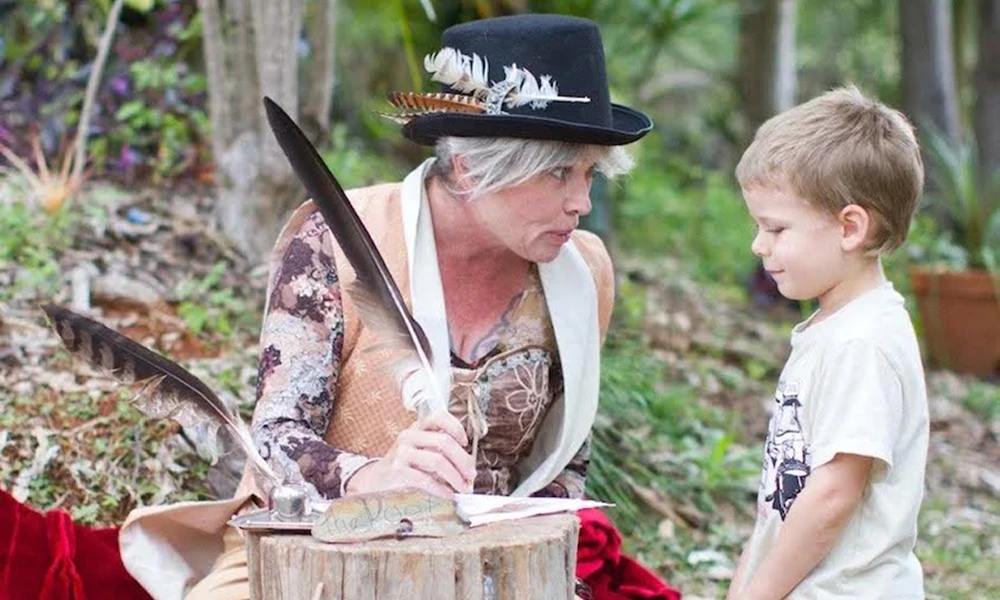
Louise isn’t just any writer; she is a poet of the soul. Her mission, which she calls “The Poet’s Gift,” is as simple as it is gargantuan: to ensure that every person on the planet receives a handwritten poem that affirms their existence. To date, she has handwritten over 12,500 poems on unique, handmade paper, touching lives from the Gold Coast to Colorado, one “downloaded” verse at a time.
I sat down with Louise to discuss the philosophy behind her work, her journey through the “low places,” and why she believes words are the most powerful magic spells we possess.
The Mirror of Affirmation
“The most important thing,” Louise tells me, her eyes reflecting a lifetime of observing humanity, “is the journey to find happiness. Through that, I realized that if we are affirmed—if we truly feel seen—we blossom.”
Louise’s work operates on a frequency of pure vulnerability. When she sets up her small table at a market or a festival, she isn’t just selling a service; she is offering a mirror. We often hold “little secrets” inside us about who we want to be, yet we rarely feel we are “good enough” to inhabit that light.
“Suddenly, someone comes along and writes you this heart song that taps right into those places where you are most vulnerable,” Louise explains. “You realise you’re already being that person you want to be. It powers you up to shine exactly where you are.”
This is the core of her mission: Making Creativity Viral. By acknowledging the light in one person, she creates a ripple effect. Her catchphrase, “Each one, reach one,” isn’t just a slogan; it’s a blueprint for a global shift in energy.
The Death and Rebirth of the Creative Spark
Louise wasn’t always a street poet. Her path was winding, marked by moments of intense creativity and periods of profound “closing down.” She reminisces about being a child, singing into a hairbrush and playing on a makeshift drum kit with her sister. Back then, creativity was a ball of fire, free and uninhibited.
However, as she grew, she saw how culture tends to “bash” the creativity out of us—not with malice, but with the “good intentions” of systems. Louise spent years conducting journaling workshops in Gold Coast schools, where she witnessed this tragedy in real-time.
The Little Kids: They grab pens and crayons, scribbling with wild abandon. For them, the paper is a playground.
The Grade Sevens: By age twelve, the questions change. “Do we have to draw a margin? Can we write in pencil first so we can rub it out if we get it wrong?” “There is this closing down of creativity that happens,” Louise says. “But it is so simple to open that door again and return to that childlike wonder of what is possible.”
From Broken Hill to the Maker’s Market
The transition into becoming “The Poet” was born out of a period of personal darkness. After working in Broken Hill on a performance project with Aboriginal children—a role that involved circus arts and high-energy output—Louise found herself in a “low place.” She had spent so much energy helping others that she had neglected her own needs.
She ended up in Brisbane, couch-surfing and struggling to find work. It was then that a friend, who ran a handmade makers market, gave her the nudge that changed everything: “Louise, you should write poems for people.”
“I set up a little table,” she recalls, “and people had incredible reactions. On the very first night, people were crying. They’d say, ‘No one has ever written me a poem before.’ They felt seen.”
Since then, Louise has been a resident poet at festivals as eclectic as the Frozen Dead Guy Days in Colorado (where she famously wrote poems from the perspectives of “dead guys” to the living) and the Love Shovel Anarchist Poetry Camp in the mountains of Nederland.
The Five Love Languages of a Poem
One of the most profound aspects of Louise’s work is how it encompasses almost every way humans give and receive love. When she hands a piece of her handmade paper—crafted from recycled messages, school notes, and journal entries—to a stranger, she is hitting several “love languages” simultaneously:
Words of Affirmation: The poem itself is a direct hit of validation.
Acts of Service: The labor of crafting the paper and the poem is a gift of effort.
Quality Time: The moment of “downloading” the poem creates a brief, intense bubble of presence.
The Gift: It is a physical artifact of a spiritual moment.
Touch: “Invariably,” Louise laughs, “if someone is a touchy person, they will give you a big hug after receiving their poem.”
Words as Magic Spells: The Philosophy of Oneness
Louise believes that words are more than just communication; they are “magic spells.” She draws parallels to Aboriginal culture, where myths are not just stories but truths that the world operates under.
Her philosophy has been deeply influenced by thinkers like Daniel Quinn, author of Ishmael, and her friend Melanie Brockwell, whom she describes as a “living master” of oneness.
“Mother Culture,” as Quinn calls it, whispers in our ears that there is only “one right way” to live, often leading us like lemmings off a cliff. Louise’s poems are an attempt to break that spell. She views her work through the lens of alchemy—taking the raw, often “wonky” emotions of a person and transforming them into beauty.
“We are cooperative, collaborative, community-oriented beings,” Louise asserts. “We aren’t the ‘bad guys’ or the ‘survival of the fittest.’ We want to connect. We want people to see us shining.”
Practical Magic: How to Nurture Your Own Gift
During our conversation, I asked Louise what she would say to the millions of people who have a gift but are too afraid to grow it. Her advice was refreshingly blunt: Stop fighting yourself.
“If you’re driving around the block saying, ‘I can’t do it,’ then great—you can’t do it. Go have a piece of cake,” she says with a wit that cuts through spiritual pretension. “Give yourself permission. If you want to sleep, sleep. But if you are thinking about writing a book, then you are a writer. You aren’t a mechanic or a scientist; you’re the person with the book in them.”
She encourages people to operate in “10-second increments”—a concept we both resonate with. It’s about making a decision and doing it now, then choosing again. Whether it’s fluffing a pillow or writing a stanza, the act of choosing is where the power lies.
The Vision: 60,000 More Moments of Truth
When Louise looks at the math, her mission seems impossible—and that’s exactly why she keeps doing it.
“I added up how many people are on the planet, divided it by how many poems I can write in a day, and worked out how many days I have left. I could probably get another 60,000 poems out of me in my lifetime if I went for it every day.”
But she knows she can’t do it alone. Her goal is to inspire others to “pay it forward”—to take up the pen and write for the people they love, and even the people they don’t know.
Taking the Weather With You
As our talk wound down, Louise left me with a beautiful thought about nature. A bird never wakes up and decides not to sing because it’s having a “bad hair day” or because it’s worried about what the bird in the next tree thinks. It just sings. A tree doesn’t stop growing because someone cut it. It just is.
“Everywhere we go, we take the weather with us,” Louise says. “Our thoughts and words are seeds. If we put our attention on abundance and beauty, magic shows up.”
Louise Moriarty is a reminder that we don’t need complicated rituals or expensive degrees to change the world. Sometimes, all it takes is a piece of handmade paper, a pen, and the courage to look someone in the eye and say, “I see you, and you are wonderful.”
- About the Author
- Latest Posts

Sara Andrew is a multifaceted media professional, journalist, and wellness advocate dedicated to inspiring change through storytelling and conscious living. As the Founder of Inspire Global Media, she leverages her expertise as a Publicist and investigative Journalist to amplify impactful narratives, with a focus on travel, health, and social issues. An enthusiastic advocate for mental and physical wellness, Sara is also a Certified Yoga Teacher, Meditation Instructor, and Recovery Coach, guiding individuals toward balance, healing, and self-discovery. Whether uncovering truths through investigative reporting, curating transformative travel experiences, or empowering others through wellness practices, Sara remains committed to creating a more connected and kind world.