Many people don’t notice or concern themselves with their flat feet until pain begins to develop elsewhere in the body. Maybe you rolled out of bed with a sore heel one day or maybe your knees hurt when you climb stairs or after sitting for too long. Your legs might even feel overly tired or heavy when you’ve been standing at work all day. Pain can seem so disconnected from the feet when it shows up elsewhere.
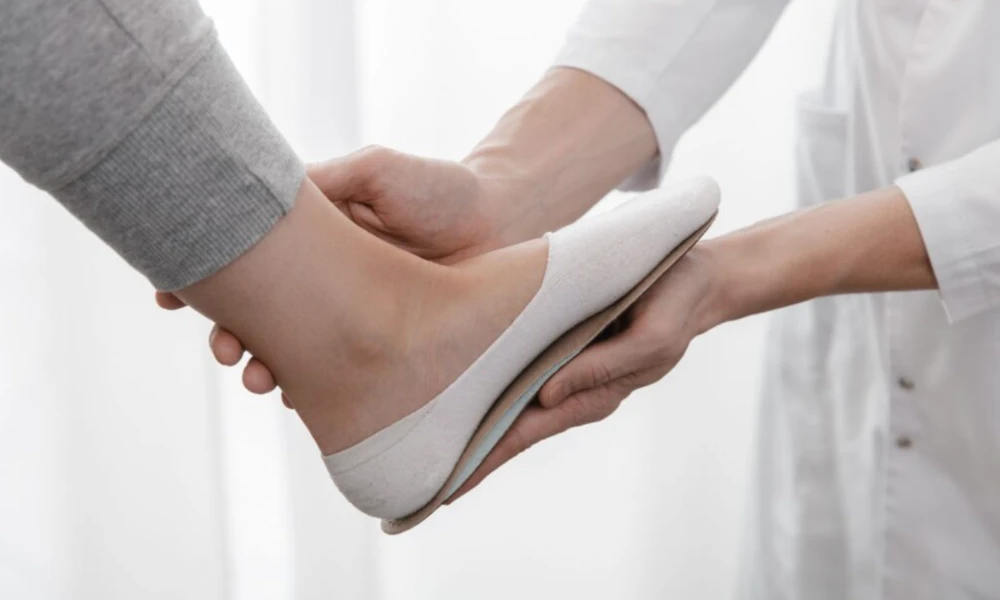
What makes this so maddening is the common perception that flat feet are the thing that’s wrong. People try to fix their flat feet despite having had them their whole life with no previous problems. The issue is rarely the feet but how well the entire lower extremity is dealing with daily load and motion.
The reason for flat feet and how they can affect your ankles, knees, and hips will help piece the puzzle together. Once you understand how the body works as a system you’ll easily be able to see why your symptoms occur and what needs to be treated.
Let’s get into it.
What Flat Feet Actually Are (and Aren’t)
Whether someone benefits from the best insoles for flat feet often depends on the type of flat feet they have and how those feet function during everyday movement.
In flat feet, your arch is lower than normal, which causes more of your foot to be placed flat on the ground. The arch of your foot is made up of many small bones, as well as ligaments, tendons and muscles. All of these components work together to absorb loads and allow your foot to adapt to various surfaces while you move.
Typically, flat feet are classified as being either flexible or rigid. Flexible flat feet means that there is an arch when the foot is not loaded or in the air. Rigid flat feet means there is no arch when either on the ground or off. Flexible flat feet are much more common and are typically considered normal.
That is why having flat feet is not always an issue. Some people naturally have low arches and never have any pain or mobility problems. Just because someone has flat feet doesn’t mean they will have an issue. How strong someone is, movement patterns, activity levels, and how much load their body can tolerate are typically more important when it comes to how the feet function over time.
What Causes Flat Feet in the First Place
The causes of flat feet can vary from patient to patient. Many people’s foot structure is genetically determined, leading to lower arches. For some, this does not lead to problems and is merely a natural variation in anatomy.
Someone may also exhibit ligament laxity or joint hypermobility, making it easier for the arch to collapse when weight is applied to the foot. Weakness or decreased control of muscles through the foot and ankle can also cause flattening. When muscles and tendons aren’t as strong as they should be or don’t work correctly, it can impact the arch’s support.
It’s also possible to develop flat feet later in life. Normal wear and tear can cause changes to the strength and elasticity of the supportive tissues. Additionally, an injury can cause abnormal functioning of the foot during activity. Another way flat feet can develop over time is through posterior tibial tendon dysfunction.
Why Flat Feet Can Change the Way You Move
The foot is the foundation of the body. Because of this, even minor shifts in foot structure can affect force absorption and distribution through the rest of the lower extremity. If the arch height is decreased, the foot may roll inward excessively during walking or running. This is commonly known as overpronation.
Overpronation itself isn’t necessarily bad. However, if your foot rolls inward too much with each step, it can change the mechanics of shock absorption throughout your foot and leg. Joints and muscles higher up may compensate in order to help stabilize the body and continue moving forward.
This is one reason some people describe flat feet as feeling like they have misaligned feet. However, your bones aren’t necessarily twisted out of proper alignment. Rather, your body moves and loads differently as a result of your flatfoot. Remember that the body is extremely capable of adjusting to its environment. But too much of these compensations can overload other tissues.
How Flat Feet Can Affect the Ankles, Knees, and Hips
The lower limb works as a kinetic chain so problems occurring in the foot can affect things up the chain. Collapse of the arch or excessive inward rolling of the foot may lead to the ankle rolling inward. When this occurs, the distribution of force throughout walking and standing is altered.
Movement and loading patterns can be altered all the way up into the knee joint. Some individuals feel increased stress around the front of the knee or the inner knee. Other individuals may notice pain when going up or down stairs, running or standing for prolonged periods of time.
Up the kinetic chain, even the hips and pelvis might be impacted. Slight differences in hip rotation and pelvic orientation can occur as your body attempts to compensate for movement abnormalities and try to stay economical in movement. This is also why you may not always feel problems in your feet when you have flat feet. Many times, people will notice pain begins in the ankle, knee, hip or even lower back.
Common Problems Linked With Flat Feet
Flat feet are commonly referred to as an issue with your feet, however the symptoms can manifest themselves up the leg depending on compensations your body has made to accommodate the load. While individual experiences differ, when flat feet do cause symptoms, they tend to appear in a fairly consistent way.
Below is a table highlighting some of the more common areas affected and possible contributing factors:
| Area Affected | Common Issue Linked with Flat Feet | Why It Happens | What People Usually Notice |
| Heel | Heel pain/plantar fascia overload | Increased strain through the arch and plantar fascia. | Morning heel pain, pain after rest, or long-standing. |
| Lower Leg | Shin splints | Higher load through tibial structures due to altered foot mechanics. | Aching along the inner shin during walking/running. |
| Achilles | Achilles tendon irritation | Extra demand on calf/Achilles from reduced arch support. | Tightness, pain at the back of the heel, and stiffness after activity. |
| Knee | Medial or patellofemoral knee pain | Changes in lower limb alignment and knee tracking. | Pain going up stairs, squatting, or prolonged sitting. |
| Whole Lower Limb | General fatigue or discomfort | Less efficient force distribution through the foot and leg. | Tired, heavy legs after standing or walking. |
When Flat Feet Are a Problem (and When They’re Not)
A lot of people have low arches and never experience any pain or mobility problems whatsoever. When your feet don’t present any issues, that’s excellent, indicating they’re working within their natural capabilities, and a low arch isn’t functionally limiting your daily life or activities.
It’s when the foot struggles to cope with the stresses and strains placed upon it that you start to run into problems. This is where form can matter more than shape. Some feet will flex, load and recover well despite having low arches. Other feet don’t cope so well when demands of standing, walking, training or work exceed what they’re used to.
The emergence of symptoms usually signals an issue with the foot’s performance, its gait, or its load management, not simply the presence of a low arch.
What Actually Helps Support Flat Feet
The most beneficial approach to managing flat feet involves improving the function of the foot and lower leg, rather than attempting to reshape the foot. Changing the shape of the foot is typically not beneficial in the long term.
A significant portion of this involves building muscle endurance and retraining through the feet and lower legs. By strengthening the tiny muscles within the foot, we can enhance its control and stability, while exercises focusing on the calf and ankle help the rest of the leg manage the demands of movement more effectively.
It’s also crucial to improve how you manage load through normal day activities and exercise. You want to avoid drastic increases in activity as this can overwhelm your tissue’s ability to adapt. Some patients may benefit from modifying footwear choices and insole support to help decrease loading through higher-demand activities.
Essentially, correcting flat feet isn’t a rapid process. As your foot and lower leg get better at handling and managing the forces from your everyday life, you’ll likely find your symptoms ease up.
It’s Not Just About the Arch
Flat feet is a very common presentation that although classified under a foot problem, is actually a whole body movement pattern involving the foot, ankle, knee and hip joint working together as one system. Symptoms are less about the development of the arch and more to do with how the body compensates over time with what is being asked of it.
Two people can have the exact same foot structure but one may develop symptoms while the other does not based on strength, movement pattern and daily stressors. That’s why treatment often focuses on control and load tolerance of the entire system rather than just the arch.
If we can improve how the body copes with daily demands and how it can tolerate these loads, then the symptoms should not matter what type of foot you have.
- About the Author
- Latest Posts

Our Editorial Team are writers and experts in their field. Their views and opinions may not always be the views of Wellbeing Magazine. If you are under the direction of medical supervision please speak to your doctor or therapist before following the advice and recommendations in these articles.