
BBC accused of getting the science wrong on Covid vaccines
A leading scientist has launched a blistering attack on the BBC - accusing it of getting the science wrong after it challenged a cardiologist over Covid…
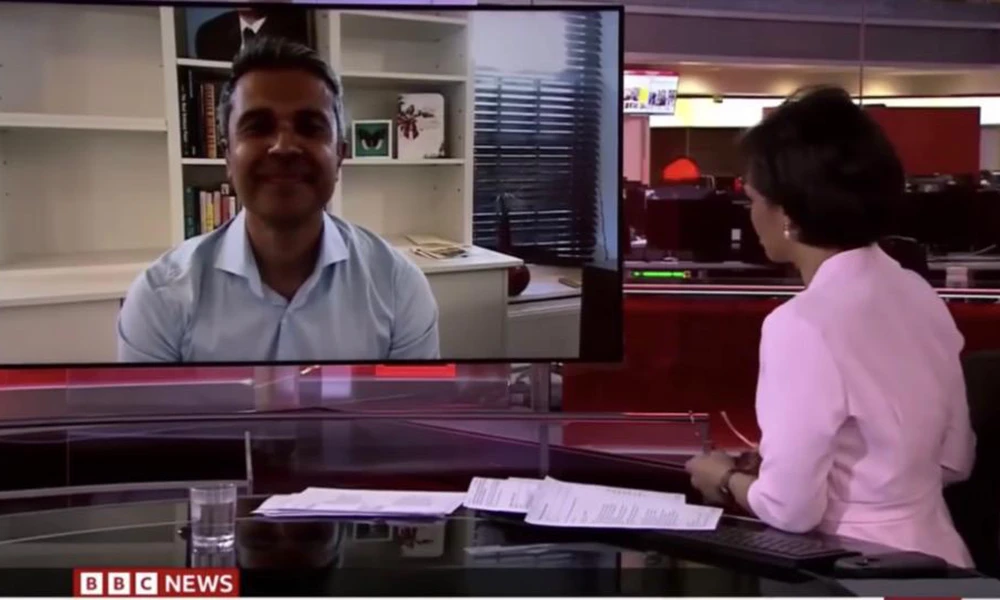
A leading scientist has launched a blistering attack on the BBC - accusing it of getting the science wrong after it challenged a cardiologist over Covid vaccine harms.
Dr Joseph Fraiman, a US emergency doctor and former senior scientific strategist to the National Institutes of health who studies clinical trial data, says the broadcaster misrepresented a key study at the centre of the row.
Dr Fraiman was lead author of the 2022 paper, published in the journal Vaccine, which showed higher rates of serious side effects in people given the Covid vaccine compared to a group given a dummy drug.
The row centres on an episode of Everything Is Fake and Nobody Cares on BBC Radio 4, hosted by Jamie Bartlett aired earlier this month. The programme explored why people trust figures like Dr Aseem Malhotra on the side effects of Covid vaccines - and questioned his reading of vaccine data.
Writing for the Brownstone institute Dr Fraiman says the BBC missed three key points - his study did find higher rates of serious side effects in vaccinated people, Dr Malhotra’s claims matched those findings.
He claims the BBC relied on something that is “not true”.
During the broadcast, Dr Vicky Male of Imperial College London said the authors of Dr Fraiman’s paper had been “specifically told to make it clear this paper should not be used” to support claims like Dr Aseem Malhotra’s. Dr Fraiman says that is wrong. ‘No one told us that. The paper does not contain such an instruction. I have the peer review correspondence; I know what the journal asked of us and what it did not.”
He adds: “Anyone could have checked this in five minutes by reading the paper… Jamie Bartlett did not check.”
Dr Fraiman’s study re-analysed data from the original Pfizer and Moderna trials. It found serious side effects were more common in the vaccinated group than in the placebo group, and compared that to how much the vaccines reduced Covid hospitalisations at the time.
He says that is exactly what Dr Malhotra was talking about. “Dr. Malhotra’s on-air statement - that a trial participant was 2 to 4 times more likely to suffer serious harm from the vaccine than to be hospitalized with COVID - was, if anything, a conservative rendering of what the paper reports.”
Dr Fraiman says the BBC was wrong to suggest otherwise. “Dr. Male’s statement that the paper ‘doesn’t show that that’s true’ is directly contradicted by the paper itself.”
He also responds to criticisms raised in the programme. On claims the study came too late, he says that is how proper research works.
“My co-authors and I began this work in July 2021… What took time was what always takes time… statistical analysis, peer review, and publication.” He also addresses the issue of missing data that the BBC raised.
Dr Fraiman says his team used the information that has been made public because the most detailed records from the trials have still not been released.
“We did not have individual participant data. That limitation is acknowledged in the paper.”
In simple terms, he says researchers still cannot see exactly what happened to each person in the trials.
“Four years later, they still have not.”
He says the answer is obvious - release the data.
“The correct response… is not to dismiss what the public data show. It is to release the participant-level data.” Dr Fraiman also rejects claims his study counted too many types of harm.
He says critics misunderstand how trials work. “In a randomised trial… If more [serious adverse events] occur in the vaccine arm, the inference is that the vaccine likely caused them.”
He adds that you don’t need to prove every single case. “You do not need to adjudicate individual causation. The trial does.” He says his team also ran a stricter check - focusing only on key side effects already flagged by safety bodies. Even then, the same warning signal appeared.
“That the signal appeared in pre-specified events… makes chance alone a less plausible explanation.”
Critics also argued the study counted incidents rather than people. Dr Fraiman says that doesn’t change the overall picture. “Event-level and participant-level counts… are both worth knowing.”
He also hits back at Dr Male’s attempts to play down certain side effects.
“A case of diarrhea severe enough to meet the regulatory threshold… is not ‘the runs’,” he says, warning these cases can be serious and involve hospital treatment.
Dr Fraiman also criticises claims mentioned in the programme that vaccines saved millions of lives.
“What the audience was not told is that this figure does not come from clinical trial data. It comes from a mathematical model.” He says models cannot be used to dismiss real trial results.
“You cannot use a zero-harm mathematical model… to refute an excess harm signal found in… randomised, placebo-controlled trials.”
He said: “On the basis of an unchecked false claim… Jamie Bartlett told his audience that Dr. Malhotra was spreading false information.” He also questions the expert used in the programme. While he praised her impressive track record as a scientist, he said her direct knowledge lay outside this field. “She is not an epidemiologist… or a clinical trialist. She does not hold a medical degree and does not treat patients.”
Dr Fraiman says this reflects a wider problem. “Mainstream media outlets… have treated it not as evidence to be weighed but as misinformation to be managed.”
He says his study has been criticised and labelled misinformation without giving the authors a chance to respond. "A scientific journal… unwilling to publish the authors’ response… is the opposite of how scholarly exchange works.”
Dr Fraiman insists his findings still stand. “Our finding is straightforward… serious adverse events… occurred more often in the vaccinated group than in the placebo group.”
He says the public should be allowed to decide.
“Readers are intelligent adults. They can weigh the evidence themselves.”
Read full article: https://brownstone.org/articles/the-vaccine-safety-signal-the-media-still-wont-read/


