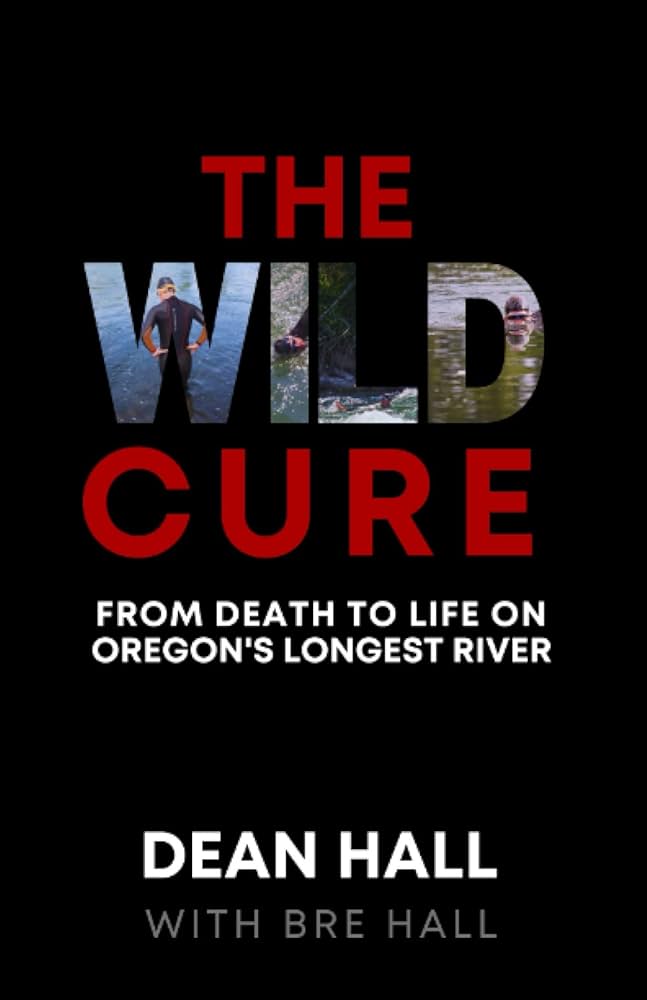
In 2013, three years after losing his wife and while fighting both leukemia and lymphoma, Dean Hall faced what he thought would be the final chapter of his life. Instead, he chose a different path — one that would eventually lead him to write The Wild Cure: From Death to Life on Oregon’s Longest River, and inspire countless others to turn to nature as medicine.
I sat down with Dean to hear his remarkable story — one that begins not with illness, but with an adventurous childhood among the waterfalls, forests, and rivers of Oregon.
“I grew up in Portland, Oregon, the son of two mountain climbers. Looking back, it really was an idyllic childhood. My parents understood my energy, my curiosity, and they let me run free — wild in the woods, always climbing, swimming, exploring. I often joke that I was raised by wolves, because every spare moment was spent outside.
We lived just a few miles from the Columbia River and the breathtaking Columbia River Gorge — a landscape of towering cliffs and waterfalls that has graced countless calendars. The mountains were only an hour away, the ocean just ninety minutes west. It was the ultimate outdoor playground. Before the term ‘adventure athlete’ even existed, that was simply what it meant to be an Oregonian.
By the time I was 15, I had climbed nearly every major peak in the state. All I dreamed of was to one day be a National Geographic–sponsored explorer.”
A Dreamer and a Footballer
“Then football — what Americans call soccer — took over my life. I was obsessed. I played on the first Nike-sponsored team here in Oregon (the brand actually began in my hometown) and later joined the Olympic Development squad, which took us to England to play in the West Midlands.
At sixteen, we thought we were the best of the best — until we played against the reserves of Wolverhampton, Birmingham, Liverpool, and Manchester. They humbled us so completely it was laughable. But that experience only deepened my love for the sport, and for England too. My grandparents were from King’s Lynn in Norfolk, and most of Portland in those days was filled with families of recent European immigrants — Scots, Swedes, Germans. There was a sense of heritage and resilience in the air.”
A Mother Ahead of Her Time
“My mother was extraordinary. In the 1950s and 60s, when women in America rarely set foot on a mountain, she was out climbing peaks. A tiny Swedish woman, fearless and determined, she set an example that shaped me deeply. My parents also shared a love story I admired — they adored each other, whether at home or on the trail. All I ever wanted was to find that same kind of partnership.”
Love and Life in Kansas
“That dream came true when I met a Kansas farm girl during college. I’d chosen a tiny school in Kansas, drawn by my love of history — the state had been the epicenter of the American Civil War. What I didn’t expect was to fall in love.
When our relationship grew serious, she told me plainly: ‘I’m close to my family. If you want to be with me, you’ll have to live here.’ And so I stayed — in a small rural town of just 12,000 people, near the Oklahoma border. For 34 years, I was ‘Mary’s husband.’ That’s what people called me. And I was fine with that. She was wonderful, and we had a beautiful marriage.
Together, we built a life based on what we thought was the American Dream — working constantly, saving, building a business, raising our daughter. I taught by day, studied at night for a Master’s degree, and became a marriage and family therapist, later running my own practice. For decades I was busy, driven, and successful by every measure that society told me mattered.
But everything began to unravel when I turned 46. First came the knee surgery that led to an unexpected diagnosis of leukemia. And then, at 50, just when we thought we had it all, life changed forever.”
Love, Loss, and the Question That Changed Everything
“My wife Mary came from a family of iron-strong stock — German Baptist roots, grandparents who lived past 100, a great uncle harvesting wheat into his late nineties in 108°F heat, and Mary herself the picture of health. She never drank, never smoked, trained regularly, and lived clean. We thought she would outlive us all. We were planning an early retirement, travel, and a life of speaking and service.
Then in the summer of 2010, she became ill. At first, doctors thought it was pneumonia — not uncommon in farm country where wheat dust and heat strain the lungs. But something felt wrong. I’d nearly died of pneumonia before; this didn’t look like that. When her whole right side sagged, they suspected Menière’s disease. That didn’t fit either. I insisted on an MRI.
It was a brain tumor — with ganglion-like tendrils wrapped around the brainstem. Surgery held only a 20% chance of success, with an 80% risk of catastrophic bleeding or paralysis. Even in the best case, they could only remove half. Radiation and chemo might give her six months, but the neurosurgeon described that time as ‘the worst flu of your life with a migraine.’ When I asked what no treatment looked like, he said: ‘She’ll sleep more, and then she’ll pass — usually without pain. We can make sure of that.’
Mary had already lost her words. The decision fell to me. They said six to eight months. She died 52 days later — fifteen days before our 30th anniversary.”
“I’d counseled hundreds through grief. When it became my life, it humbled me completely.”
“I was a grief specialist. I’d led seminars, written columns, helped people through the darkest hours. And yet when it happened to me, the magnitude eclipsed everything I thought I knew. I even called former clients to apologise — not because I had failed them, but because I finally grasped how unspeakably hard it truly is.
We lived in a small town where everyone loved Mary. People called it ‘Mary’s town.’ After the funeral — one of the largest they’d seen — life moved on for others, as life does. But mine had shattered. And I realised something subtle yet devastating: my adult identity had fused with being ‘Mary’s husband.’ Without her, I wasn’t sure who I was.
One year later, almost to the day, the second blow landed. In October 2011, my leukemia returned with a vengeance — this time with lymphoma. I sold my practice, our home, and our cars, and moved back to Oregon, imagining a fresh start. Instead, I found myself in a rented duplex, stripped of the roles that once anchored me — therapist, speaker, husband. Even conversations with my agent dissolved into tears. I paused my speaking career. Two years blurred into survival.”
The Mirror and a Promise
“In August 2013, I accidentally met my own eyes in the bathroom mirror. I’d avoided mirrors for years. What I saw was a man I barely recognised: emaciated, lymph nodes swollen like gravel across my clavicle, a ‘hockey puck’ under my right arm, seventy others raised across my body. I weighed 152 pounds with a 28-inch waist. And in my eyes — a sadness I can still feel.
For a moment I thought, If I slip away, no one will notice. Then the truth hit me: my daughter had already lost her mother at seventeen. I could not make her a 21-year-old orphan.
As a therapist, I’d long used Viktor Frankl’s work with clients, helping them survive the unbearable by connecting to purpose. Frankl observed in Auschwitz that those most passionately tethered to a purpose — any purpose — had the greatest chance of living. I asked myself the same question I’d asked others: What purpose would I fight for?
I began a daily practice I call ‘centering down,’ asking with my whole heart: How can I spend the rest of my life — even if it’s short — leaving my daughter a legacy of hope and courage, and the world a little better? The brain, I’d learned, must answer a clear question. Usually the answer comes in days. Weeks passed. Nothing.
So I unpacked another box — this time from childhood — and found an eleven-year-old’s school journal. On the first page I’d written: When I grow up, I will climb Mount Everest and swim the English Channel. A jolt of electricity ran through me. Everest was out — no altitude tolerance, no funds. But the water? That called me home.
My doctor warned me: with my immune system, a public pool could be lethal. I told him gently — I’m not going to die on a couch. I pushed off the wall the next day. Ten laps had once been an eight-minute warm-up. It took me over an hour, resting at each end, gasping. But I felt something I hadn’t felt in three years: myself. Each day, one more length. I stopped telling people; their fear sounded like love, but it was still fear. I kept going.”
“The extraordinary becomes possible when you make it impossible to remain ordinary.”
“By Christmas, another question surfaced: Who needs another middle-aged man in a speedo crossing to France? It felt performative, not purposeful. Almost immediately, a childhood dream returned with clarity: Oregon’s Willamette — 187 miles from mountain snowmelt to the Columbia — the river that shaped my home and, decades earlier, had been too polluted to touch. Environmental protections had brought it back to life. What if I could swim its entire length — not to set a record, but to show what renewal looks like in a body and a river?
Thirty years before, even my adventurous father had called the idea ridiculous. Back then, life and bills postponed it. Now, facing the end, postponement was a luxury I no longer had.
So I built a system that made quitting harder than continuing. Each night I locked my laptop — my portal to numbing out — in the car beneath my packed swim bag. In the morning, to reach the laptop I had to pick up the bag. Every time I touched it, the decision was made: Go swim.
People imagine the hard part was discipline. In truth, it was the aftermath. The lymph system is our blood’s filter — it moves only when we move. Swimming shook loose toxins; thirty to sixty minutes after each session, I was flattened by flu-like symptoms, sometimes for the rest of the day. I swam anyway. Because purpose is a medicine that works from the inside out.”
The River That Gave Me Back My Life
“When you choose a big dream, life tests your resolve. I knew the hardest part wasn’t the swim — it was showing up again tomorrow, knowing what the effort would cost me afterward. So I built roadblocks to quitting.
I started a daily Facebook blog. Within weeks, about 500 friends — many from my Kansas days — were reading. I couldn’t bear the thought of telling them I’d quit. I put a photo of my daughter by my bed, so when I crawled back under the covers feeling sorry for myself, she was there, looking at me. Little things, but they kept me honest.
And then the gifts began.”
The Gifts That Arrive When You Don’t Quit
“Most of life’s great gifts first arrive dressed as problems.”
“To safely swim a river, you need a guide boat ahead of you. Your eyes see the near and far; your danger is usually 30–50 yards in that middle zone you can’t quite read — especially on the Willamette with its fast mountain water, hairpin bends, and the ‘strainers’ formed by fallen Douglas firs.
An environmental group, Willamette Riverkeepers, put me in touch with Travis, an outdoorsman with a Johns Hopkins background who knew the river better than anyone. He’d literally mapped it and written the book on it. He loved the idea and helped us break the 187 miles into daily stages.
Two months before the start, four of our six boaters dropped out in 48 hours. I told my dad. He was 79. ‘I’ll do it,’ he said. I thought he meant one stage. He meant all of it. He’d never been in a kayak.
We trained together. Two veteran river men — one had reportedly saved over a hundred lives — tried to scare us off by running us through the hairiest sections. We just got more excited. When they realized I wasn’t drowning or drunk — simply swimming — they came on board for the first 80 miles. The rest of the way, it was mostly Dad and me. Twenty-two days, with Sundays off. Father and son, river and current. A gift I didn’t know I’d been asking for.”
Cold, Pride, and Purpose
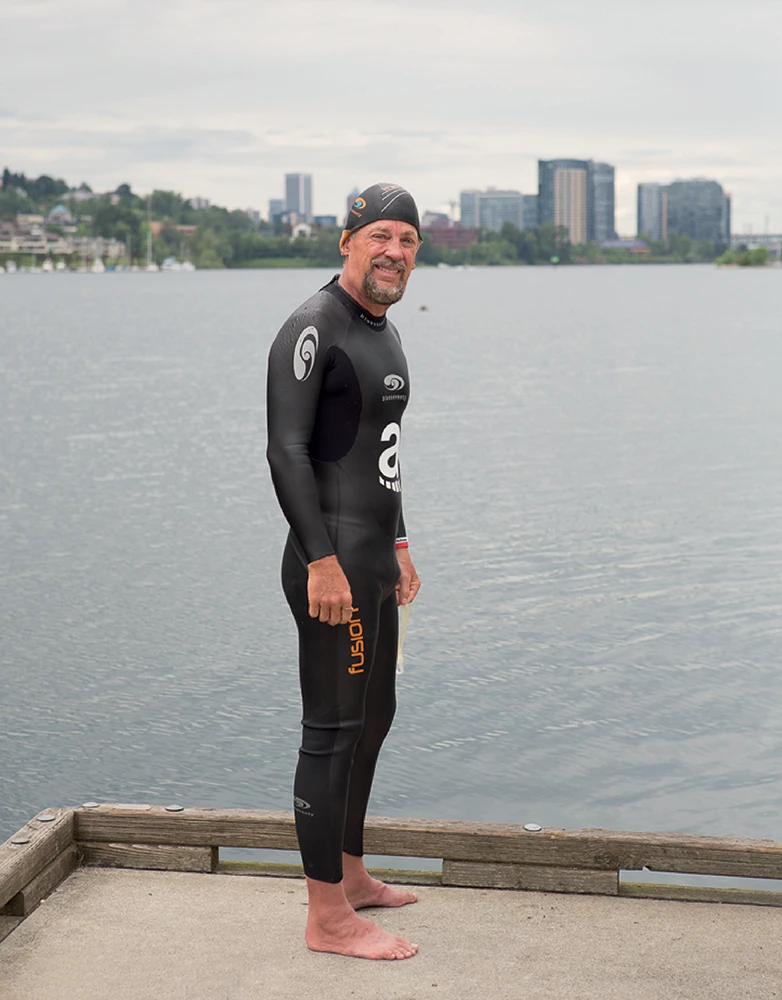
“In 2013, ‘cold plunging’ wasn’t a thing. I’d never heard of Wim Hof. On our first practice swim, the water was 39°F (4°C). I tried without a wetsuit so some London sticklers might count it as ‘official.’ Within minutes, my chest seized; I reflexively blew out all my air and went under. Hypothermic aspiration. Lesson learned.
I called Travis. ‘If I wear a wetsuit, it won’t be an official record.’ He asked, ‘Is that why you’re doing this — to impress a few old men in London? Or are you doing it to inspire people not to be defined by cancer?’ The answer was obvious. I put on the wetsuit and kept the purpose.”
The Swim
“We set off June 3, 2014. The river was snowmelt-cold, the days long. We took Sundays off — publicly because my parents are devout Christians, privately because I wanted to prove to myself I could achieve something unprecedented without doing it perfectly. On July 27 — Mary’s birthday — I swam into the Columbia River and finished. To this day, as far as I know, no one else has completed the Willamette end to end. It’s cold, technical, and full of places where a mistake becomes a story you don’t get to tell.”
Blue Mind, Quiet Miracles
“My family threw a celebration dinner. We were sharing funny ‘Mary stories’ — she was hilarious — when my brother-in-law stopped me: ‘What’s up with you? You haven’t been able to say her name for three years. Now you’re laughing.’ I hadn’t noticed. But I’d spent twenty-two days floating in what marine biologists call ‘blue mind’ — the calming, meditative state that arrives near water within minutes. My nightmares, once nightly, dropped to one or two a week.
Then came the bloodwork. My oncologist, who had planned chemo and radiation ‘the minute you finish,’ walked in and said, ‘I don’t know how to tell you this.’ My stomach dropped — I’d heard that phrase before. He smiled: ‘I can’t find the leukemia. If I hadn’t diagnosed you myself, I’d think we’d made a mistake. Chronic lymphocytic leukemia isn’t supposed to vanish. In thirty years, I’ve never seen it.’”
Back to the Forest
“The lymphoma didn’t obey the same timeline; it swelled and grew. My doctor urged chemo and radiation. I told him, respectfully, that those were my ‘atom bombs’ — a last resort. Nature had healed me once. Could it help again?
I came across research on forest bathing — the phytoncides trees release, and their effect on our natural killer cells. If an hour helps, I thought, what might a day do? So every Friday, I hiked deep into Mount Hood Wilderness, slung a hammock among 100-foot cedars and firs, read, wrote, prayed, breathed, and, at dusk, slid into a glacial stream to wash off the week. By March 2016, my lymphoma was gone.
There was another, quieter healing too. In four years at home, I’d never once woken in tears. Alone beneath those trees, I’d wake at 1 or 2 a.m. and sob — guttural, honest grief the forest seemed to draw out and then cradle. It was as if those living ‘antennae’ let my body finish what it needed to finish.”
BioWild Psychology
“All of this reshaped my work. I call it Biowild Psychology: first restore connection with the source — nature — before pathologising the person. Health isn’t a trophy on the individual shelf; it’s overflow — strength that nourishes family, friends, and community, the way a tree bears fruit for the forest, not for itself.
I still coach people worldwide, often remotely, but my dream is to meet clients in the places that heal: Patagonia, Snowdonia, Oregon — to help them find their river, their forest, their practice.”
A Simple Practice: How Dean Forest-Bathes
- Go where phones don’t work. Claim a full day.
- Walk in quietly, using all five senses.
- Sit or sway in a hammock among trees; read, journal, nap, pray, or simply notice.
- At dusk, immerse briefly in cold running water (if safe).
- Go home unhurried. Repeat weekly.
“Swimming the Willamette didn’t just change my labs; it changed my life. If there’s one message I want to leave, it’s this: your diagnosis, your grief, your past — none of it defines you. Purpose does. Nature helps you remember it.”
Dean Hall – The Wild Cure: From Death to Life on Oregon’s Longest River.
DISCOVER: instagram.com/deanhallofficial