The Promise of Ketamine Therapy for Treating Mental Health
Ketamine therapy has emerged as a powerful treatment modality for a variety of mental health conditions. Its ability to interrupt entrenched patterns of major depression, anxiety, and trauma can open a window of possibility—one in which new insights, perspectives, and ways of relating to oneself become more accessible. Beyond symptom relief, ketamine can also support deeper therapeutic work by softening rigid defenses and allowing previously inaccessible material to surface in a more workable way. When paired with thoughtful preparation and integration, it has the potential not only to alleviate suffering but to support meaningful, lasting change in how a person experiences themselves and their life.

When someone comes to the ketamine chair, they have often been suffering for many years with sadness, fear, anger, shame or self-loathing, or they may experience repetitive thought patterns that keep them stuck in anxiety or despair. They come at a threshold moment- when something in them is read for a fundamental change. In this space, ketamine can open a unique window of possibility as outdated patterns are softened and new ways of seeing, feeling, and relating can emerge.
Psychedelics have been used by humans all over the globe for centuries and have fundamentally shaped human consciousness and spirituality. They have been used in ceremony as a method for connecting to something larger than ourselves, for physical and emotional healing, and for guidance and personal insight. They open doorways into new understandings, and they also open critical periods of social-emotional learning so that we can relearn that there is space for us, and it’s safe to express our authenticity.
The beauty and uniqueness of ketamine is that it often gives immediate relief from suffering in the short term, pulling people out of despair within a very short amount of time. Ketamine can actually not just calm but reset the nervous system, triggering a neuroplastic cascade that rebuilds synaptic connections, reduces neuroinflammation, and regulates the body’s stress response system. It interrupts the neural loops that lock trauma and depression in place, and the dissociative experience itself can create some distance from deeply rooted patterns, especially in the context of therapeutic support.
The Importance of Integration
Taking time for integration is what turns an experience into real change. Without it, ketamine can function more like a short-acting pharmaceutical, shifting brain chemistry for temporary relief without creating a deeper shift in awareness or behavior. Without proper psychological integration, results often don’t last long, and may in fact be destabilizing or confusing. The brain is in a neuroplastic state for just 72 hours following ketamine administration, and without creating the opportunity to make meaning and cultivate change out of the material that surfaces, people often need repeated doses, often over months and years.
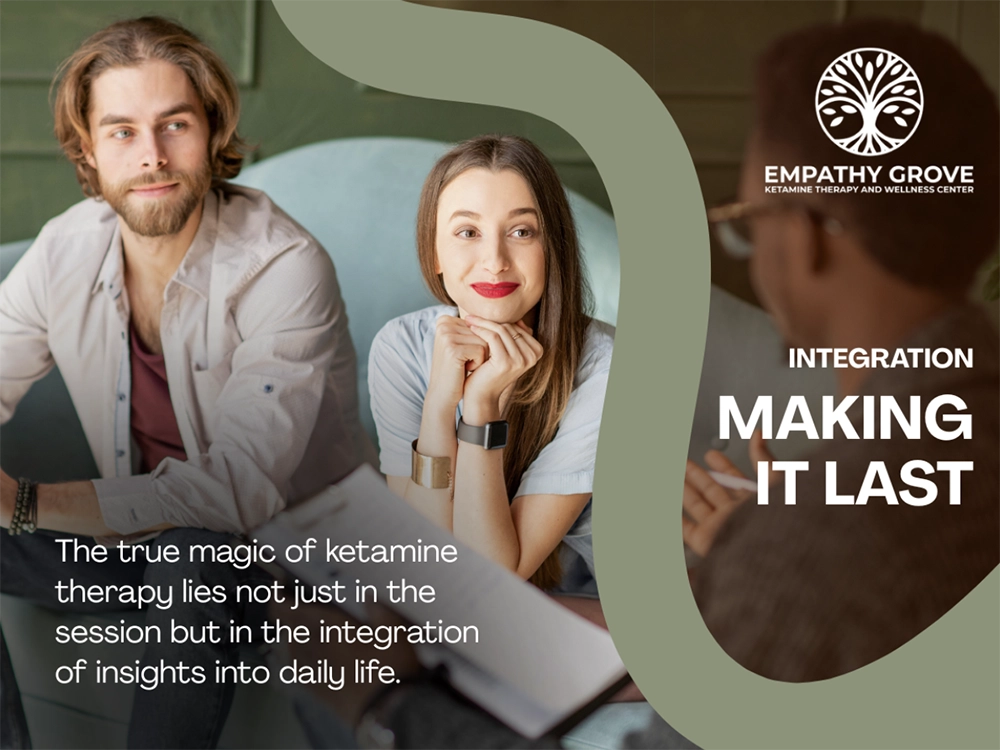
Psychological integration of the ketamine experience is the gentle work of letting insight take root—allowing what was glimpsed to naturally shape how we feel, relate, and live.. Opening a window for change is powerful, but lasting transformation comes from what you build with that opening— intentionally shaping a new way of being rather than just stepping briefly into fresh air. Therapy offers an attuned, spacious environment where this unfolding can happen at the pace of the client’s unique system
Integration sessions often include:
- Deep listening to what emerged, creating space for meaning and insight to arise organically
- Gentle, curiosity-led inquiry and parts-oriented exploration—meeting different aspects of the self with openness rather than judgment
- Supporting shifts in behavior, boundaries, and self-perception as they naturally emerge from within
In this way, change isn’t imposed—it grows, unfolding in its own timing, supported by the grounded, attuned presence of the therapist.
Unfortunately, the majority of ketamine clinics do not provide integration support, instead focusing on maximizing profit instead of prioritizing patient outcomes and healing. We at Empathy Grove Ketamine Therapy and Wellness Center in Portland, Oregon, are an example of a standout exception. Because we understand the imperative for therapeutic integration, we help ketamine therapy clients sort what’s meaningful from what’s momentary, and the clinic’s practitioners support them through vulnerable moments after a session.
Opening into a New Story
During the ketamine journey, I encourage people to “go for the ride.” That ride can look like almost anything; drifting through space, revisiting a childhood home, floating in a womb-like stillness, or lying beneath a starlit sky. Sometimes it feels abstract, other times deeply meaningful. But it’s often the time after the journey that matters most because when meaning begins to take shape, when new perspectives gently land, when healing starts to take root. Sitting with a trusted therapist, feeling held and unconditionally accepted, listening to music or watching geese pass overhead, this is where the nervous system settles and a quiet sense of peace can emerge.
In that softened state, the mind’s usual structures loosen. The rigid ways we’ve been holding ourselves and our lives begin to relax, and something more spacious becomes possible. We find ourselves in a kind of threshold, much like the collective moment we’re living in now, where old stories are unraveling and new ones have yet to fully form. Entering a psychedelic experience mirrors this uncertainty. We step in because the story we’ve been living no longer fits, and something in us is ready for a different way of being, even if we can’t yet name it.
In this opening, people often glimpse a deeper sense of self—something steady, expansive, and connected beneath the surface of everyday identity. One client, with awe in her voice, said, “There is nowhere to fall,” realizing she couldn’t fall out of life because she is life. Another described sensing two parts of herself at once: a “Big Self” connected to the whole universe, and a “Small Self” navigating daily reality—understanding that even when she feels caught in the small self, the larger one is always there. These insights can be profound, offering new ways of relating to pain, identity, and purpose. And yet, without support, they can fade as old patterns quietly return. Integration is what helps carry the new story forward—so it doesn’t remain a fleeting glimpse, but becomes something we can live into and grow over time.
Healing Is a Process
Ketamine-assisted therapy is not about achieving perfect insight or forcing lessons, it is about staying connected to what truly matters. The ketamine experience is an opening, not a substitute for deep processing or practical action. Often, clients revisit traumatic memories, reclaim lost parts of themselves, and integrate forgotten aspects back into their current lives. This healing may require feeling grief, updating protective behaviors, and making intentional changes.
Early adaptations, developed in childhood to meet our need for connection, can persist into adulthood, shaping our behaviors and identities. Ketamine therapy reveals that we exist beyond these patterns, offering a chance to recreate our lives from a place of deeper knowing.
Creating Space
A key benefit of ketamine therapy is its ability to shift the nervous system out of a trauma response, allowing for true relaxation and calm. Whether the journey leads to immediate processing or simply a slower, more peaceful state, the challenge is often to integrate this newfound calm into daily life. This requires intentional steps to make space for one’s needs and authentic self in relationships and routines.
Healing is not linear and ketamine is not a magic solution; rather, it provides an opportunity and perspective within a calm nervous system. Authentic living and lasting change require ongoing cultivation, ideally supported by a trusted, compassionate therapist.
Collaborative Healing in Practice
The process starts by understanding a client’s intentions and current challenges, exploring their history, health, support systems, and self-care. Together, we set a meaningful intention, open to whatever unfolds.
During the ketamine session, we create a safe, soothing space: eye masks, calming music, blankets, and steady therapeutic presence. Rituals and spiritual support are welcomed as desired. There is no rush after the journey; we simply hold space for whatever emerges, whether that’s conversation, quiet reflection, drawing, or gazing outdoors.
In the following integration session, we gently explore the insights and experiences, letting meaning develop naturally. We translate these insights into small, grounded steps for my client’s daily life, focusing on self-compassion, curiosity, and care. If difficulties arise, supportive practices help them remain steady and connected.
Integration is not about having all the answers, but about nurturing their ongoing relationship with themselves, staying open, compassionate, and curious as their new story unfolds.
Conclusion
Integration in ketamine therapy bridges transformative in-session insights with real-world change. Ketamine therapy integration is a process, not a performance; kindness and consistency are key. We emphasize this practice at Empathy Grove in Portland, Oregon, where our ketamine therapy integration services are expertly designed to complement the ketamine experience, supporting clients through every step of their healing journey.
Written by Dr. Amy Kelchner, ND., clinical director at Empathy Grove Ketamine Therapy and Wellness Center in Portland, Oregon.
- About the Author
- Latest Posts

Our Editorial Team are writers and experts in their field. Their views and opinions may not always be the views of Wellbeing Magazine. If you are under the direction of medical supervision please speak to your doctor or therapist before following the advice and recommendations in these articles.