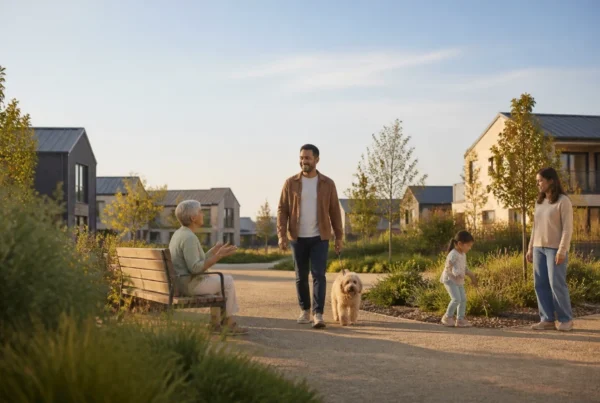
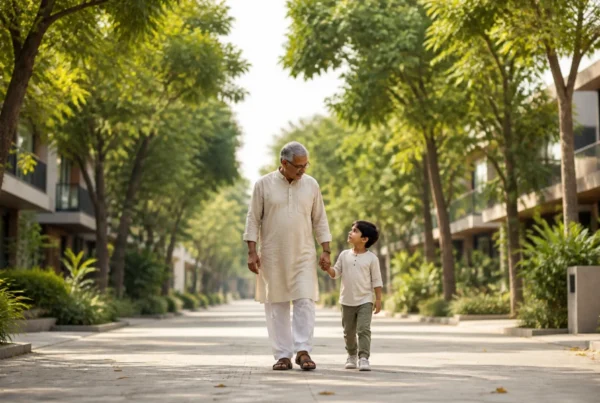
What if the biggest lever for public health is not in the bathroom cabinet, but in the streets outside our front door?
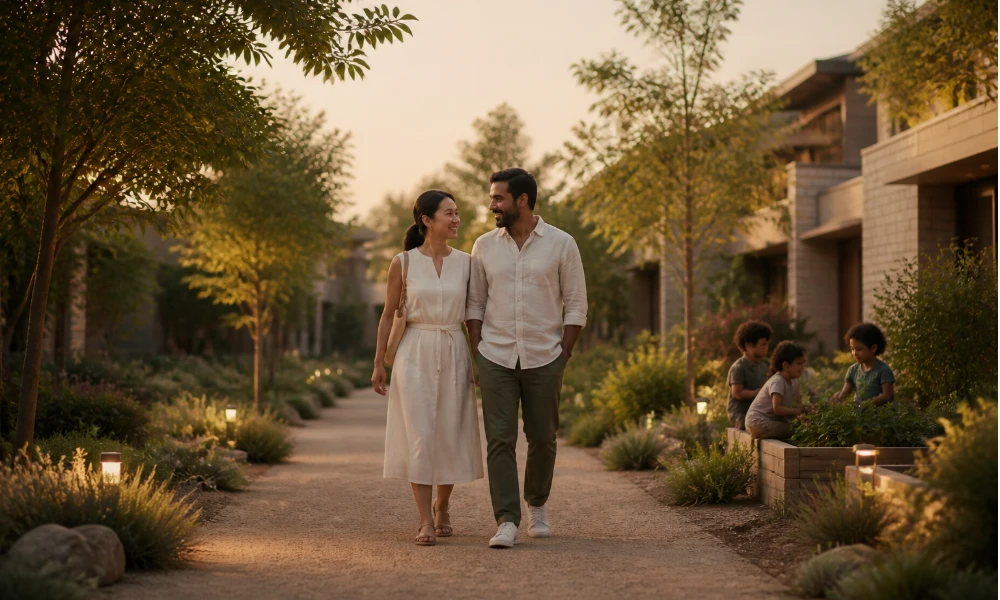
We have become very good at talking about wellbeing as something we must actively add to our lives.
We buy the supplements, download the meditation app, join the gym, book the retreat and promise ourselves that next month will be different. We wait until our sleep is disturbed, our bodies hurt, our anxiety rises or we are too exhausted to think clearly, and then we search for something that might make us feel well again.
But what if we are looking for wellbeing in the wrong place?
What if our health is not shaped only by the choices we make after something has gone wrong, but by the environments in which we make those choices every day? The view from the kitchen window. The route to school. The noise outside the bedroom. The safety of the pavement. The presence of trees. The distance to a park. The ability to step outside after dinner and walk without getting into a car.
Perhaps wellbeing begins long before we enter a doctor’s surgery, open a medicine cabinet or arrive at a point of burnout. Perhaps it begins with the way we design our homes, neighbourhoods and daily lives.
What does it truly mean to be well?
For most of us, the structure of adult life is decided remarkably early.
We move through school, perhaps university or training, and then rush towards the first job that offers us a foothold. From that moment, work begins shaping almost everything else. Our salary determines what we can afford. Our workplace influences where we live. Our commute dictates when we wake, when we eat and how much time remains at the end of the day.
We rarely pause before choosing a career and ask: How do I want my ordinary Tuesday to feel?
What environment makes my heart sing? How much daylight do I need? Do I want to walk to work, work from home or live within a community where the things I need are close by? Do I feel restored by mountain views, water, woodland, open skies or the energy of a busy city?
For me, it is mountains and trees. For someone else, it may be the sea. Another person may feel most alive among theatres, cafés, galleries and bustling streets. Wellbeing does not require us all to retreat to the countryside. Cities can offer stimulation, belonging, culture and connection that are equally important to human health.
Yet ask most people to describe the moments in which they feel genuinely restored and nature will probably appear somewhere in the answer: sitting beneath trees, paddling in water, walking beside the sea, lying in long grass or looking across an uninterrupted horizon.
The World Health Organization identifies urban green spaces as valuable public-health infrastructure because they can support physical activity, psychological relaxation and social connection while reducing exposure to excessive heat, noise and air pollution.
Why, then, is contact with nature still treated as a leisure activity rather than a condition of everyday life?
Nature should not be saved for the weekend
Many of us postpone nature.
We wait for the summer holiday, the weekend walk or the occasional trip to the coast. We squeeze a few restorative hours into a life otherwise spent between buildings, screens, traffic and artificial light.
This turns nature into another item on the wellbeing to-do list: something beneficial that requires planning, travelling, equipment and time.
But the research suggests that smaller and more regular encounters matter too. Reviews of nature-based walking interventions have found improvements in mood, optimism and mental wellbeing, alongside reductions in stress, anxiety and repetitive negative thinking. Some evidence indicates that walking in natural surroundings may offer greater benefits for anxiety and rumination than walking through heavily built-up environments.
An umbrella review published in 2025 found beneficial associations between green-space exposure and outcomes including mental health, cognitive function and mortality, while also warning that the strength and quality of evidence varies across different health conditions. Nature is not a miracle cure, but the overall pattern is difficult to ignore.
Crucially, we should distinguish between being able to see greenery and being able to meaningfully use it.
A strip of grass beside a dual carriageway is technically green space. A fenced field may look rural. A young tree planted between two parking bays might satisfy a landscaping condition. None of these necessarily gives a child somewhere to play, an older person somewhere to walk or a tired parent somewhere to breathe.
Wellbeing is not created by colouring unused land green on a development plan. It is created by making nature visible, accessible, safe and woven into the journeys people already make.
A city can sometimes offer more nature than the countryside
There is a persistent assumption that urban life is disconnected from nature while rural life is immersed in it. The reality is more complicated.
I live in a village surrounded by fields. From a distance, it appears wonderfully green. Yet many of those fields and woodlands have no public access. The community is connected by narrow country roads that can be dangerous to walk along, particularly in winter when darkness arrives early and there is little street lighting or pavement provision.
An evening walk after dinner may be practically impossible.
Meanwhile, a friend living in New York can reach a public park within minutes. She has pavements, lighting, pedestrian crossings and a destination that is open and accessible. Although she lives in one of the world’s most densely populated cities, she may have more usable access to nature than someone whose home is surrounded by privately owned countryside.
This is why we need to stop measuring nature by what can be seen from above and start asking what can be reached on foot.
Can a child walk safely to a wooded area without crossing a fast road? Can a woman walk alone after dark without feeling vulnerable? Can someone using a wheelchair or mobility scooter reach the park? Are there benches for people who cannot walk far? Does the path connect to homes, shops and schools, or does it end at the edge of the development?
Access is not simply about distance. It is about whether the journey feels possible.
The greenest cities are designing nature into daily life
Some cities are beginning to understand this.
The Ellinikon, a vast regeneration project on the Athenian Riviera, describes itself as a next-generation green and smart city. Built across approximately 6.2 million square metres, the development is transforming the site of Athens’ former international airport into a mixed urban district centred around homes, culture, public space and a substantial metropolitan park.
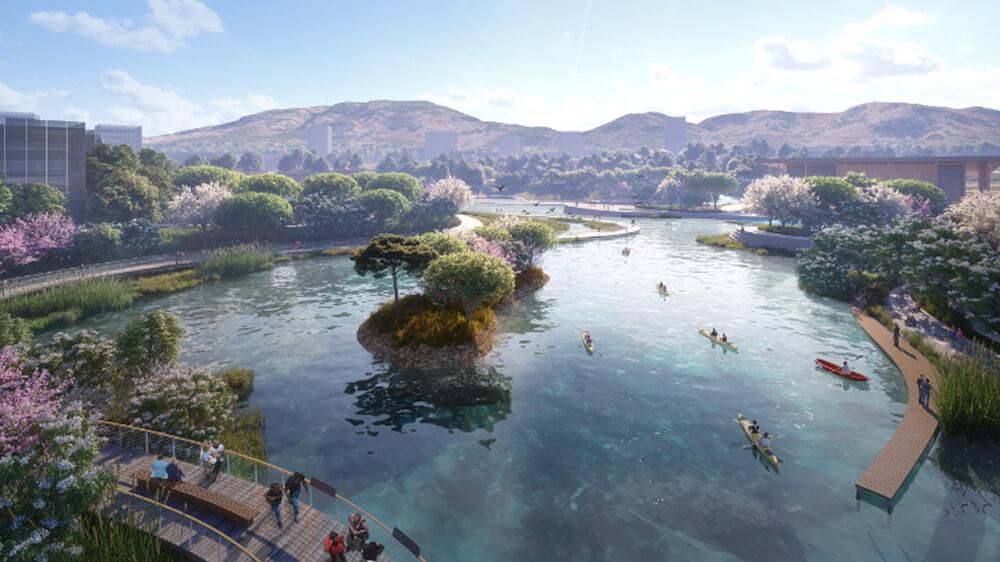
Its language is revealing: “A city reimagined. Life redesigned.”
That should be the ambition of development—not simply to fit the maximum number of housing units onto a parcel of land, but to consider how life will actually be lived between them.
Elsewhere, cities are experimenting with rooftop habitats, urban forests, green corridors, community growing and planting designed to draw cooler air into dense urban centres. The examples collected by BBC Earth demonstrate that bringing nature back into cities does not require a single model. It can mean allowing vegetation to reclaim hard surfaces, restoring waterways, connecting fragmented habitats or introducing greenery at roof, street and neighbourhood level.
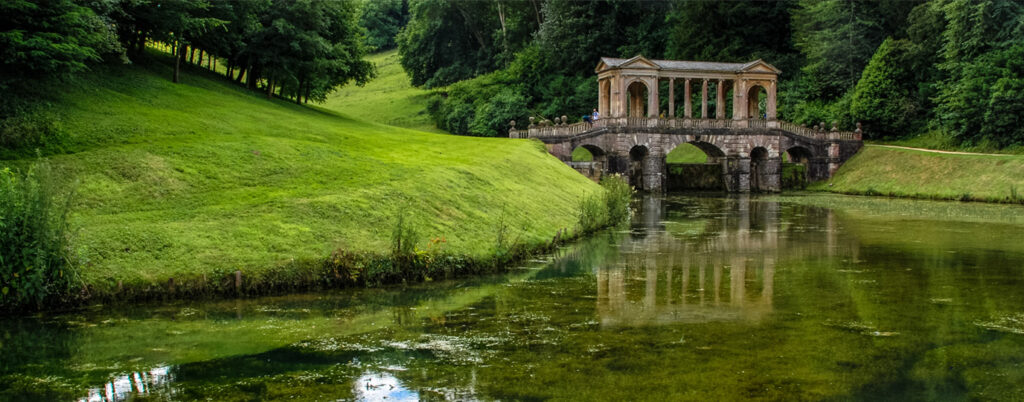
Perhaps surprisingly, it is Bath that residents currently rate most highly for green space and access to nature. In Time Out’s 2026 city survey, based on responses from more than 24,000 urban residents across its wider city research, Bath achieved a 94 per cent approval score for green space and nature. Chicago and Montreal followed it in the global green-space ranking.
Bath also scored highly for community feel and belonging. That connection is worth noticing. Green spaces are not only places for exercise; they are places where people pause, meet, observe, play and participate in public life.
A good park can be part gym, part meeting room, part playground, part sanctuary and part village square.
Green space is also an equality issue
Access to nature is not evenly distributed.
Office for National Statistics analysis found that one in eight British households had no access to a private or shared garden, rising to more than one in five households in London. The same analysis highlighted profound inequalities: Black people in England were nearly four times as likely as White people to have no outdoor space at home.
This matters because the communities with the greatest health challenges are not always those with the easiest access to safe, attractive and well-maintained natural spaces.
Research examining disadvantaged communities has found that the quality of neighbourhood green space can be particularly important. A neglected park that feels unsafe or inaccessible will not deliver the same protective value as a welcoming place with paths, seating, shade, biodiversity and opportunities for social activity.
We cannot tell people to “spend more time outside” while designing neighbourhoods that make doing so difficult.
Wellbeing cannot become another form of personal responsibility in which individuals are blamed for not walking, exercising or managing stress, while their surroundings encourage driving, isolation, inactivity and exhaustion.
What if we prescribed places before pills?
Medication is essential. Medical treatment saves lives. Nature should never be presented as a substitute for necessary clinical care.
But perhaps we should ask why so much of our health system is focused on intervening once poor health has already taken hold.
NHS England describes prevention as central to improving population health and reducing inequalities. It also recognises green social prescribing, through which people are connected to gardening, walking, conservation and other nature-based activities to support physical and mental wellbeing.
This is a promising shift, but it raises another question.
Why must nature be prescribed at all?
Why is it not already present in the design of the patient’s neighbourhood?
A doctor might recommend walking, yet the patient may live beside an unsafe road. A therapist may suggest time outdoors, yet the nearest park might require two buses. An older person may be encouraged to stay active, but there may be no bench between their home and the shops.
We are attempting to prescribe behaviours that our built environment repeatedly obstructs.
Evidence reviewed by the WHO suggests that investments in walking and cycling routes can produce benefits far beyond transport, with some trail projects reporting benefit-to-cost ratios greater than four to one through increased physical activity and associated health gains.
Imagine what might happen if a fraction of the money spent treating preventable ill health were invested earlier in connected paths, trees, accessible parks, community gardens, natural play areas and safe routes between homes and everyday services.
Instead of asking only, “How many homes can we build here?”, we might ask, “How much health can this place create?”
A new definition of housing infrastructure
When new developments are built on former farmland, the process can feel brutally simple. A boundary is drawn, roads are added and the remaining land is divided into plots of houses of different sizes.
Nature becomes whatever is left over.
There may be an attenuation pond behind a fence, several young trees, a narrow landscaped strip and perhaps a play area positioned on the edge of the estate. The development can then be described as green, even when residents still need to drive to reach a meaningful walk.
We need a broader definition of essential infrastructure.
Infrastructure is not only drainage, roads, electricity and broadband. It is also the network of conditions that allows people to remain physically active, emotionally regulated and socially connected.
That means continuous walking and cycling paths rather than isolated fragments. It means mature trees and planting that provide shade, beauty and seasonal change. It means blue spaces that are safe and ecologically healthy. It means community gardens, orchards, natural play, seating, sheltered spaces and routes suitable for wheelchairs, prams and mobility scooters.
It also means preserving dark skies and open views where possible. Seeing the sky, watching weather move across a landscape and observing the changing seasons reconnect us to rhythms that our screen-dominated lives can easily erase.
Design the ordinary day
The future of wellbeing will not be solved by another product alone.
It will be shaped by whether someone can walk among trees before work. Whether a child can play outside without being driven somewhere. Whether teenagers have safe spaces beyond their bedrooms. Whether older adults can remain connected to the community as their mobility changes. Whether neighbours naturally cross paths.
The most powerful wellbeing interventions may be the ones we barely notice because they are built into the ordinary day.
A path that makes walking the easiest choice.
A tree that shades a bench.
A park visible from the front door.
A communal garden where conversations begin.
A safe route connecting a village to the countryside surrounding it.
A city street alive with plants, people and possibility.
The question is not whether everyone should leave the city for a rural life. Nor is it whether nature can replace medicine. The question is whether we have underestimated the extent to which health is produced—or eroded—by place.
Perhaps the biggest public-health opportunity is not waiting in a laboratory, clinic or bathroom cabinet.
Perhaps it is waiting outside the front door.
And perhaps the most important question we can ask of any new home, neighbourhood or city is no longer simply, How many people can live here?
It is this:
How well will they be able to live?
- About the Author
- Latest Posts

Rachel Branson is the Founder of Haywood Media and Editor-in-Chief of Wellbeing Magazine, where she has spent more than twenty years exploring the relationship between health, wellbeing and the environments in which we live. Her passion for housing began growing up in her family’s estate agency, where her grandfather, father and uncles worked as a Chartered Surveyor specialising in commercial, residential property and new homes. She later became Head of Communications for a social housing provider, working closely with communities and new developments. Bringing together experience across property, housing, communications and wellbeing, Rachel is developing a new body of work focused on how homes and neighbourhoods can be designed to support healthier, happier lives through every stage of life.