Few approaches to food seem to attract as much idealism, projection and debate as raw veganism. People often speak about it as though it were either salvation or folly, when the reality is usually far more human than that.
Many people feel extraordinary on a raw vegan diet, at least for a time. They report easier digestion, clearer skin, unparalleled energy, a greater sense of vitality and, sometimes, a feeling of living in closer alignment with nature. Others begin with similar hope but gradually find themselves depleted, anxious, bloated, underfed or increasingly rigid around food. Both experiences are real, and both deserve to be taken seriously.
So perhaps the better question is not whether raw veganism is good or bad in the abstract. It is whether the particular flavour of raw vegan diet adopted is genuinely nourishing the person living on it.
Why raw veganism appeals so strongly
Part of the attraction is obvious. Raw vegan food can look vivid, fresh and beautiful. Fruit, greens, herbs, sprouts, soaked seeds, colourful salads and young coconuts all carry a certain promise of lightness. For many, the appeal is not only nutritional but symbolic. It can represent simplicity, clarity, ethics, purity and a wish to live in a more direct relationship with the natural world.
And, in fairness, people nearly always do feel better at first.
When someone moves away from ultra-processed foods, heavy restaurant meals, sugar, alcohol and erratic eating and towards a more whole-food, plant-rich way of eating, the shift alone can bring considerable relief. More water-rich foods, more fibre, more micronutrients and fewer inflammatory burdens can make a noticeable difference in a short space of time.
In that sense, the early benefits are often entirely genuine. They should not be dismissed simply because they do not tell the whole story.
Why it can become more difficult over time
What begins as cleansing can, for some people, become quietly depleting if it is not adapted with care.
One of the most common problems is simple under-eating. Raw foods tend to be high in volume but often less calorie-dense than people imagine, which means someone can feel full while still not taking in enough energy. Over time, that matters. The body cannot run indefinitely on ideals.
Protein can also become too sparse if the diet leans heavily on fruit and vegetables without enough structured support from foods such as sprouted pseudograins, nuts seeds and, sprouted legumes. Micronutrients deserve similar attention. B12 is essential, and beyond that there may be questions around iodine, iron, zinc, selenium, calcium and omega 3 status, depending on the individual.
Blood sugar regulation is another piece of the puzzle. A diet that is vastly fruit-heavy, or too low in protein, fats and minerals, may leave some people feeling clear and buoyant one moment and oddly anxious, hungry or exhausted the next.
For women, the menstrual cycle often tells an especially honest story. Shortened cycles, irregularity, lower resilience, worsening PMS or reduced libido can all suggest that the body is not receiving enough support. It is often the body’s way of saying that something which appears “clean” on paper may not feel sufficiently resourced in practice.
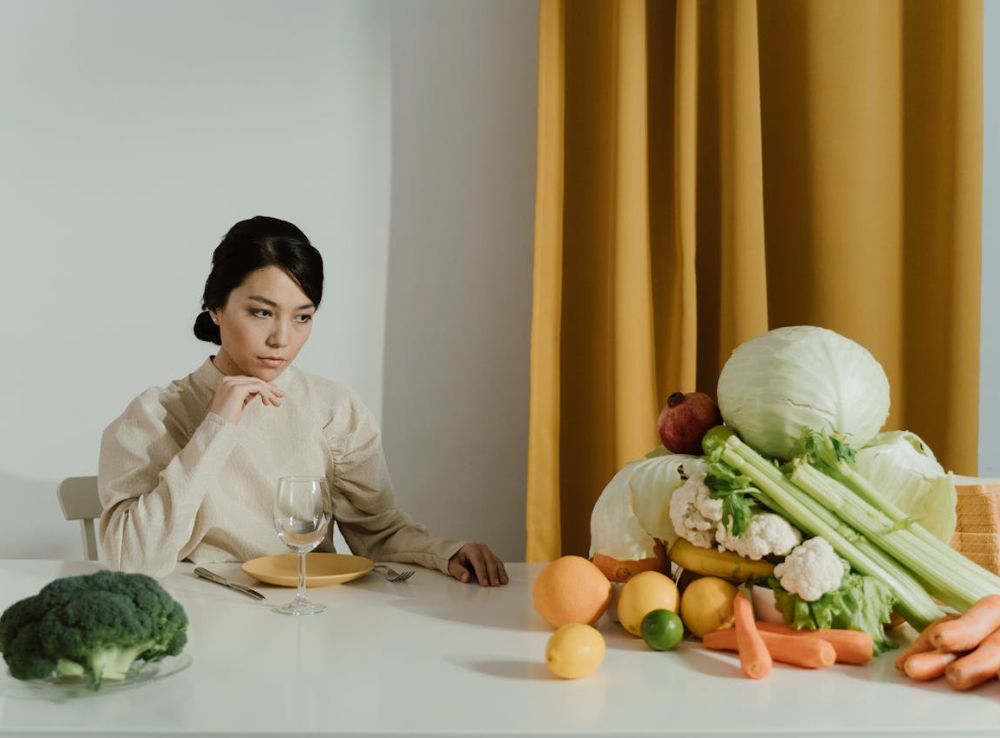
Digestion is not always improved by more rawness, at least at first
There is also the practical matter of digestion. Some people do remarkably well on a very high raw intake from the get-go. Others become bloated, cold, uncomfortable or overwhelmed by the sheer bulk and fibre load of the diet, especially when the shift has been abrupt.
This does not necessarily mean raw food is inherently unsuitable. It may simply mean the gut has not adapted, the meals are too bulky, or the person’s current digestive capacity is being asked to do more than it comfortably can.
The nervous system matters here too. Restrictive eating, even when dressed in wholesome language, can make some people more brittle, perfectionistic and physiologically stressed. There comes a point at which food ceases to feel like nourishment and begins to feel like moral performance.
That is rarely a sign that things are going well.
A healing phase is not necessarily a lifelong template
One of the more unhelpful habits in nutrition is the assumption that any approach which helps for a season must therefore be the right way to eat forever.
Sometimes a raw vegan diet works beautifully as a reset. It may help someone reconnect with appetite, simplify their meals, increase whole food intake and reduce their reliance on more burdensome foods. That can be valuable. But a therapeutic phase is not the same as a universal rule.
Life changes. Hormones change. Stress changes. Digestive capacity changes. Climate changes. The body you have at twenty eight is not necessarily the body you have at forty eight, and neither one should be expected to live happily under the same dietary doctrine without question.
Wisdom in nutrition is rarely about rigid loyalty. More often, it is about staying honest enough to notice when something that once helped is no longer helping in quite the same way.
What seems to make it sustainable
When a raw vegan diet does work well over the long term, it is usually being done with more thoughtfulness and flexibility than outsiders realise.
There is enough food. There is enough protein. Fats are included sensibly, rather than feared or overdone. Mineral intake is considered. Supplementation is approached with maturity rather than denial. Digestion is respected. The person is paying attention not only to how the diet looks, but to how they actually feel living on it.
And perhaps most importantly, there is flexibility.
That may mean adjusting the ratio of fruit to greens. It may mean relying more on sprouts, seeds and other structured sources of nourishment. It may mean including strategic supplementation. For some, myself included, it may mean that the most sustainable version of raw veganism is not fully raw at all, but mostly raw, with some lightly cooked, grounding foods added according to season, stress levels or digestive needs.
That is not failure. It is responsiveness.
Signs your diet may not be serving you well
Sometimes the body whispers before it shouts. Feeling cold much of the time, sleeping poorly, losing hair, becoming anxious around food, noticing cycle changes, feeling socially restricted, bloated or increasingly tired are not trivial details to be explained away in the name of purity.
Health is not the same as looking disciplined. Nor is it the same as appearing virtuous online.
A way of eating should make a person feel more robust, not less. More nourished, not more frightened. More alive, not more brittle.
A more honest conclusion
Can a fully raw vegan diet be sustained long-term? For some people, undoubtedly yes. For others, it seems to be more advantageous to adopt a modified high-raw form. And for others still, it may serve best as a phase rather than a permanent identity.
The deeper point is that the success of any diet depends on context. Constitution, stress levels, hormones, digestive capacity, activity, climate, stage of life and meal structure all matter. So does a person’s emotional relationship with food.
There is a line from T.S. Eliot that feels relevant here: “The only wisdom we can hope to acquire is the wisdom of humility.” Nutrition asks for precisely that. Enough humility to recognise when the body is thriving, and enough humility to recognise when it is asking for something different.
In the end, the most meaningful question is not whether a label has been followed perfectly. It is whether the person is genuinely well.
- About the Author
- Latest Posts

Camilla Brinkworth is a naturopath, nutritionist (BHSc Naturopathy, GradCert Human Nutrition) and Family Constellations facilitator with 15 years of experience in the wellness industry. She specialises in plant-based nutrition, mental health and holistic natural PMDD recovery. Her approach goes beyond food and supplements—she combines lifestyle medicine and nutritional guidance with herbal medicine, nervous system support, trauma processing and ancestral healing work to address the deeper causes of disease. Originating from the UK, Camilla now lives in Ubud, Bali, offering online consultations to clients worldwide. Having personally overcome PMDD, autoimmune arthritis, anxiety, depression, and panic disorder, Camilla understands the complex relationship between the body, mind, and lived experience; her clinical work is grounded in compassion, and evidence-informed practice. As a speaker, clinician, and educator, Camilla guides people in understanding the deeper story behind their symptoms, resolving what’s held in the body, and supporting long-term transformation through highly expertised, science-backed yet holistic care.