
Why Employee Development Is the Wellbeing Investment Most Businesses Overlook
Ask most business owners what they invest in for employee wellbeing. You'll hear about gym memberships. Mental health apps. Flexible working. All of those…

Ask most business owners what they invest in for employee wellbeing. You'll hear about gym memberships. Mental health apps. Flexible working. All of those things matter. But one investment consistently gets left off the list, despite having some of the strongest evidence behind it.
That investment is employee development. The opportunity for people to learn, grow and build real skills in their role.
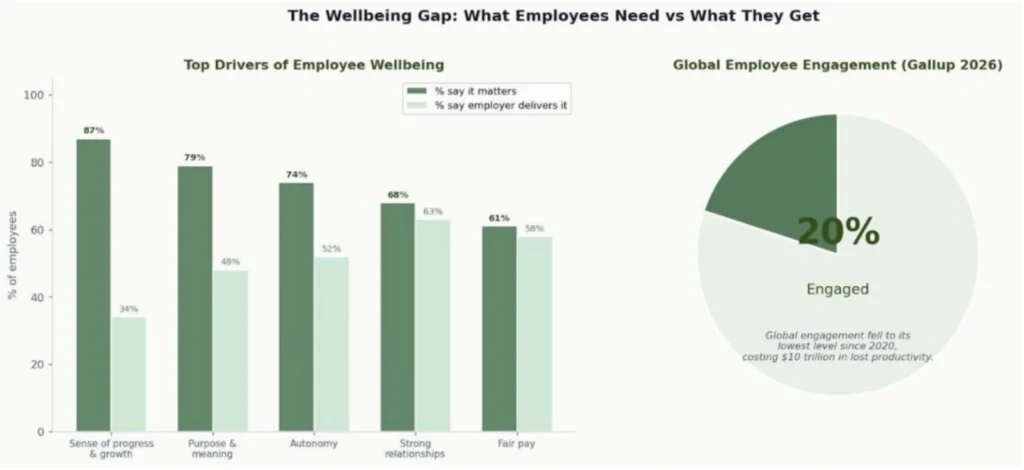
The latest Gallup State of the Global Workplace 2026 report found that global employee engagement fell to just 20% in 2025. Its lowest level since 2020. The estimated cost to the world economy: $10 trillion in lost productivity. That is not a small number. And it points to a crisis that gym discounts alone cannot solve.
The root cause, in most cases, is not a lack of perks. It is a lack of progress.
Why Growth Is a Wellbeing Need, Not a Bonus
Psychologists have known this for decades. Self-determination theory, one of the most robust frameworks in occupational psychology, identifies three core human needs that drive wellbeing at work: autonomy, relatedness, and competence.
Competence — the sense that you are developing real mastery — is not a nice-to-have. Research published in the journal Behavioral Sciences found that satisfying the need for competence at work is directly linked to better performance, higher engagement, and lower burnout. When people feel like they are getting better at something, they feel better, full stop.
And yet most businesses treat training as a compliance exercise. A box to tick. Something that happens once during onboarding and then disappears.
The result is employees who feel stuck. Who stop growing. Who eventually start looking for somewhere that will invest in them — and usually find it somewhere else.
The Numbers Are Hard to Ignore
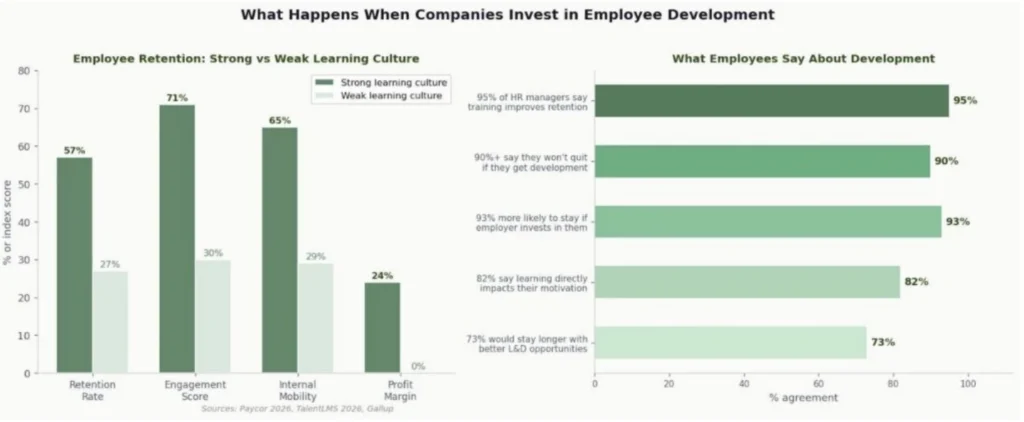
The TalentLMS 2026 Learning and Development Report found that 73% of employees would stay longer at their company if it offered stronger learning and development opportunities. That is not a minority view. That is nearly three quarters of your workforce telling you exactly what would keep them.
The same report found that 95% of HR managers agreed that better training and skills development directly improves retention. Meanwhile, data from Paycor's 2026 retention analysis shows that organisations with strong learning cultures retain 57% of their employees, versus just 27% in those without.
That is more than double the retention rate. For a business of any size, that gap is enormous.
The financial case is just as clear. According to Devlin Peck's training statistics analysis, companies that offer consistent employee training earn more than double the income per employee and carry a 24% higher profit margin overall. Development is not a cost centre. It is a growth driver.
What Most Companies Get Wrong
The problem is not usually a lack of intention. Most business owners genuinely want to support their people.
The problem is execution. Training gets organised informally. Someone runs a session. A few people attend. Nobody tracks who completed it. Certifications are issued on paper and then forgotten. Six months later nobody can tell you what your team actually knows, what qualifications are current, or whether the training made any difference.
The LinkedIn 2025 Workplace Learning Report found that 88% of organisations are concerned about employee retention, and that providing learning opportunities is the number one retention strategy. But only 36% qualify as genuine career development champions — organisations with robust, structured programmes in place.
The gap between knowing development matters and actually delivering it well is where most businesses fall short.
Ad-hoc training tends to be inconsistent. Different employees get different experiences. Some managers prioritise it, others don't. The business has no clear picture of skills, gaps or progress. And employees quietly notice all of it.
What Employee Development Looks Like in Practice
The case for development is not abstract. Across very different industries, the same pattern holds: structured investment in people produces measurable business results. Here are three examples.
Healthcare. Clinics and healthcare providers face some of the most demanding training requirements of any sector. Staff must hold current certifications across safeguarding, infection control, medication handling and more. A missed renewal is not just an admin problem — it is a compliance risk. Healthcare businesses that manage this through structured training programmes, with automatic certification tracking and renewal alerts, consistently report fewer incidents, better inspection outcomes and lower staff turnover. The training itself becomes part of the culture of care.
The wedding industry. Wedding photographers and planners operate in a high-stakes, high-emotion environment where client experience is everything. Studios that invest in developing their teams — not just on technical skills but on the entire client journey — tend to generate far stronger referrals and repeat business. That includes how work is delivered after the day itself. Learning to share photos with clients in a polished, professional way — rather than sending a Dropbox link and hoping for the best — is a genuine, trainable skill. Studios that treat it as part of onboarding see fewer complaints, faster approvals and clients who are far more likely to recommend them.
Hospitality and wellness retreats. Retreat businesses often rely on seasonal or rotating teams, which makes consistent training especially difficult. When onboarding is ad-hoc, the guest experience varies depending on who happens to be working that week. Retreat operators who invest in structured staff development — covering everything from guest communication to safety protocols — create a consistent standard that guests feel and respond to. That consistency is not accidental. It is the result of treating training as a system, not an afterthought.
Structure Is the Key Ingredient
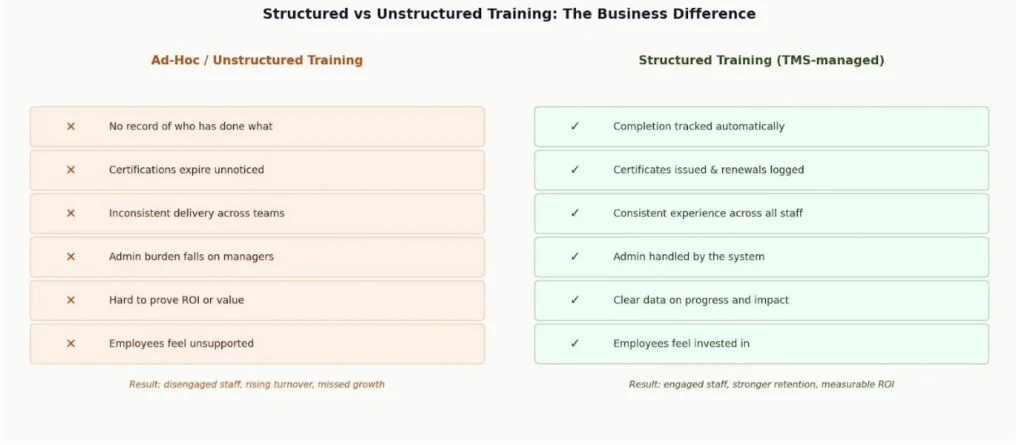
The difference between training that works and training that doesn't usually comes down to structure. Not the content itself, but the system around it.
Structured development means employees know what is expected of them. They have a clear path. They can see their progress. They get recognised when they complete something. These are the conditions that make learning feel good rather than like an obligation.
Structure means having a system that tracks who has completed what, issues certificates automatically, and flags renewals before they lapse — rather than leaving it to someone's memory or a shared spreadsheet. Tools like EduAdmin exist specifically to handle that operational layer, so the business can focus on the quality of the training itself rather than the admin around it.
When development is managed this way, it stops being something that relies on a manager remembering to chase people. It becomes part of how the business runs.
Employees notice that too. When the process is seamless — when they receive a proper certificate, when their progress is tracked, when the business clearly has a system for this — it sends a signal. It says: this organisation takes your development seriously.
That signal has real wellbeing value. It reduces uncertainty. It increases the sense of progress. And it makes people feel like they matter.
Real Businesses Are Already Doing This
The companies consistently cited as the best places to work tend to share this trait. Google's g2g (Googler-to-Googler) learning programme is built around the idea that a culture of learning sustains itself — employees at every level teach and learn from each other, and the company actively manages and tracks that process. The result is a team that feels continuously supported and engaged.
Microsoft's approach is grounded in what they call a growth mindset — the belief that skills can always be developed. According to Employment Hero's analysis, Microsoft found that when employees adopt this mindset, engagement with their work increases significantly. The company invests heavily in making that possible through structured learning programmes.
Neither of these is a coincidence. The businesses that perform best over time tend to be the ones where people feel like they are moving forward.
Where to Start
If your business doesn't have a structured approach to employee development yet, the good news is you don't need to overhaul everything at once.
Start with these three questions:
- What do our employees actually need to learn to do their jobs better and feel more confident in their roles?
- How are we currently tracking who has completed what training — and does that system actually work?
- Are we recognising development properly, with certificates and visible progress, or does it just disappear once a session is done?
The answers will usually point to where the gaps are. Most businesses find the biggest issue is not content — it is the system around the content. Nobody is tracking completion. Certifications are not being renewed. Employees have no visibility into their own progress.
Fixing that does not require a huge budget. It requires a decision to take development seriously and a system that makes it manageable.
The Wellbeing Investment That Pays Back
Wellbeing at work is not just about how people feel in the moment. It is about whether they feel like they are going somewhere. Whether they believe the business sees them as someone worth investing in.
Development delivers both. It gives people the sense of progress that psychology tells us is essential for sustained wellbeing. And it gives businesses the engaged, capable, loyal teams they need to grow.
Most wellness budgets are spent on things that reduce stress after the fact. Employee development is one of the few investments that addresses the root cause — the feeling of being stuck, unseen and undervalued.
Filed underRetreat