For most of the history of facial implants, choosing one meant choosing from a catalogue. Chin implants came in small, medium, and large, in a handful of shapes. Cheek implants offered a few profiles. The surgeon picked the closest match and, if it did not sit well, carved it by hand in the operating room.
The problem is that a face is not a catalogue. Facial skeletons vary in ways a standard shape cannot accommodate: one side of the jaw sits further forward than the other, the chin is deficient vertically rather than horizontally, the cheekbone slopes at an angle no stock implant was designed around. A near-fit is usually visible, and it is visible in exactly the way patients hoped surgery would avoid.
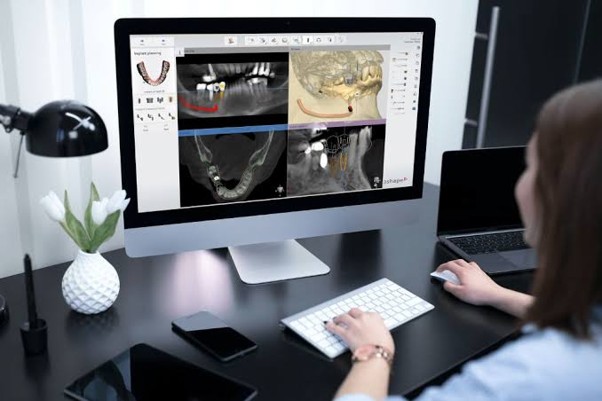
That gap is what patient-specific implants were built to close. Jonathan Zelken, MD, a board-certified plastic surgeon in Newport Beach whose practice concentrates on facial surgery, is among a relatively small number of surgeons in Southern California offering fully custom-designed implants for the chin, jaw, and cheeks — designed digitally against the patient’s own
anatomy before any operation is scheduled. The process behind that sentence is worth understanding, because it changes what the surgery is and what it costs in time.
What “custom” actually involves
It starts with imaging. A CT scan captures the facial skeleton in three dimensions, which is then converted into a digital model of that specific patient’s bone.
The design happens on screen. The surgeon works through iterations — adding projection here, reducing it there, correcting for asymmetry that exists in the bone rather than pretending it does not. The implant is shaped to the surface it will sit on, so that its underside matches the contour of that person’s bone rather than approximating it.
Manufacture follows, typically in biocompatible material, and the finished implant arrives sterile and ready. That sequence takes weeks, not days. It is not a decision made in a consultation and acted on the following Friday.
Why fit is the entire problem
To someone outside surgery, fit sounds like a refinement. It is closer to the whole question.
An implant that does not sit flush against bone can shift microscopically over time. Gaps at the edges can become palpable, or visible under thin soft tissue as a defined line where the eye expects a gradual transition. Asymmetry in the underlying skeleton, if unaddressed, is not corrected by a symmetrical implant — it is emphasised by one.
Fixing those problems later means a second operation. That is the practical argument for designing against the actual anatomy: it reduces the number of decisions being made under time pressure with a scalpel and a piece of stock material.
What it does not solve
Custom design is a manufacturing improvement, not a different category of medicine, and it carries the same risks any implant surgery does: infection, malposition, nerve-related effects, changes in sensation, extrusion in rare cases, and the possibility of revision.
It also does nothing about soft tissue. Implants address skeletal structure. They do not lift skin, remove laxity, or stop ageing, and a patient whose concern is descent rather than projection may be a candidate for something else entirely — or for nothing yet.
Then there is the practical side: higher cost than stock implants, a lead time measured in weeks, and the requirement for imaging before anything is committed. Suitability depends on anatomy, health history, and goals, and can be established only through an in-person evaluation.
Filler is not a cheaper version of this.
Injectable filler is often presented as the non-surgical alternative to a chin or jaw implant. The two do genuinely different things.
Filler adds volume within soft tissue. An implant adds structure at the level of bone. One is temporary and adjustable; the other is a single durable change that requires surgery to place or remove. Filler can be an excellent way to preview a direction or to address a modest concern. Used to replicate substantial skeletal projection, it generally requires repeated volume, and the results behave differently over time than structure does.
Neither is better. They answer different questions, and conflating them is the most common misunderstanding in this area.
Questions worth asking
- Is the implant stock or designed from my own imaging, and why is that the right choice for me?
- What material is used, and what is the plan if it needs to be removed?
- How many of these do you place per year?
- What does the timeline look like from scan to surgery?
- What would make me a poor candidate, and are you willing to say so?
That last one matters more than any technical detail. The strongest signal in a consultation is a surgeon prepared to say no — to a procedure that would not achieve what you are describing, or to operating at all right now.
The honest summary
Patient-specific implants are a real improvement in how a specific problem is solved: they replace approximation with measurement. They are not a shortcut; they do not remove surgical risk, and they are not the answer to every facial concern.
What they do offer is a plan made in advance, against a model of the face that actually exists, rather than a judgement made in the moment against a shape designed for someone else.
This article is for general information and is not medical advice. It does not replace consultation with a qualified, board-certified surgeon. All surgery carries risk, and individual results vary.
- About the Author
- Latest Posts

Our Editorial Team are writers and experts in their field. Their views and opinions may not always be the views of Wellbeing Magazine. If you are under the direction of medical supervision please speak to your doctor or therapist before following the advice and recommendations in these articles.