
The Vagus Nerve: The Invisible Thread Connecting Mind, Body and Meaning
There is a quiet intelligence within the body that most of us move through life without ever consciously noticing.

There is a quiet intelligence within the body that most of us move through life without ever consciously noticing. It is not loud like adrenaline or obvious like a racing heart, yet it is constantly at work, shaping how we feel, how we respond, and ultimately how we experience the world. This intelligence flows through the vagus nerve — a vast, wandering network that may be one of the most important, and still underappreciated, systems in human health and wellbeing.
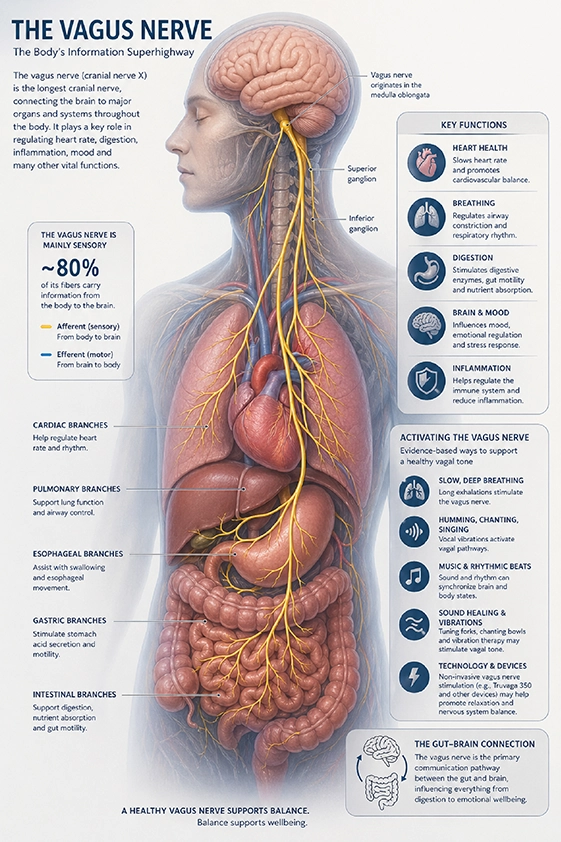
The word vagus comes from the Latin for “wandering,” and it could not be more aptly named. Emerging from the brainstem, this is the longest cranial nerve in the body, travelling down through the neck and branching out into the heart, lungs, digestive system and beyond. It is less a single nerve and more an intricate communication highway — carrying signals from the brain to the body, and crucially, from the body back to the brain.
In many ways, the vagus nerve is the physical embodiment of the mind–body connection. It governs the parasympathetic nervous system — the state often described as “rest and digest.” When functioning optimally, it slows the heart rate, supports digestion, regulates inflammation, and helps the body return to calm after stress.
Yet in modern life, where chronic stress has become a baseline rather than an exception, this system is often underperforming. We live in a constant state of low-level “fight or flight,” and the vagus nerve — the very system designed to restore balance — struggles to keep up.
A Nerve That Changed Medicine
The scientific community has not always understood the importance of the vagus nerve. In fact, its therapeutic potential was only truly recognised through clinical trials in epilepsy. Researchers discovered that stimulating the vagus nerve reduced seizure frequency — but something unexpected happened. Patients also reported improvements in mood.
This was a turning point. What began as a neurological intervention expanded into the fields of mental health, inflammation, and even longevity. Today, vagus nerve stimulation (VNS) is used clinically for conditions such as epilepsy and depression, and is being explored for a wide range of chronic disorders.
And yet, despite decades of research, scientists still acknowledge that we do not fully understand how it works.
There is something both humbling and exciting in that — a reminder that the body still holds mysteries we are only just beginning to decode.
The Language of the Body
One of the most profound aspects of the vagus nerve is that it is not just sending commands — it is listening. In fact, the majority of its fibres carry information from the body to the brain.
This is where the emerging science of the gut–brain connection becomes impossible to ignore. The vagus nerve is the primary pathway through which the gut communicates with the brain, translating physical sensations into emotional and cognitive states.
This was something I encountered not through theory, but through lived experience. When my daughter was diagnosed with absence seizures, I found myself diving deeply into the research. Again and again, I saw references to the vagus nerve — to its role in neurological regulation, and to its intimate relationship with gut activity.
There was, and still is, a compelling thread suggesting that what is happening in the gut may directly influence what is happening in the brain. While science is still catching up in many areas, the correlation felt undeniable. It opened up a question that continues to shape how I view health: are we treating symptoms in isolation, when the true conversation is happening between systems?
Tuning the Signal: From Breath to Basslines
If the vagus nerve is a communication highway, then the quality of that communication matters. What we are beginning to understand is that we can influence it — not just through medical intervention, but through everyday experiences.
Simple practices such as slow breathing, humming, chanting, and singing have all been shown to stimulate the vagus nerve.
This is where the worlds of science and lived experience begin to merge. Think about the feeling of being immersed in music — particularly on a dancefloor. The rhythm, the bass, the collective energy. Breathing synchronises, heart rates align, and for a moment, the noise of the outside world dissolves.
From a physiological perspective, vibration and sound are not just emotional experiences; they are neurological inputs. They stimulate the vagus nerve, shifting the body towards a parasympathetic state. It is no coincidence that sound healing, chanting, and even the simple act of humming have been used across cultures for centuries.
We are, quite literally, tuning the nervous system.
Technology Meets the Nervous System
Where this becomes even more fascinating is in the intersection between ancient practices and modern technology.
In the past week, I have been testing the Truvaga 350, a handheld vagus nerve stimulation device designed to bring this science into daily life. Unlike implanted medical devices, which require surgery, this is a non-invasive tool that delivers gentle electrical stimulation through the skin of the neck.
The experience is subtle but unmistakable. As the device is applied to the side of the neck, there is a rhythmic pulsing sensation — a mild contraction of the muscles that feels almost like a controlled internal vibration. It is not uncomfortable, but it is tangible enough to remind you that something is happening beneath the surface.
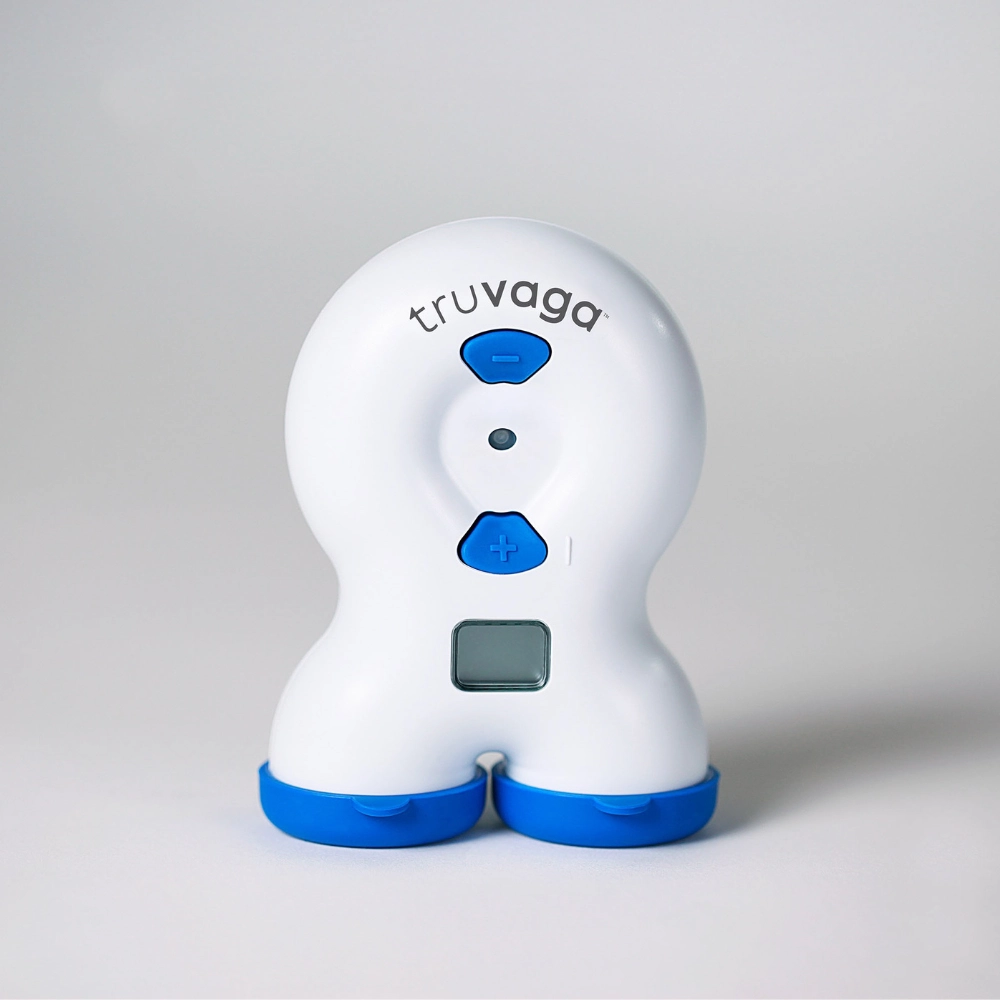
Scientifically, what is happening is this: the device sends low-level electrical impulses to the vagus nerve, which then signals the brainstem to activate parasympathetic pathways.
The intended outcome is a shift in the nervous system — a movement away from stress and towards calm. Studies suggest improvements in heart rate variability, sleep quality, and perceived stress levels with consistent use.
The Truvaga 350 itself comes with a fixed number of sessions, while newer versions offer rechargeable, app-connected functionality.
Other devices on the market take slightly different approaches. Some use ear-based stimulation (auricular VNS), targeting branches of the vagus nerve through the ear. Others are wearable neckbands or clip-on devices. More advanced, clinically approved systems are implanted surgically and are used in hospital settings for conditions like epilepsy and depression.
However, it is important to hold a balanced perspective. While the potential is significant, researchers caution that non-invasive devices are still being studied, and their effectiveness can vary.
This is not a miracle cure. But it may be a meaningful tool.
A New Frontier of Wellbeing
What makes the vagus nerve so compelling is not just what it does, but what it represents. It challenges the idea that the mind and body are separate. It suggests that our emotional state, our physical health, and even our sense of connection are part of the same conversation.
It also invites a more nuanced question around wellbeing. Not just how we optimise, biohack, or extend life — but how we regulate, restore, and truly feel it.
Perhaps the future of wellbeing lies not in pushing harder, but in learning how to come back into balance more intelligently. To listen more closely. To recognise that the body is constantly speaking — and that the vagus nerve is one of its most eloquent voices.
From the hum of a breath to the pulse of a device, from the rhythm of music to the complexity of neuroscience, we are only just beginning to understand how to work with this system rather than against it.
And in that space, between science and sensation, there is something quietly powerful emerging — a new way of thinking about health that is less about control, and more about connection.
Filed underDepression

About the author
Rachel BransonFounder & Editor in Chief
With over 30 years in publishing and a background in Naturopathic Medicine, she has made it her mission to challenge mainstream health narratives and empower people to take control of their wellbeing. Now expanding her vision across the Atlantic, Rachel is bridging UK and US audiences with inspiring stories, trusted insights, and pioneering partnerships that align with a new era of health innovation.